
Opening bank accounts for crypto businesses is genuinely difficult. Most traditional banks decline crypto-related entities because AML/KYC/KYB overhead is high and regulatory risk is hard to quantify. Approval is possible but never guaranteed; it depends on documented compliance infrastructure, transparent disclosures, and realistic volume projections, operational groundwork that sits alongside the broader crypto estate planning and entity structuring decisions crypto businesses face. Normal scrutiny is the cost of access, not an obstacle to evade.
What is "banking access" for a crypto business?
Crypto businesses need traditional fiat banking for payroll, vendor payments, tax obligations (the IRS wants dollars, not Bitcoin), and customer on- and off-ramp transactions. Operating exclusively on blockchain rails works until you need a credit line, a lease agreement, or any obligation denominated in fiat. Stable bank access is operational infrastructure, not optional.
Why do banks decline crypto businesses?
Banks operate under federal oversight from regulators including the OCC, FDIC, and FinCEN. Their risk-reward calculation on crypto business accounts typically runs against them:
- AML/KYC/KYB scrutiny: Tracing source-of-funds through blockchain transactions is technically complex. Automated transaction monitoring systems flag crypto flows as anomalous by design.
- Regulatory ambiguity: Token classification (security vs. commodity), evolving FinCEN guidance, and shifting state money-transmitter licensing requirements make it hard for banks to forecast ongoing compliance costs.
- Reputational risk: High-profile exchange collapses, several centralized crypto lenders and a major exchange that failed in 2022, have made compliance officers more cautious, fairly or not.
- Volume volatility: Sharp month-to-month swings in transaction volume (illustratively, an order-of-magnitude jump) can trigger automated suspicious-activity flags even when the underlying business is legitimate.
- Correspondent-bank pressure: Many regional banks process wires through larger correspondent banks that prohibit crypto exposure entirely, limiting what the downstream bank can accept.
How to open a bank account for a crypto business
Step 1. Build compliance before applying
Banks can identify afterthought compliance programs. Before approaching any institution, implement:
- A written AML/KYC program with documented customer-verification workflows, database checks, and escalation procedures.
- Transaction monitoring with defined thresholds, review assignments, and a Suspicious Activity Report (SAR) filing process.
- Sanctions screening against OFAC lists, with documented cadence and responsible parties.
- Record-retention policy: what data is kept, for how long, and where.
- Evidence of actual operation, screenshots of KYC dashboards, examples of flagged transactions, SAR filing history.
Step 2. Organize corporate formation documents
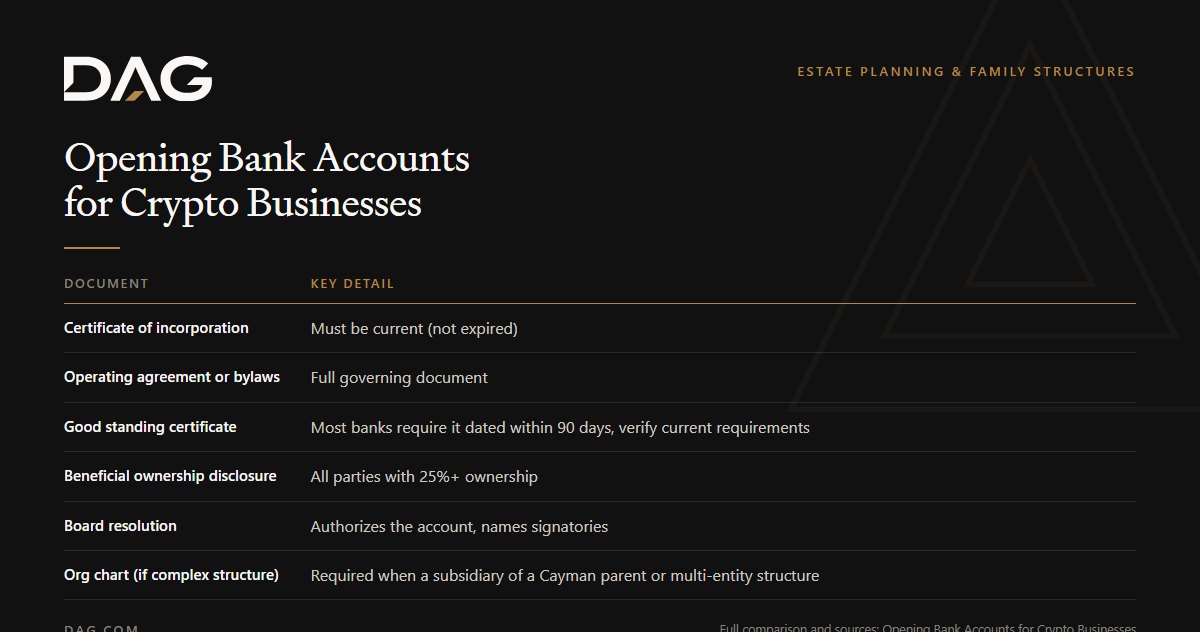
| Document | Key detail |
|---|---|
| Certificate of incorporation | Must be current (not expired) |
| Operating agreement or bylaws | Full governing document |
| Good standing certificate | Most banks require it dated within 90 days, verify current requirements |
| Beneficial ownership disclosure | All parties with 25%+ ownership |
| Board resolution | Authorizes the account, names signatories |
| Org chart (if complex structure) | Required when a subsidiary of a Cayman parent or multi-entity structure |
Step 3. Prepare transparent financial disclosures
- Source of funds: Startup capital origin, crypto-sale transaction history or investor agreements.
- Revenue model: Trading fees, custody fees, mining rewards, staking, be specific.
- Customer base: Retail users, institutional clients, and the countries they operate in.
- Expected transaction volumes: State realistic monthly deposit and withdrawal figures and stay within them. Significant deviations after account opening are a leading cause of closures.
Step 4. Apply to appropriate institutions
Not all banks accept crypto business accounts. The institutions most likely to have defined evaluation frameworks (as of this writing, verify current acceptance) include:
- Regional banks differentiating from larger national competitors
- Fintech-adjacent digital banks built with modern compliance infrastructure
- International banks in jurisdictions with established crypto regulatory frameworks
These institutions are generally not publicly marketing crypto business services. Industry connections, compliance advisors, and specialized consultants are the primary discovery channel.
Step 5. Maintain multiple relationships
Single-bank dependency is an operational risk. If the only bank closes your account, which can happen with as little as 30 days' notice, payroll and customer withdrawals halt during the search for an alternative. Two or three active accounts, each with regular transaction flow, is standard risk mitigation for stable operations.
What causes bank account closures mid-operation?
- Transaction volumes materially exceeding what was disclosed at onboarding
- The bank's own risk appetite changes (new compliance officer, regulatory pressure, crypto-related press)
- Automated transaction monitoring flags an unusual flow pattern
- The bank's correspondent bank restricts or terminates crypto exposure
Disclosing accurate, conservative volume projections at onboarding and communicating material business changes proactively are the primary controls against mid-operation closures.
What does "crypto-friendly bank" actually mean?
A crypto-friendly bank has a defined risk framework for evaluating digital asset businesses rather than a blanket refusal policy. It typically means dedicated compliance staff familiar with blockchain transactions, established correspondent-banking relationships that permit crypto-related wires, and higher fees to cover the compliance overhead. It does not mean reduced scrutiny, it means the criteria are defined rather than arbitrary.
Related Questions
Does the NAICS classification of a crypto business affect bank applications?
Yes. How a bank's compliance team classifies a business, money services business (MSB), software company, financial intermediary, affects which internal risk standards apply. Exchanges and custody providers that meet the definition of an MSB under 31 CFR § 1010.100(ff) carry higher AML obligations, which banks factor into their evaluation. Misrepresenting business type to avoid MSB classification creates problems when transaction activity doesn't match the stated description.
Can a crypto LLC or trust entity open a business bank account?
Yes, but beneficial ownership documentation and organizational structure clarity become more important. A crypto LLC operating agreement checklist should address signatory authority and ownership thresholds that banks will require. Trust-owned structures need trustee documentation and, where applicable, certification that the trust is not an unregistered investment company. See crypto custody for LLCs and crypto custody for trusts for related structural considerations.
How long does a crypto business bank application typically take?
Application timelines vary significantly by institution and depend on documentation completeness. As an illustrative range, initial review can take roughly 30–90 days (verify current institution practices). Some institutions run longer diligence cycles before declining without explanation. Planning for several months from first application to a functioning account, with parallel applications at multiple institutions, is prudent for new entities.
What happens if our transaction volumes exceed what we projected?
Banks treat material volume deviations as a disclosure failure. Account restrictions or closure notices are the typical response. Proactively notifying the bank when volumes change materially, before automated systems flag it, is a better outcome than waiting for a restriction letter.
Internal links
For crypto businesses structured as LLCs, see what is a Wyoming digital asset LLC and crypto LLC operating agreement checklist for governance documentation that supports bank onboarding. The crypto account opening checklist for trusts and LLCs covers the entity-level documentation requirements in detail. Businesses managing treasury across crypto and fiat should also review stablecoin treasury management for family offices and crypto custody for LLCs for operational infrastructure context.
Sources
- FinCEN: Definition of "money services business", 31 CFR § 1010.100(ff), available at ecfr.gov (verify current version)
- FinCEN: Guidance on the Application of FinCEN's Regulations to Persons Administering, Exchanging, or Using Virtual Currencies (FIN-2013-G001, March 2013)
- OCC: Interpretive Letter 1170 (2020), national banks and crypto-asset activities
- FDIC: Supervisory Guidance on Multiple Deposit Account Relationships (FIL-2-2022)
- OFAC: Sanctions Compliance Guidance for the Virtual Currency Industry (October 2021), available at treasury.gov
Note: regulatory guidance in this area continues to evolve. Verify current agency positions before relying on any specific guidance cited above.
Compliance Note
This page is educational only and does not constitute legal, tax, investment, or compliance advice. Bank approval for crypto businesses is not guaranteed; every institution applies its own risk framework and may decline applications without explanation, and AML/KYC/KYB scrutiny is a normal part of the process rather than something to evade. Regulatory requirements for AML, KYC, KYB, and money-services-business classification change frequently. Entity formation and trust drafting are legal services; DAG coordinates these with qualified professionals and does not itself provide legal advice. Consult qualified legal and compliance professionals before establishing a banking strategy for a crypto-related business. DAG Wealth and its affiliates do not guarantee banking access or any specific outcome from applying the approaches described here.
Advisory services are provided by DAG Wealth, an SEC-registered investment adviser. Registration does not imply a certain level of skill or training.