
For digital assets held jointly with a spouse, a manager-managed multi-member LLC and a joint revocable trust both clarify control and transfer assets without probate, decisions that sit at the core of crypto estate planning for couples. The right choice depends on your state's property laws, your management preferences, and how the holdings fit your broader estate plan.
Which structure works best for jointly held digital assets?
The short answer: a manager-managed multi-member LLC works well when spouses want formal ownership percentages and a clear, single decision-maker for day-to-day transactions. A joint revocable living trust works well when the priority is seamless transfer at death without probate, with both spouses retaining full revocable control during their lifetimes.
Neither is universally superior. The better question is which one fits how you want decisions made, where you live, and what happens to the assets at first death.
Options at a glance
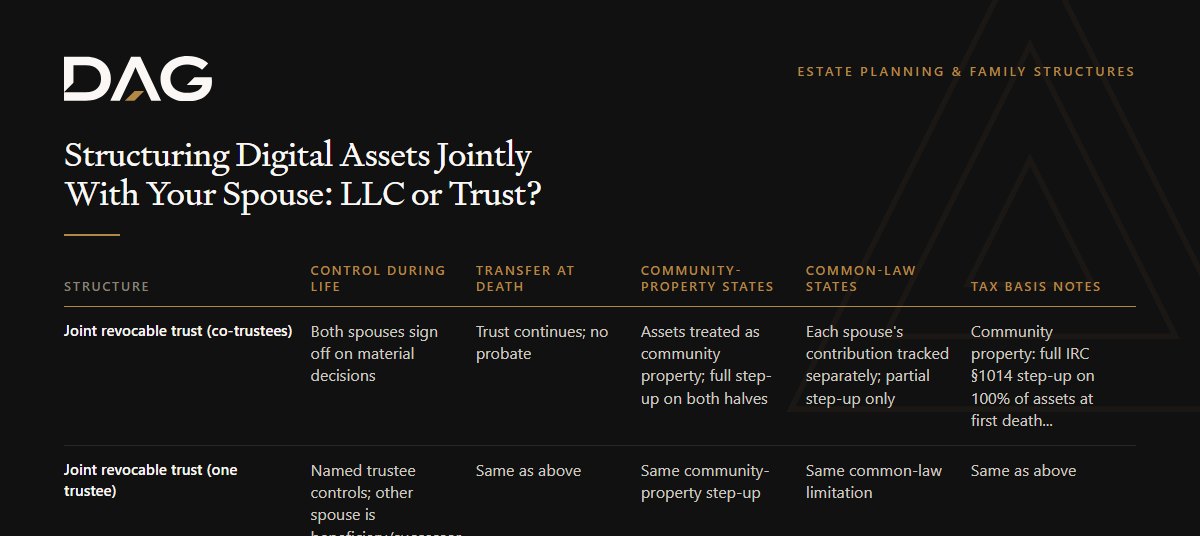
| Structure | Control during life | Transfer at death | Community-property states | Common-law states | Tax basis notes |
|---|---|---|---|---|---|
| Joint revocable trust (co-trustees) | Both spouses sign off on material decisions | Trust continues; no probate | Assets treated as community property; full step-up on both halves | Each spouse's contribution tracked separately; partial step-up only | Community property: full IRC §1014 step-up on 100% of assets at first death. Common-law: only decedent's half steps up. |
| Joint revocable trust (one trustee) | Named trustee controls; other spouse is beneficiary/successor | Same as above | Same community-property step-up | Same common-law limitation | Same as above |
| Multi-member LLC (manager-managed) | Manager controls all transactions; members hold ownership interests | Membership interest passes per operating agreement or trust that holds interest | A spousal LLC in a community-property state may be eligible for disregarded-entity treatment under IRS guidance | Generally a partnership for federal tax purposes by default | Basis adjustment on transfer of an LLC interest is fact-specific (e.g., a §754 election); confirm with a CPA |
| Separate trusts (each spouse's share) | Each spouse controls own trust | Each trust independently administers its share | Requires careful allocation of community assets to avoid severing community character | Cleaner separation; each spouse's assets governed independently | Community-property: full step-up may be preserved if allocation documented properly; consult a CPA |
Key state-law point: Nine states are community-property states (AZ, CA, ID, LA, NV, NM, TX, WA, WI). In those states, assets acquired during marriage are presumed equally owned and may receive a full basis step-up at the first spouse's death under IRC §1014(b)(6). Common-law states do not have this presumption. Before funding any structure, confirm your state's property law with a licensed attorney.
LLC partnership classification warning: A two-member LLC owned by spouses is generally treated as a partnership for federal tax purposes by default. The qualified joint venture (QJV) election under IRC §761(f) is generally not available to a business held in a state-law entity such as an LLC; however, a spousal LLC in a community-property state may instead be eligible for disregarded-entity treatment under IRS guidance. These rules are fact-specific and easy to misapply, and misclassification can create unexpected partnership filing obligations. Confirm classification with a CPA before funding.
Why control structure matters more than most people expect
Crypto transactions are irreversible. If both spouses hold signing authority with no documented approval process, every transaction is a potential point of conflict or error. A manager-managed LLC or a sole-trustee arrangement concentrates decision authority without eliminating the non-managing spouse's ownership rights, they retain their membership interest or beneficial interest fully; they just are not executing wallet transactions day to day.
For more on how LLC manager duties apply to digital assets, see Crypto LLC Manager Duties.
What happens if a spouse dies and there is no structure?
Digital assets do not transfer automatically to a surviving spouse the way a joint bank account does. If assets sit in a personal wallet and the surviving spouse does not have the private key or seed phrase, those assets are inaccessible. A properly drafted trust or LLC operating agreement, combined with a documented custody plan, prevents that outcome.
See also: Can Heirs Recover Bitcoin Without a Seed Phrase? and Should My Spouse Know My Seed Phrase?
Related Questions
Does it matter whether we are in a community-property state?
Yes, materially. In a community-property state, assets acquired during marriage are typically treated as equally owned, and IRC §1014(b)(6) may provide a full basis step-up on 100% of jointly held assets at the first spouse's death, not just the decedent's half. In common-law states, only the decedent's ownership interest receives a step-up. This difference can mean a significant capital-gains liability for the survivor if appreciated crypto is later sold. The structure chosen should account for this, and the operating agreement or trust document should clearly reflect how each asset was funded. Confirm with a CPA who understands both state law and crypto cost-basis tracking.
Can we just use a shared wallet with no entity?
Shared wallet access without a governance structure creates operational and legal risk. There is no documented approval process, no defined ownership percentages, no succession plan, and no protection from creditors. If one spouse dies, the survivor may lack legal standing to claim the assets if title was never formally established. Shared wallet access is not the same as documented co-ownership.
For a broader comparison of holding options, see Should Crypto Be Held Personally, in an LLC, or in a Trust?
Should the trust hold the LLC, or should spouses be direct LLC members?
A trust-owned LLC combines both structures: the trust holds the LLC membership interest, so the asset transfers without probate at death, and the LLC provides the operational control layer and potential liability separation. This arrangement adds complexity and cost, but for couples with substantial digital holdings it may be the cleaner long-term architecture. See Should a Trust Own a Wyoming LLC for Crypto Assets? and Trust-Owned LLC for Crypto Assets.
What about custody, who holds the private keys?
The structure you choose on paper only works if the custody arrangement matches it. An LLC operating agreement that designates one manager as the sole authorized signer should correspond to a custody setup where that manager controls the wallet credentials. The trust document should name who is authorized to access wallets and under what conditions. Documented custody procedures, seed phrase storage protocols, and a clear chain of access are part of the structure, not an afterthought. See Crypto Custody for Trusts and Crypto Custody for LLCs.
Sources
- IRS Publication 555, Community Property (2023 ed.): https://www.irs.gov/pub/irs-pdf/p555.pdf
- IRC §1014. Basis of property acquired from a decedent: https://www.law.cornell.edu/uscode/text/26/1014
- IRC §761(f). Qualified joint venture election for certain spousal ventures: https://www.law.cornell.edu/uscode/text/26/761
- IRS Revenue Ruling 2001-3 (community property basis rules): https://www.irs.gov/irb/2001-02_IRB#RR-2001-3
- Wyoming Statute §17-29-101 et seq. (Wyoming LLC Act, including digital asset provisions): https://law.justia.com/codes/wyoming/title-17/chapter-29/
Compliance Note
This page is for educational purposes only and does not constitute legal, tax, or investment advice. The rules governing community property, basis step-up, LLC classification, and digital asset titling vary by state and individual circumstance. DAG coordinates entity formation, trust and estate drafting, and operating-agreement preparation with qualified professionals; it does not itself provide legal advice or draft legal documents. Consult a licensed estate attorney and a CPA qualified in digital assets before establishing any structure or transferring assets into an entity. Advisory services are provided by DAG Wealth, an SEC-registered investment adviser. Registration does not imply a certain level of skill or training. Tax and securities laws applicable to digital assets continue to evolve; confirm current rules with qualified counsel.