
A virtual family office is a coordinated structure of professionals managing a crypto-wealthy family's financial complexity, investment oversight, estate planning, tax coordination, custody governance, and wealth transfer under one operating model, with the crypto family office hub covering the full landscape of options. Families build one when fragmented accounts and advisors no longer hold together, though the structure carries real coordination cost and may not suit smaller holdings.
What is a virtual family office?
A virtual family office organizes advisors, structures, and processes so a family's wealth, including crypto, traditional assets, and private holdings, is managed as a coherent system rather than a collection of unrelated accounts. The "digital" descriptor reflects the inclusion of blockchain-based assets as first-class holdings requiring specialized governance, custody policy, and tax coordination.
Traditional family offices serve ultra-high-net-worth families through a full-time in-house staff. A virtual family office for crypto-wealthy individuals typically takes a lighter form: a coordinated network of specialists (wealth manager, estate attorney, crypto-literate CPA, qualified custodian) governed by shared policy rather than a single employer. See What Is a Crypto Family Office? and Crypto Family Office vs Traditional Family Office for a fuller comparison.
Why do crypto-wealthy families need a dedicated structure?
Digital assets introduce problems that standard wealth management is not designed to handle:
- Custody complexity. Self-custody, exchange accounts, and qualified custodians each carry distinct access, security, and succession risks. A fragmented setup creates key-person risk and inheritance failure points. See Crypto Custody for Family Offices.
- Tax coordination gaps. On-chain activity (swaps, staking, airdrops) generates taxable events across multiple wallets and tax years. Without coordinated record-keeping, cost-basis reconstruction becomes expensive or impossible.
- Estate and succession exposure. Seed phrases and private keys do not pass through probate the way brokerage accounts do. Without a documented succession plan, crypto wealth can be permanently inaccessible at death. See Crypto Estate Planning for High-Net-Worth Families.
- Governance gaps. Investment decisions, custody authorizations, and beneficiary distributions need documented policy to survive personnel changes, incapacity, or family disputes.
Who should consider building a virtual family office?
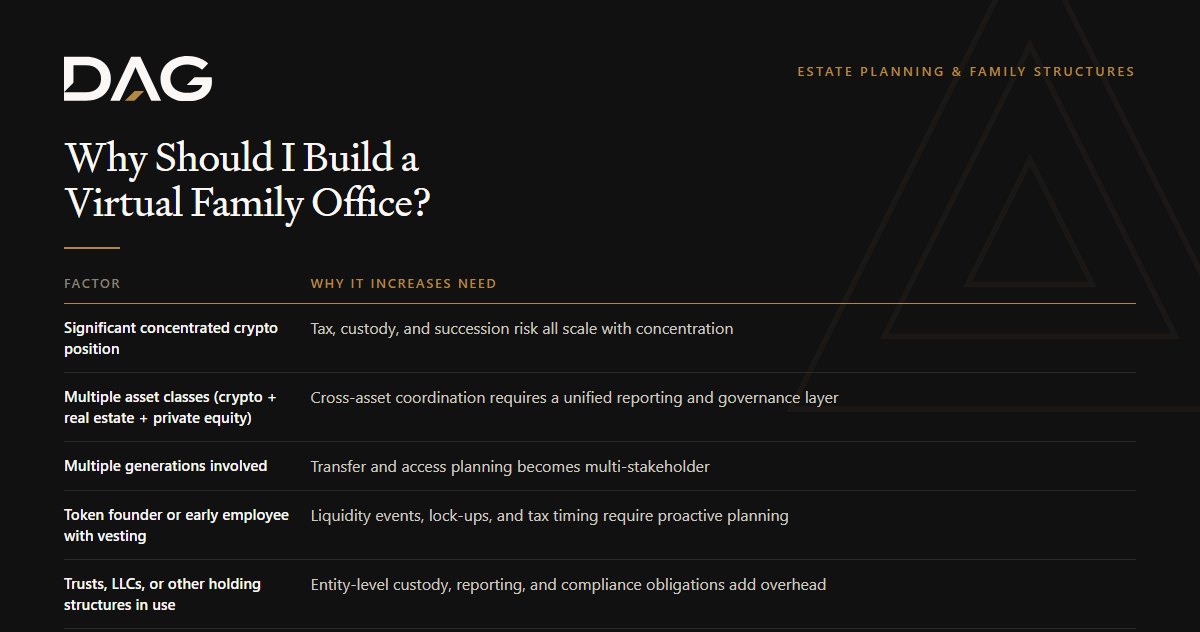
No universal threshold triggers the need, but the following factors increase complexity to the point where a coordinated structure pays for itself:
| Factor | Why it increases need |
|---|---|
| Significant concentrated crypto position | Tax, custody, and succession risk all scale with concentration |
| Multiple asset classes (crypto + real estate + private equity) | Cross-asset coordination requires a unified reporting and governance layer |
| Multiple generations involved | Transfer and access planning becomes multi-stakeholder |
| Token founder or early employee with vesting | Liquidity events, lock-ups, and tax timing require proactive planning |
| Trusts, LLCs, or other holding structures in use | Entity-level custody, reporting, and compliance obligations add overhead |
| Cross-border family members | Jurisdictional complexity multiplies without a central coordinating function |
For a more granular threshold discussion, see How Much Crypto Is Enough to Need a Family Office?
What does a virtual family office actually do?
At the operating level, a virtual family office typically coordinates five functions:
- Investment oversight, policy-based allocation decisions, manager or custodian selection, and periodic review against an investment policy statement.
- Custody and security governance, defining who controls keys, under what authorization conditions, with what backup procedures.
- Tax coordination, aggregating transaction records across wallets and entities, coordinating with a crypto-literate CPA on estimated payments, harvesting, and reporting.
- Estate and succession planning, ensuring trust structures, beneficiary designations, and key/seed phrase succession plans are documented and tested.
- Reporting and compliance, consolidated net worth reporting, governance documentation, and entity-level compliance (particularly for trust-owned or LLC-held assets).
The Crypto Family Office Governance Checklist covers what the governance layer should contain.
What are the costs and tradeoffs of building one?
A family office structure, even a lightweight coordinated model, carries real costs and complexity:
- Coordination overhead. Keeping advisors aligned requires ongoing effort. Policy documents go stale without maintenance.
- Professional fees. A crypto-aware estate attorney, CPA, and wealth manager each bill independently. A full embedded model adds staffing cost.
- Setup time. Establishing custody policy, drafting trust instruments, and onboarding across entities takes months.
- Diminishing returns at lower asset levels. Below a certain portfolio size, the overhead may exceed the benefit. A qualified crypto wealth manager relationship may be sufficient without the full office structure.
Related Questions
How is a virtual family office different from hiring a financial advisor?
A financial advisor typically manages investment accounts within their firm's custodial platform. A virtual family office coordinates across advisors, entities, custodians, legal counsel, and tax professionals, and governs the whole system with documented policy. The scope is broader and multi-disciplinary. See Crypto Wealth Manager vs Financial Advisor and Family Office vs Crypto Wealth Manager.
Can a trust or LLC serve as the foundation of a virtual family office?
Yes. Many families use a Wyoming LLC or a directed trust to hold digital assets at the entity level, which creates a natural governance anchor. The operating agreement or trust instrument can formalize investment policy, custody authorization, and succession. Entity formation, trust drafting, and operating-agreement drafting are legal services: DAG coordinates these arrangements with the family's attorney and does not provide legal advice or draft instruments itself. Contributing crypto to a single-member LLC or funding a revocable trust is generally not itself a taxable event, the taxable disposition occurs on a later sale, but a revocable trust provides no creditor protection and remains part of the taxable estate. See Trust Structures for Crypto Wealthy Individuals and Should Crypto Be Held Personally, in an LLC, or in a Trust?
Does a virtual family office require a registered investment adviser?
Not as a structural matter, a family office can exist without an RIA if it is organized to qualify for the family office exemption under the Investment Advisers Act (a narrow exemption with specific requirements). Where the coordinating entity provides investment advice for compensation to persons outside the family, registration may be required. This is a legal question that varies by structure and jurisdiction; consult qualified legal counsel.
What is the difference between a single-family office and a multi-family office for digital assets?
A single-family office serves one family exclusively, typically requiring a substantially larger asset base to be cost-effective. A multi-family office serves multiple families under a shared infrastructure, lower cost per family, but less customization. DAG Wealth operates as a coordinated wealth management structure serving digital asset families; it does not operate as a registered multi-family office. For further context, see Digital Asset Family Office.
Sources
- SEC, "Family Offices," Investment Advisers Act of 1940, Rule 202(a)(11)(G)-1, https://www.sec.gov/rules/final/2011/ia-3220.pdf (2011)
- IRS, "Virtual Currencies," Publication 544, Sales and Other Dispositions of Assets, https://www.irs.gov/publications/p544
- Family Office Exchange, "What Is a Family Office?", referenced for structural definitions; verify current at https://www.familyoffice.com
Compliance Note
This page is educational only and does not constitute legal, tax, investment, or financial advice. Digital asset markets are volatile and family office structures involve complex legal and regulatory considerations that vary by jurisdiction and individual circumstance. Nothing here should be read as a guarantee of outcomes, a promise of performance, or a solicitation to engage any particular service. Tax treatment described here is general and current as of 2026; verify against present law with a licensed tax professional. Consult qualified legal counsel, a licensed tax professional, and a registered investment adviser before making structural or investment decisions. Advisory services are provided by DAG Wealth, an SEC-registered investment adviser. Registration does not imply a certain level of skill or training.