
A crypto family office is a family office model built to handle digital asset wealth alongside traditional holdings. It generally coordinates investment management, custody, tax, estate planning, entity structure, reporting, governance, and next-generation education for families whose net worth includes meaningful crypto exposure. The goal is to make that wealth manageable, reportable, and transferable.
Definition
A family office is the private organization that manages a wealthy family's financial and administrative affairs. A crypto family office extends that mandate to digital assets, adding the operational discipline those assets require: qualified custody, private-key authority, on-chain record keeping, and crypto-specific tax accounting. It does not replace a family's outside professionals; it coordinates them. For families weighing the decision, see how much crypto is enough to need a family office.
Why This Matters
Traditional family office infrastructure was built around bankable assets: brokerage accounts, real estate, private equity, and operating businesses. Digital assets add operational problems those systems were never designed for: custody, private keys, wallet authority, staking, protocol risk, token liquidity, tax lots, and on-chain records.
A crypto family office does not simply add Bitcoin to an asset allocation. It builds the operating model around assets that may live on public ledgers and require specialized custody and reporting. This sits within the broader discipline covered in the Crypto Family Office Hub.
How It Works
The setup process is generally sequential:
- The family defines digital asset exposure, risk limits, and liquidity needs, often in a written digital asset investment policy statement.
- Custody and account structure are selected and documented, ideally using a qualified custodian that can provide SOC 1 or SOC 2 reporting.
- Tax records and reporting workflows are coordinated, accounting for IRS treatment of digital assets as property and the move toward Form 1099-DA reporting.
- Trusts, entities, and succession documents are updated so private keys and wallet authority pass cleanly to heirs.
- Family governance and next-generation access are handled intentionally, often through a crypto governance framework.
Crypto Family Office vs. Traditional Family Office
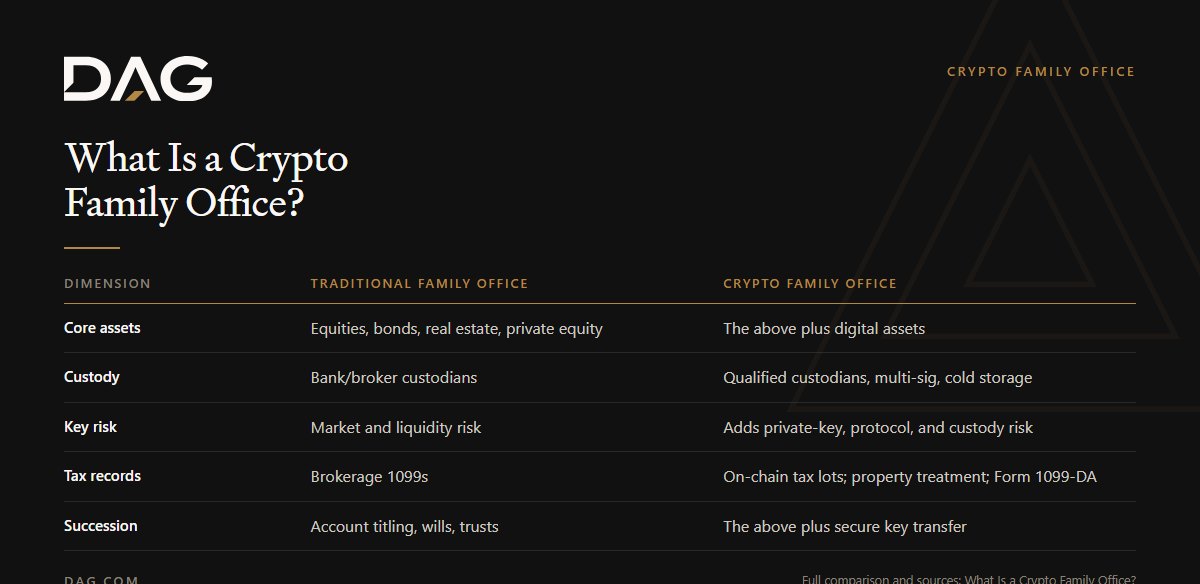
| Dimension | Traditional family office | Crypto family office |
|---|---|---|
| Core assets | Equities, bonds, real estate, private equity | The above plus digital assets |
| Custody | Bank/broker custodians | Qualified custodians, multi-sig, cold storage |
| Key risk | Market and liquidity risk | Adds private-key, protocol, and custody risk |
| Tax records | Brokerage 1099s | On-chain tax lots; property treatment; Form 1099-DA |
| Succession | Account titling, wills, trusts | The above plus secure key transfer |
Evidence Standard
This article defines a category and does not claim any particular client result. Any examples added later should be publicly cited, internally approved, or labeled hypothetical. Third parties named here are referenced for context only; nothing here ranks one provider against another.
When It May Help
- A family has meaningful digital asset exposure.
- A family office needs crypto infrastructure without building everything internally.
- Digital assets sit outside the family's consolidated reporting.
- Trustees, CPAs, attorneys, and investment teams need a shared process. A crypto custody policy often anchors that process.
- The family wants continuity beyond one crypto-native family member.
When It May Not Be Enough
A crypto family office still needs outside specialists. Custodians, legal counsel, tax professionals, fund managers, exchanges, and trustees may all play roles. The family office coordinates the ecosystem; it does not replace every professional. No structure removes market, custody, or tax risk, and digital assets carry no guaranteed yield or principal protection.
Related Questions
How is a crypto family office different from a crypto fund?
A crypto fund manages an investment product. A crypto family office coordinates a family's broader digital asset wealth, including custody, tax, estate, governance, and reporting. The two can coexist; a family office may allocate to a fund as one part of its plan.
How is it different from a traditional family office?
The difference is digital asset fluency. Crypto introduces custody, private-key, protocol, and tax issues that traditional systems may not handle well. Many families add crypto capability to an existing office rather than starting over.
Who uses a crypto family office?
Generally HNW and UHNW individuals, founders, crypto-native families, existing family offices, and advisors with clients who hold meaningful digital assets. Whether it fits depends on the facts; consult a qualified professional before deciding.
Does working with a registered adviser remove crypto risk?
No. Registration with the SEC or a state does not guarantee skill or performance, and it does not remove market, custody, or tax risk. It signals a regulatory framework and disclosure obligations, not a safe outcome.
Bottom Line
A crypto family office is the coordination layer for families whose wealth includes digital assets. Its job is to make crypto wealth manageable, reportable, transferable, and governable across generations, while acknowledging the risks digital assets carry.
Sources
- SEC: Family Office Rule (17 CFR 275.202(a)(11)(G)-1)(11)(G)-1)
- SEC: Investment Adviser Public Disclosure (IAPD)
Compliance Note
This article is for general educational purposes and is not legal, tax, custody, or investment advice. Digital assets involve substantial risk and may not be suitable for all investors.