
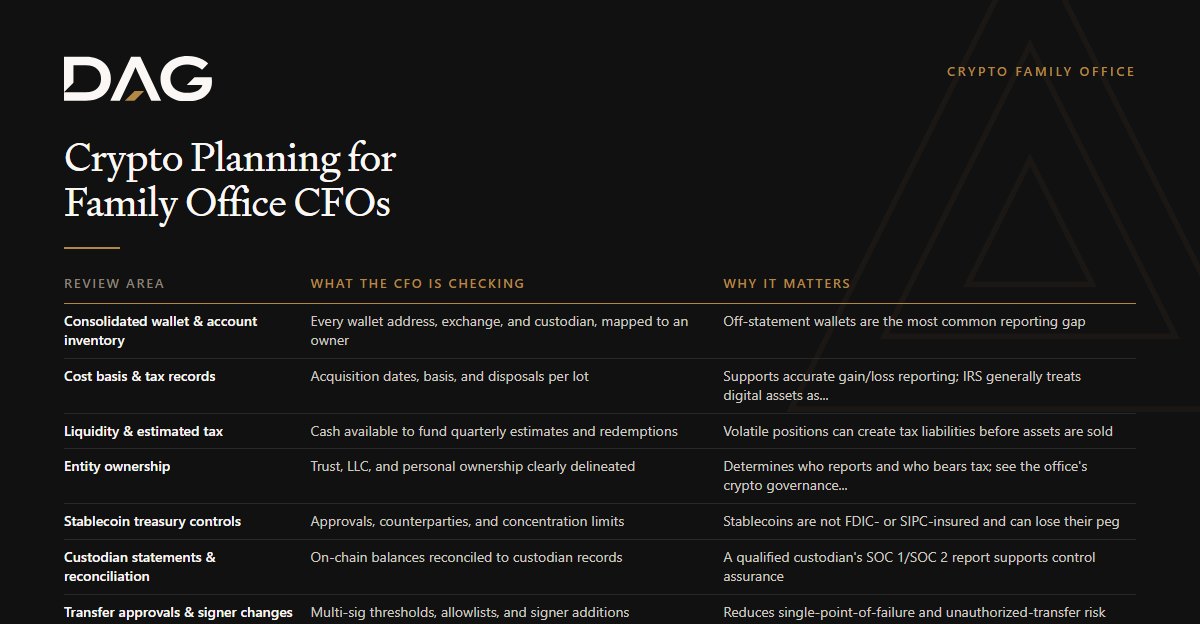
Crypto planning for family office CFOs is the operational work of making digital assets auditable and reportable: maintaining a consolidated wallet inventory, cost-basis and tax records, liquidity and estimated-tax planning, custody oversight, entity records, and transfer controls. It is where crypto complexity becomes a daily reporting and control responsibility rather than an abstract allocation question.
What CFO Crypto Planning Covers
For a family office CFO, crypto planning means extending existing finance, treasury, and reporting disciplines to assets that often sit outside traditional custodian statements. Digital assets can create recordkeeping, liquidity, and internal-control gaps that a standard portfolio report will not surface, self-custodied wallets, on-chain transfers, and multiple entity owners rarely roll up cleanly. The CFO's job is to bring that activity into the same books, controls, and audit trail as everything else the office reports. This work sits within the broader Crypto Family Office Hub and connects closely to how the office sets its family office crypto allocation policy.
CFO Review Areas
A practical CFO review covers the points where crypto most often breaks reporting or controls:
| Review area | What the CFO is checking | Why it matters |
|---|---|---|
| Consolidated wallet & account inventory | Every wallet address, exchange, and custodian, mapped to an owner | Off-statement wallets are the most common reporting gap |
| Cost basis & tax records | Acquisition dates, basis, and disposals per lot | Supports accurate gain/loss reporting; IRS generally treats digital assets as property, and Form 1099-DA reporting is phasing in |
| Liquidity & estimated tax | Cash available to fund quarterly estimates and redemptions | Volatile positions can create tax liabilities before assets are sold |
| Entity ownership | Trust, LLC, and personal ownership clearly delineated | Determines who reports and who bears tax; see the office's crypto governance framework |
| Stablecoin treasury controls | Approvals, counterparties, and concentration limits | Stablecoins are not FDIC- or SIPC-insured and can lose their peg |
| Custodian statements & reconciliation | On-chain balances reconciled to custodian records | A qualified custodian's SOC 1/SOC 2 report supports control assurance |
| Transfer approvals & signer changes | Multi-sig thresholds, allowlists, and signer additions | Reduces single-point-of-failure and unauthorized-transfer risk |
| Reporting to principals & committees | Consistent, periodic reporting package | Keeps governance bodies informed and decisions documented |
Definition: What a Family Office CFO Does With Crypto
A family office CFO's crypto mandate is recordkeeping and control, not trading. The role centers on making positions verifiable (reconciling on-chain balances to custodian and accounting records), keeping tax records defensible, ensuring liquidity exists to meet obligations, and confirming that transfers follow documented approval rules. Investment selection generally sits with the CIO or investment committee; the CFO makes the resulting activity reportable and controllable. Coordinating those two roles is covered in crypto planning for family office CIOs.
A CFO Onboarding Checklist for a New Crypto Position
Before a new digital-asset position is considered fully onboarded, a CFO can confirm:
- The owning entity (trust, LLC, or individual) is recorded and consistent with the entity's governing documents.
- Custody arrangement is documented, qualified custodian, self-custody, or multi-sig, with cold-storage and signer details captured.
- Cost basis, acquisition date, and source of funds are recorded per lot.
- The position appears in the consolidated inventory and reconciles to a statement or on-chain balance.
- Transfer-approval thresholds and authorized signers are defined.
- Tax treatment has been reviewed with a qualified professional, including estimated-tax impact.
- The position is reflected in the next reporting package to principals and committees.
Documenting these controls is easier when the office already maintains a family office crypto custody policy.
Why CFO Involvement Matters
No process removes market, custody, or tax risk, digital assets remain volatile, and custody and reporting failures are real exposures. CFO oversight does not eliminate those risks; it makes them visible, measurable, and governed. Without it, positions drift off-statement, basis records degrade, and liquidity surprises arrive at tax time. With it, crypto is reported on the same footing as the rest of the balance sheet.
Related Questions
What financial controls should a family office CFO apply to crypto?
Generally, the same control principles used elsewhere: segregation of duties, documented transfer approvals (often multi-sig thresholds), reconciliation of on-chain balances to custodian and accounting records, and periodic reporting. The specifics depend on the office's custody model and entity structure, so coordinate with qualified professionals.
How is crypto taxed for a family office?
The IRS generally treats digital assets as property, so dispositions can create taxable gains or losses, and basis records matter. Exact treatment depends on the facts, the owning entity, and the transactions involved. A qualified tax adviser should review the office's specific situation.
Does a family office need a qualified custodian for crypto?
It depends on the facts, including whether an SEC-registered adviser has custody under the applicable rule. Using a qualified custodian can support custody and control assurance, but registration or custodian selection alone does not guarantee outcomes or skill. Confirm the requirements that apply with qualified counsel.
Sources
Compliance Note
This article is educational and does not provide legal, tax, accounting, investment, fiduciary, treasury, or custody advice. Family office CFOs should coordinate with qualified professionals. Registration does not imply a certain level of skill or training.
Terms used in this article
Related articles
- Crypto Planning for Family Office CIOs
- Family Office Digital Asset Quarterly Review Process
- How Should a Family Office Report Crypto?
- Digital Asset Family Office
- Financial Advisor Due Diligence Checklist to Prevent Fraud
- The First 100 Days of Wealth: Essential Checklist for Founders After Selling Their Business