
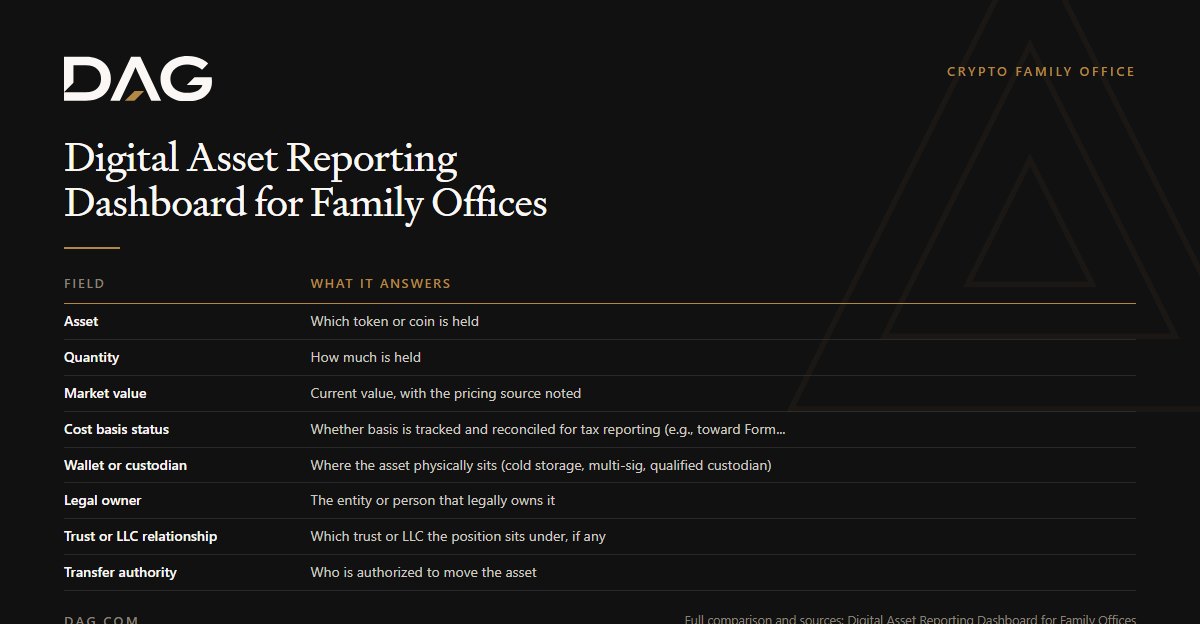
A digital asset reporting dashboard for family offices is a single view that shows where crypto is held, who legally owns it, how it is custodied, what it is worth, and what records each position needs for tax and governance. It pulls wallets, custodians, trusts, and LLCs into one reconciled picture so the family can oversee holdings rather than guess at them.
What a Digital Asset Reporting Dashboard Tracks
The core term is straightforward: a reporting dashboard is the consolidated record a crypto family office uses to monitor digital assets across every wallet, account, and legal entity it touches. It is not only a performance screen. It carries the ownership, custody, and record-keeping data needed for control and oversight, so a chart of returns never stands in for an audit trail.
Performance still matters, but a dashboard built only around price and gains hides the questions a family office actually has to answer: which entity holds the asset, who can move it, and whether the tax records are complete.
Dashboard Fields
A useful dashboard captures, per position:
| Field | What it answers |
|---|---|
| Asset | Which token or coin is held |
| Quantity | How much is held |
| Market value | Current value, with the pricing source noted |
| Cost basis status | Whether basis is tracked and reconciled for tax reporting (e.g., toward Form 1099-DA) |
| Wallet or custodian | Where the asset physically sits (cold storage, multi-sig, qualified custodian) |
| Legal owner | The entity or person that legally owns it |
| Trust or LLC relationship | Which trust or LLC the position sits under, if any |
| Transfer authority | Who is authorized to move the asset |
| Staking or reward activity | Yield, staking, or reward events that create taxable income |
| Tax record status | Whether the records needed to file are complete |
| Last reconciliation date | When the position was last verified against the source |
These fields connect to a family's broader digital asset reporting requirements and to the controls in a family office crypto custody policy.
Why Ownership Matters
A family office may hold assets personally, through trusts, through LLCs, through retirement accounts, or through third-party custodians. Reporting should separate legal ownership from operational custody, because the entity that owns an asset and the system that holds the keys are often not the same. A directed trust may own a position that a qualified custodian holds and that a named officer is authorized to move; the dashboard should show all three. Custody arrangements vary, and the SEC custody framework and a custodian's SOC 1 or SOC 2 reporting can affect how positions are verified, so the right structure generally depends on the facts and is worth confirming with a qualified professional. Mapping these relationships is closely tied to crypto governance for family offices.
Review Cadence
Review the dashboard on a regular schedule and after major events: token unlocks, transfers, custodian changes, trust updates, or tax reporting deadlines. A reconciliation date on each position makes it visible when a holding has drifted out of sync with its source of record.
Related Questions
What should a family office crypto dashboard track beyond performance?
Beyond value and returns, it should generally track legal owner, custody location, transfer authority, cost basis status, staking or reward activity, and the last reconciliation date. These control and record-keeping fields are what let a family office answer ownership and tax questions, not just performance ones.
How often should a digital asset reporting dashboard be reviewed?
There is no single required cadence. Many family offices review on a regular schedule and again after triggering events such as token unlocks, transfers, custodian changes, or tax deadlines. The right frequency depends on the facts and is worth setting with qualified professionals.
Does a reporting dashboard replace formal custody or tax records?
No. A dashboard summarizes and reconciles, but it does not replace a custodian's statements, qualified-custodian arrangements, or the underlying records used to file taxes. The IRS generally treats digital assets as property, so source records still matter and a dashboard should point back to them rather than stand in for them.
Sources
Compliance Note
This article is educational and does not provide legal, tax, investment, fiduciary, reporting, or custody advice. A reporting dashboard does not remove market, custody, or tax risk, and no dashboard or custody arrangement guarantees the safety of digital assets. Family office reporting systems should be reviewed with qualified professionals.