
A crypto family office for founders is the structure a token founder or early team member builds after a liquidity event to coordinate custody, tax, diversification, and estate planning for newly concentrated wealth. Most founders do not need a full family office the day they sell, they need the right sequence of decisions. A family office becomes worth its overhead once holdings are large and complex enough that scattered wallets and ad hoc advice create real risk.
"I Just Sold Tokens. Do I Need a Family Office?"
Usually not immediately. A liquidity event creates urgent, time-sensitive problems, securing assets, reserving for taxes, and reducing single-asset concentration, that come before the question of organizational structure. The family office is the eventual operating model; the first job is not losing the proceeds to a hack, a tax shortfall, or a concentrated position that craters. The founder-specific planning around the event itself lives in the crypto founder liquidity hub and in crypto liquidity planning after a token sale.
A full family office generally starts to make sense when several of these are true: holdings are large (often eight figures), spread across many wallets and entities, shared among family members, or carry significant estate and governance needs. Below that, a single entity plus outsourced advisory often covers what a founder actually needs, see how much crypto is enough to need a family office.
The Post-Liquidity Sequence for Founders
Secure custody first. Move proceeds off exchange hot wallets into a deliberate custody model, qualified custody, multi-sig, or institutional cold storage, before doing anything else. A liquidity event makes a founder a visible target.
Reserve for taxes immediately. A token sale is generally a taxable disposition. Set aside the estimated tax before spending or reinvesting, and plan estimated payments with a tax professional. Founders who skip this step face the classic problem of a gain on paper with no cash for the bill. See token sale tax planning.
Address concentration. A founder's wealth is often concentrated in one token. Diversification, staged, tax-aware, and sometimes using lending against the position rather than selling, reduces the risk that the whole net worth moves with one asset. How founders approach this is covered in how do founders diversify token wealth.
Choose the holding structure. Decide whether assets sit personally, in an LLC, or in a trust, with counsel. This is also when estate and gifting planning starts, especially if the founder has a family.
Build the operating model, only as needed. Add governance, reporting, and a committee process as complexity grows, rather than building a full family office on day one. The build sequence and costs are in building a crypto family office.
Founder Situations and What They Point Toward
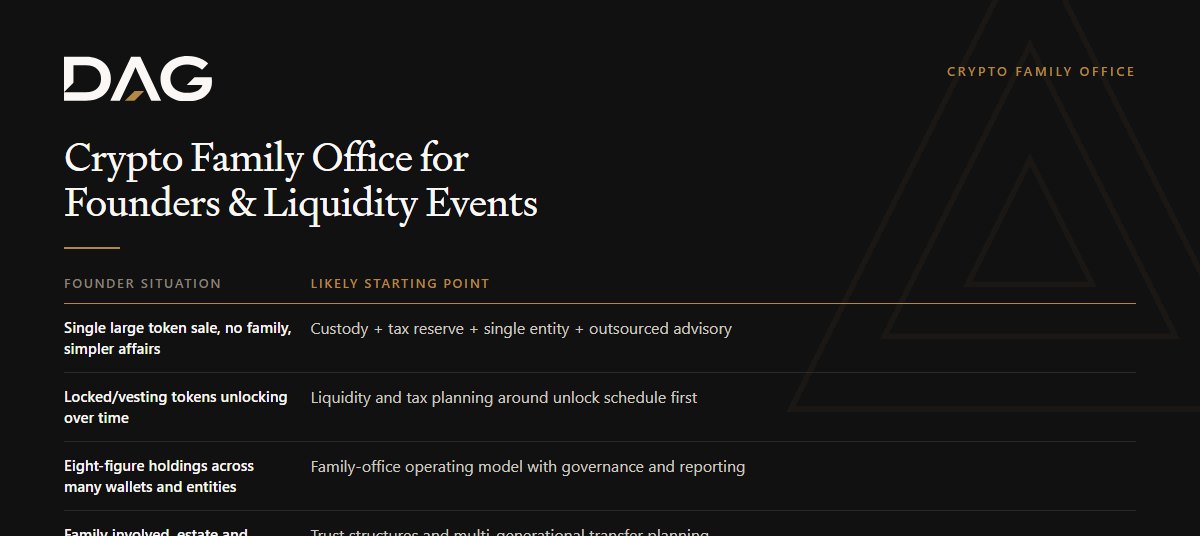
| Founder situation | Likely starting point |
|---|---|
| Single large token sale, no family, simpler affairs | Custody + tax reserve + single entity + outsourced advisory |
| Locked/vesting tokens unlocking over time | Liquidity and tax planning around unlock schedule first |
| Eight-figure holdings across many wallets and entities | Family-office operating model with governance and reporting |
| Family involved, estate and succession goals | Trust structures and multi-generational transfer planning |
These are orientation points, not rules; the right structure depends on the facts and on professional advice.
Related Questions
I just sold a large token position. Do I need a family office right away?
Usually no. The immediate priorities are securing custody, reserving for taxes, and reducing concentration, none of which requires a full family office. A family office is the longer-term operating model that becomes worthwhile once holdings are large and complex enough to justify the overhead. Start with the urgent steps and add structure as needed, with professional advice.
What is the first thing a founder should do after a token liquidity event?
Secure the assets and reserve for taxes. Move proceeds out of exchange hot wallets into a deliberate custody model, then set aside the estimated tax on the disposition before spending or reinvesting. A liquidity event raises both security risk and tax exposure at the same time, and both are time-sensitive. Diversification and structure follow.
When does a founder's wealth justify a full crypto family office?
Generally when holdings are large (often eight figures), spread across many wallets and entities, shared among family members, or carry meaningful estate and governance needs. Below that, a single entity plus outsourced advisory usually covers the need at far lower cost. The threshold is about complexity, not a single number, and should be assessed case by case.
Sources
- IRS: Digital assets (disposition and property treatment), https://www.irs.gov/filing/digital-assets
- IRS: Estimated Taxes (Form 1040-ES), verify current at irs.gov
Compliance Note
This article is educational only and is not investment, legal, or tax advice. Diversification, lending against a position, and entity or trust selection involve material risks and depend on each founder's facts; review them with qualified professionals. Any thresholds or figures are illustrative and dated. Advisory services are provided by DAG Wealth, an SEC-registered investment adviser. Registration does not imply a certain level of skill or training. Entity formation and trust drafting are legal services the firm coordinates rather than provides. No structure removes market, custody, or tax risk, and no outcome is guaranteed.