
Founders diversify token wealth by coordinating liquidity, taxes, transfer restrictions, custody, market impact, and estate planning into one process rather than a single trade. The goal is to reduce concentration in one token while managing the tax, legal, and custody consequences that each sale or transfer can create. Approaches depend on the facts and warrant review with qualified professionals.
Diversification, in this context, means deliberately lowering exposure to a single concentrated position and redeploying value across other assets or structures. For a founder, that rarely happens in one transaction. Lockups, insider rules, and tax timing usually push it into a sequence of decisions, which is why it belongs inside a broader crypto founder wealth management plan rather than a standalone order ticket. Diversification can lower concentration risk, but it does not remove market, custody, or tax risk, and no approach guarantees a result.
This question sits within our Founder & Token Liquidity Hub, which covers how concentrated token holders plan around liquidity events.
Planning Questions
- Which tokens are liquid, locked, or contractually restricted?
- What tax impact would a sale create, given that the IRS generally treats digital assets as property and a sale can trigger a capital gain or loss?
- How much liquidity is needed for taxes, lifestyle, or reinvestment?
- Are there insider, contractual, or securities limitations (for example, lockups, trading windows, or affiliate-resale rules)?
- Where are the tokens custodied, and is a qualified custodian involved?
- What family, trust, or entity structures already exist or should?
- What target exposure makes sense once diversification is complete?
Coordinating the answers, especially around a vesting cliff, overlaps heavily with how a founder should plan before a token unlock.
Diversification Tools
Each tool below carries its own tax, legal, and custody implications and requires professional review. None is a recommendation; suitability depends on the founder's facts.
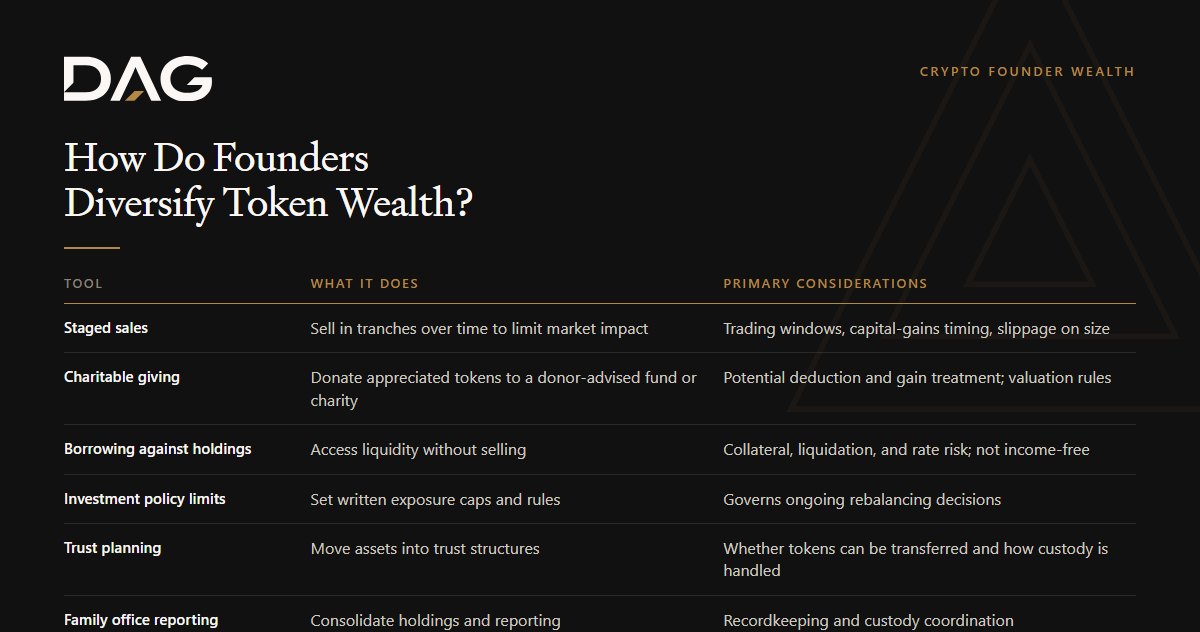
| Tool | What it does | Primary considerations |
|---|---|---|
| Staged sales | Sell in tranches over time to limit market impact | Trading windows, capital-gains timing, slippage on size |
| Charitable giving | Donate appreciated tokens to a donor-advised fund or charity | Potential deduction and gain treatment; valuation rules |
| Borrowing against holdings | Access liquidity without selling | Collateral, liquidation, and rate risk; not income-free |
| Investment policy limits | Set written exposure caps and rules | Governs ongoing rebalancing decisions |
| Trust planning | Move assets into trust structures | Whether tokens can be transferred and how custody is handled |
| Family office reporting | Consolidate holdings and reporting | Recordkeeping and custody coordination |
Whether a given holding can move into a trust is a threshold legal question, see can founder tokens be transferred to a trust. When diversification follows a sale, crypto liquidity planning after a token sale covers how the proceeds are managed.
Why Records Matter
Diversification decisions rest on clean records. Founders should preserve:
- Grant documents and vesting schedules
- Cost basis records for each lot
- On-chain transaction IDs and wallet addresses
- Sale and transfer records
- Legal ownership and entity documents
These records support tax reporting (including evolving forms such as Form 1099-DA), substantiate cost basis, and document custody and ownership if questions arise later.
Related Questions
Does diversifying token wealth eliminate risk?
No. Diversification can reduce concentration in a single token, but market, custody, and tax risk remain. No strategy guarantees a return or protects against loss, and outcomes depend on the specific facts.
Do founders have to sell tokens to diversify?
Not always. Selling is one path, but staged sales, charitable giving, borrowing against holdings, and trust planning each change exposure differently. Some carry tax consequences and some do not, so the choice depends on the founder's situation and should be reviewed with qualified professionals.
How do taxes affect founder diversification?
Because the IRS generally treats digital assets as property, selling or exchanging a token can trigger a capital gain or loss, and timing affects the result. Coordinating sales with tax planning is central, which is why diversification overlaps with token sale tax planning.
Sources
Compliance Note
This article is educational and does not provide legal, tax, investment, securities, employment, or custody advice. Founder diversification should be reviewed with qualified professionals.