
Token liquidity event planning is the work a founder or early token holder does before a sale, unlock, exchange listing, or secondary transaction turns illiquid digital-asset wealth into liquid wealth. Done early, it coordinates taxes, custody, transfer restrictions, diversification, estate planning, and family governance so the holder is not forced into rushed decisions when the market opens.
What Is a Token Liquidity Event?
A token liquidity event is any moment that makes previously restricted or illiquid tokens transferable or saleable. That includes token unlocks, vesting releases, exchange listings, token generation events, network launches, treasury distributions, and secondary sales. The tax, legal, and securities consequences depend on the specific facts, grant documents, and how the token is characterized, so each event should be reviewed on its own terms.
Why This Matters
Liquidity events compress years of wealth planning into a short window. The planning runway before liquidity often matters more than the event itself. Once assets are transferable, custody, tax, diversification, and public-visibility decisions all become urgent at once. Founders who build structure ahead of time keep more options open. This page sits within our crypto wealth management hub, and pairs with broader crypto founder wealth management planning.
How It Works
- Identify tokens, vesting schedules, lockups, and transfer restrictions.
- Review securities characterization and contractual constraints.
- Reconstruct cost basis and supporting tax records.
- Plan the custody and transfer workflow, including who can approve moves.
- Model liquidity timing and a diversification approach.
- Coordinate trusts, LLCs, and family office reporting.
For the timing mechanics around scheduled releases, see how to plan around a token unlock.
Planning Checklist
Before a liquidity event, founders and early holders should review:
- Token grant or purchase documents.
- Vesting and lockup terms, and any cliff dates.
- Transfer restrictions and rights of first refusal.
- Wallet access and custody controls (multi-sig approvers, cold storage, key recovery).
- Estimated tax exposure and available cost-basis records.
- A written diversification policy.
- Insider, securities, or contractual limitations on selling.
- Estate plan and entity ownership of the tokens.
Custody and Transaction Controls
Liquidity events can raise security risk because assets become easier to move or sell. A written custody policy should define who can approve transfers, which destinations are permitted, and how transaction records are retained. Where a qualified custodian is used, founders can review the custodian's controls and any SOC 1 or SOC 2 reports; multi-signature approval and cold storage are common ways to reduce single-point-of-failure risk. These controls reduce, but do not eliminate, custody and operational risk. Custody choices connect to the firm's digital asset custody hub.
Tax Coordination
The IRS generally treats digital assets as property for federal tax purposes, so sales, swaps, and certain transfers can be taxable depending on the facts. Reconstructing basis and documenting each disposition supports accurate reporting, including on forms such as Form 1099-DA as it phases in. Tax outcomes depend on your specific situation, and you should coordinate with a qualified tax professional before acting. Deeper detail lives in token sale tax planning.
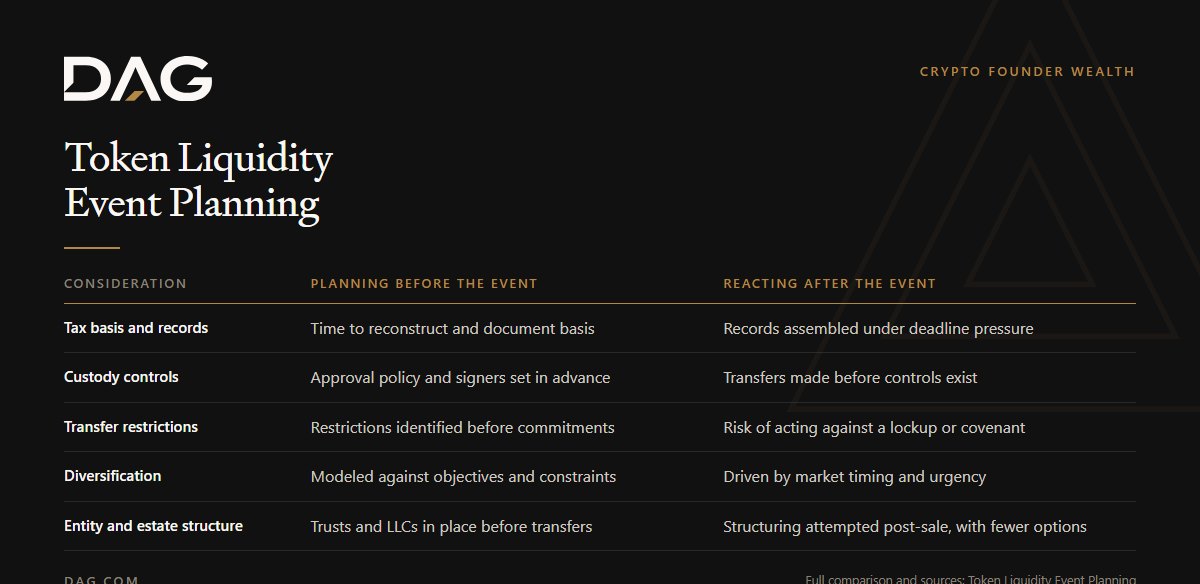
Comparison: Planning Before vs. After Liquidity
| Consideration | Planning before the event | Reacting after the event |
|---|---|---|
| Tax basis and records | Time to reconstruct and document basis | Records assembled under deadline pressure |
| Custody controls | Approval policy and signers set in advance | Transfers made before controls exist |
| Transfer restrictions | Restrictions identified before commitments | Risk of acting against a lockup or covenant |
| Diversification | Modeled against objectives and constraints | Driven by market timing and urgency |
| Entity and estate structure | Trusts and LLCs in place before transfers | Structuring attempted post-sale, with fewer options |
This table is general and educational; it does not guarantee any outcome.
When It May Help
- Token unlocks are scheduled.
- A secondary sale is being discussed.
- An exchange listing may create liquidity.
- A concentrated position needs tax and estate planning.
- Family office infrastructure is not yet in place.
When It May Not Be Enough
Token liquidity events can involve securities law, lockups, insider restrictions, tax exposure, and market risk. No plan removes market, custody, or tax risk, and professional review is required before action.
Evidence Standard
This article does not describe any actual liquidity event or token project.
Related Questions
What should be done first?
Map the asset, restrictions, wallets, tax basis, and ownership before making any transfer or sale decision. Sequencing this groundwork early generally leaves more planning options open.
Should tokens be transferred to a trust before liquidity?
Sometimes, but transfers can create tax, legal, contractual, or securities issues, and the right answer depends on the facts. See can founder tokens be transferred to a trust and consult a qualified professional.
Should founders diversify after liquidity?
Diversifying a concentrated token position is often worth evaluating, but the timing and method depend on liquidity, taxes, restrictions, and personal objectives. See how do founders diversify token wealth.
Bottom Line
Token liquidity planning generally works best before the market opens. The earlier the structure is ready, the fewer forced decisions a founder faces, though no plan can remove market, custody, or tax risk.
Sources
- IRS: Digital assets
- IRS: Frequently asked questions on digital asset transactions
- IRS: Digital asset guidance for businesses
- SEC Investor.gov: Crypto Assets
- SEC: Crypto assets
Compliance Note
This article is educational and does not provide legal, tax, investment, securities, or custody advice. Token liquidity events should be reviewed with qualified advisors before action is taken.