
An OTC block trade for large token positions is a privately negotiated sale of a sizable token holding away from public order books, arranged through an over-the-counter desk or counterparty so the position changes hands at an agreed price without pushing it through thin exchange liquidity. Founders and early holders use it to reduce visible market impact when selling concentrated project tokens. Selling is generally a taxable disposition.
An OTC (over-the-counter) desk is a dealer that matches large buyers and sellers off-exchange and quotes a single negotiated price for the full size, rather than filling the order in pieces across a public book. A block trade is one large transaction sized well above what the open market absorbs without moving the price. For a concentrated, project-token position, these mechanics matter more than for liquid assets like Bitcoin or Ethereum, because the token may have a thin float, a small set of venues, and contractual or securities-law selling limits.
This page covers the founder and concentrated-token angle. General cash-out mechanics for liquid majors like Bitcoin and Ethereum are a distinct topic. The founder context starts with crypto founder liquidity planning and the sequencing in token liquidity event planning.
Why Selling a Large Token Position Is Different
Concentrated project tokens often trade with limited depth. A market sell order large enough to clear a founder's position can walk down the order book, fill at progressively worse prices, and signal the sale to the rest of the market. That visible pressure is market impact, and the gap between the quoted price and the realized average price is slippage. OTC and block-trade routes exist to move size with less of both.
Three constraints shape the options:
- Float and depth. A token with little public liquidity may have no realistic on-exchange path for the full size.
- Selling restrictions. Lockups, vesting, and securities-law limits may cap how much can be sold and when. Review these before soliciting quotes.
- Information leakage. Telegraphing a large sale can move price ahead of execution. OTC negotiation is private, which can reduce that risk but does not eliminate it.
How Do Founders Sell a Large Token Position Without Crashing the Price?
The following is a general sequence to review with qualified legal, tax, and execution professionals. It is educational, not execution advice, and no route guarantees a given price or fill.
- Confirm what is sellable. Verify the unlock schedule, remaining lockup, and any contractual or securities-law selling limits before anything else. See crypto lock-up agreement review and negotiation for what to check.
- Size the position against market depth. Estimate how much the public market could absorb over a reasonable window versus what must move off-exchange.
- Select execution routes. Weigh an OTC desk (single negotiated price for the block), secondary-market or private sale to a known buyer, or a structured/programmatic dribble-out (selling small slices over time to limit impact). Many plans combine routes.
- Vet counterparties. Assess the desk or buyer's settlement track record, regulatory standing, custody arrangements, and references. Counterparty failure is a real risk in OTC dealing.
- Negotiate price and terms. Clarify whether the quote is firm or indicative, the reference price, fees and spread, and any conditions. For locked tokens, a forward sale (selling the right to tokens that unlock later) may be discussed; these are complex contracts that carry counterparty and legal risk and need professional review.
- Define settlement. Agree on settlement timing, the sequence of asset and cash transfer, whether an escrow or qualified custodian holds assets in between, and how delivery-versus-payment is handled to limit settlement risk.
- Document for tax and records. A sale is generally a taxable disposition; the IRS treats digital assets as property. Record proceeds, basis, and date. Coordinate with a tax professional before transacting; see token sale tax planning.
- Plan the proceeds. Decide custody and reinvestment for the cash before the trade settles, not after.
OTC Desk vs. Programmatic Dribble-Out vs. Secondary Sale
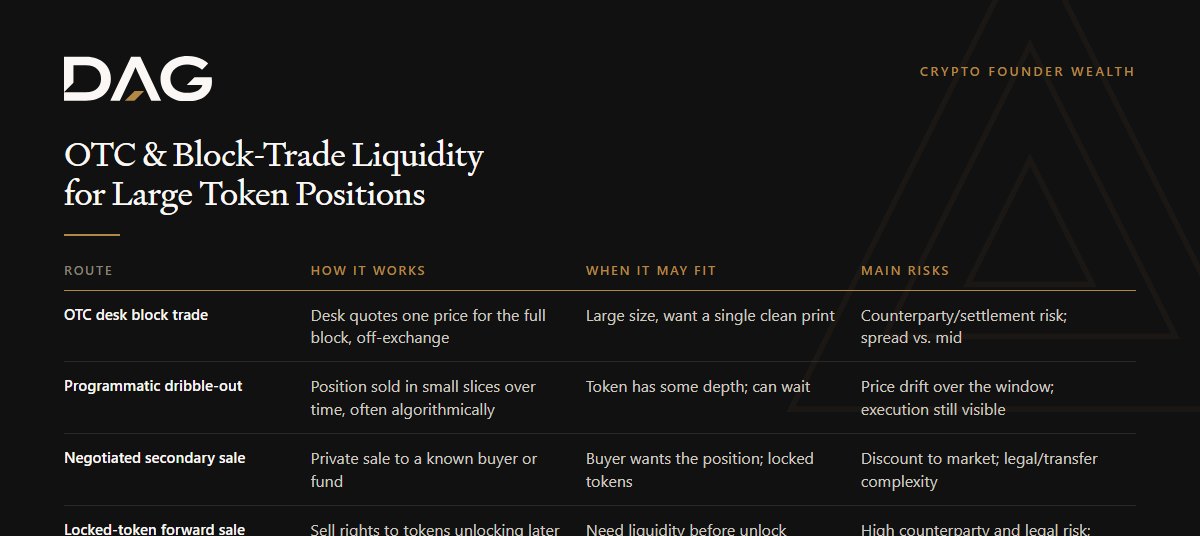
| Route | How it works | When it may fit | Main risks |
|---|---|---|---|
| OTC desk block trade | Desk quotes one price for the full block, off-exchange | Large size, want a single clean print | Counterparty/settlement risk; spread vs. mid |
| Programmatic dribble-out | Position sold in small slices over time, often algorithmically | Token has some depth; can wait | Price drift over the window; execution still visible |
| Negotiated secondary sale | Private sale to a known buyer or fund | Buyer wants the position; locked tokens | Discount to market; legal/transfer complexity |
| Locked-token forward sale | Sell rights to tokens unlocking later | Need liquidity before unlock | High counterparty and legal risk; complex contract |
No single route is best; the fit depends on float, restrictions, timing, and risk tolerance, and should be set with qualified advisers.
Related Questions
What is slippage on a large token sale?
Slippage is the difference between the price you see quoted and the average price you actually realize once the order fills. On a thin token, a large market order can cause significant slippage as it consumes available bids. OTC and staged selling aim to reduce it, but cannot guarantee a particular outcome.
Is an OTC sale of tokens taxable?
Generally, yes. Selling or exchanging tokens is typically a taxable disposition because the IRS treats digital assets as property. The amount and character depend on your basis and holding period. Confirm treatment with a qualified tax professional before transacting.
Can I sell tokens that are still locked?
Sometimes, through structures like forward sales or negotiated private agreements, but lockups and securities-law restrictions may prohibit or limit it, and these arrangements carry meaningful counterparty and legal risk. Review the underlying agreement and consult qualified counsel first.
How do I reduce counterparty risk in an OTC trade?
Vet the desk's regulatory standing and settlement history, define delivery-versus-payment terms, and consider escrow or a qualified custodian to hold assets during settlement. These steps can reduce, but do not remove, the risk that a counterparty fails to perform.
Sources
- IRS: Digital assets
- IRS: Frequently asked questions on virtual currency transactions
- SEC Investor.gov: Crypto Assets
Compliance Note
This page is educational and does not provide investment, legal, tax, or securities advice, and is not an offer or solicitation to buy or sell any asset. Selling a token position is generally a taxable disposition, and no execution route guarantees a price, fill, or outcome. Securities-law restrictions may apply to founder and insider sales. DAG coordinates with qualified execution, legal, and tax professionals rather than providing those services directly. Registration does not imply a certain level of skill or training.