
Yes, a family office can hold stablecoins, but the question "can a family office hold stablecoins" is really a governance question. Before holding them, the family office should review issuer risk, custody arrangements, liquidity, tax records, transfer controls, the holding entity's legal status, and internal governance. A stablecoin is not the same as cash or an insured bank deposit.
What Is a Stablecoin?
A stablecoin is a digital asset designed to track the value of a reference asset, usually a fiat currency such as the U.S. dollar. The peg is a design goal, not a guarantee: it depends on the issuer's reserves, redemption mechanics, and market conditions, and a stablecoin can deviate from or lose its peg. Stablecoins are generally not covered by FDIC or SIPC protection, and the IRS generally treats digital assets as property for tax purposes. These considerations sit alongside broader decisions in the Crypto Family Office Hub.
Questions to Review
- Which stablecoins are approved, and is each one fiat-backed, over-collateralized, or algorithmic?
- Who is the issuer, and does it publish reserve attestations or audits?
- Where are the stablecoins custodied, and is a qualified custodian holding the keys (cold storage, multi-sig)?
- What transfer controls apply, including approval thresholds and whitelisted addresses?
- Are the stablecoins held personally, by a trust, by an LLC, or by another entity, and how does that affect liability and charging-order protection?
- How are transactions recorded for the cost-basis and Form 1099-DA reporting that the IRS requires?
- What concentration limits apply by issuer or custodian?
A formal answer to these belongs in a digital asset investment policy statement, and the supporting review is covered in crypto due diligence for family offices.
Stablecoin vs. Bank Deposit
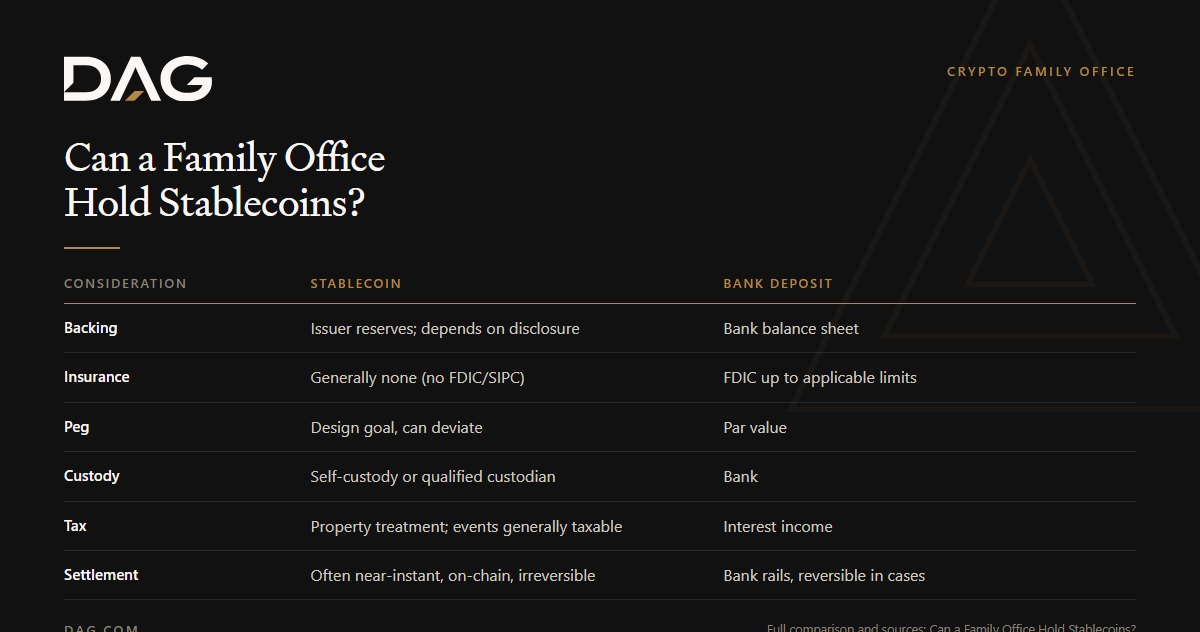
| Consideration | Stablecoin | Bank Deposit |
|---|---|---|
| Backing | Issuer reserves; depends on disclosure | Bank balance sheet |
| Insurance | Generally none (no FDIC/SIPC) | FDIC up to applicable limits |
| Peg | Design goal, can deviate | Par value |
| Custody | Self-custody or qualified custodian | Bank |
| Tax | Property treatment; events generally taxable | Interest income |
| Settlement | Often near-instant, on-chain, irreversible | Bank rails, reversible in cases |
This is a structural comparison, not a recommendation; no stablecoin removes market, custody, depeg, or tax risk.
Governance Policy
A family office should consider a stablecoin policy that defines permitted assets, use cases, custody locations, transfer approvals, and reporting requirements. Pair it with the wider crypto governance for family offices framework so stablecoin decisions follow the same controls as the rest of the digital asset book.
Related Questions
Are stablecoins insured like cash?
Generally no. Stablecoins are typically not covered by FDIC deposit insurance or SIPC protection, and the value of a stablecoin depends on the issuer's reserves and redemption mechanics. Confirm coverage and reserve disclosures with a qualified professional before relying on any stablecoin as a cash equivalent.
Should a family office hold stablecoins in a trust or an LLC?
It depends on the facts. The holding entity affects liability, tax reporting, and asset protection, so families often weigh personal holding against a trust or an LLC with directed-trust or charging-order features. Decide the structure with qualified legal and tax counsel rather than by default.
How are stablecoin transactions taxed?
The IRS generally treats digital assets, including stablecoins, as property, so transfers and conversions can be taxable events even when the price stays near the peg. Keep cost-basis records and prepare for Form 1099-DA reporting, and confirm treatment with a qualified tax professional.
Sources
Compliance Note
This article is educational and does not provide legal, tax, investment, fiduciary, treasury, stablecoin, or custody advice. Stablecoin use should be reviewed with qualified professionals.