
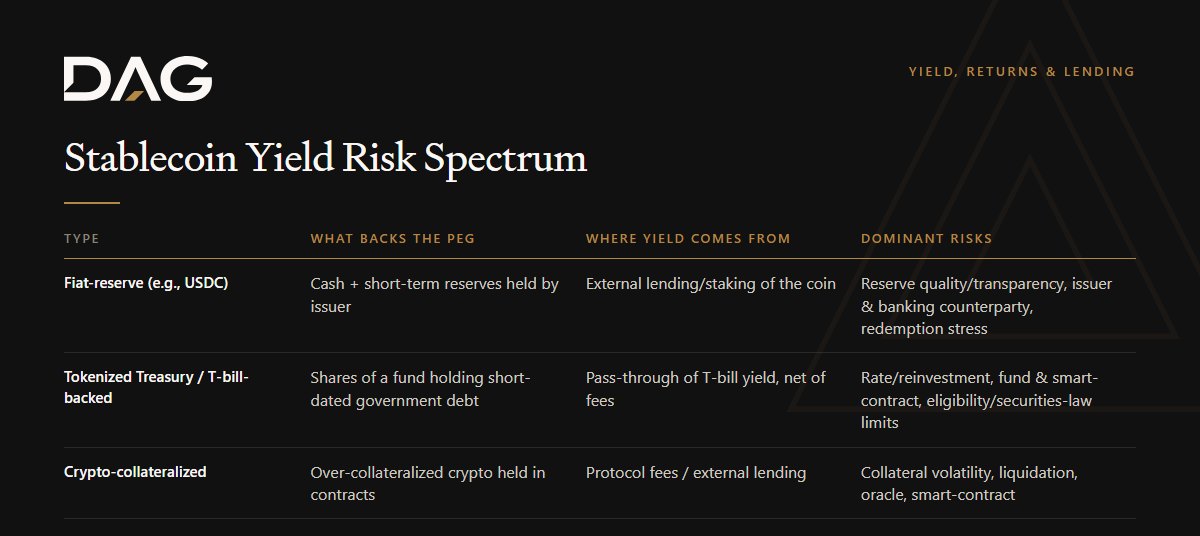
The stablecoin yield risk spectrum runs from relatively conservative to highly speculative, and the yield rarely tells you where a token sits. A fiat-reserve coin like USDC, an algorithmic stablecoin, and a tokenized-Treasury product can all advertise a "yield," but their backing, failure modes, and depeg history differ sharply. The single most important question is what stands behind the peg, and whether anything actually guarantees it (generally, nothing does).
What Is "Stablecoin Yield" and Why Does the Risk Differ?
A stablecoin is a token designed to hold a stable value, usually a dollar. "Stablecoin yield" is the return earned by lending, staking, or holding a yield-bearing version of one. The phrase hides a wide risk range because two things vary independently: how the peg is maintained (the stability risk) and where the yield comes from (the yield risk). A token can have a robust peg but pay yield through a risky lending venue, or pay yield from safe collateral but rely on a fragile peg mechanism. You have to evaluate both.
This page is about the risk profile of the stablecoin itself and its yield source. For the protocol you might lend it through, see the DeFi lending protocol comparison. For how stablecoin yield is taxed when it flows to an entity, see crypto yield in a trust or entity.
The Backing Spectrum: Three Distinct Risk Profiles
Fiat-reserve / collateralized stablecoins (e.g., USDC, USDT)
These aim to hold reserves, cash, short-term Treasuries, or similar, equal to the coins in circulation, and to redeem 1:1. The main risks are reserve quality and transparency (what is actually held, and is it audited or merely attested), issuer and banking counterparty risk (where the reserves are held), and redemption/liquidity risk in a stress event. They are not bank deposits and are generally not FDIC-insured; a holder is an unsecured creditor of the issuer in the ordinary case.
Tokenized-Treasury / T-bill-backed products
These tokens represent shares of a fund or vehicle holding short-dated U.S. government securities, so the "yield" is the underlying T-bill yield passed through, net of fees. Risk here is closer to a money-market-style product: interest-rate and reinvestment risk, fund-structure and manager risk, smart-contract and transfer-agent risk, and, importantly, securities-law and eligibility restrictions, since many are offered only to qualified or accredited investors. They are not bank deposits and are not government-guaranteed at the token level.
Algorithmic stablecoins
These attempt to hold the peg through code, market incentives, or a paired token rather than full off-chain reserves. They occupy the high-risk end of the spectrum: the peg depends on continuous market confidence and arbitrage, and a loss of confidence can trigger a reflexive collapse. The most-cited example is the May 2022 failure of the algorithmic stablecoin TerraUSD (UST) and its paired token LUNA, which lost their peg and collapsed in value over a matter of days. Treat advertised yields on algorithmic designs as compensation for a real risk of total loss.
Comparison: Stablecoin Types Across the Risk Spectrum
| Type | What backs the peg | Where yield comes from | Dominant risks |
|---|---|---|---|
| Fiat-reserve (e.g., USDC) | Cash + short-term reserves held by issuer | External lending/staking of the coin | Reserve quality/transparency, issuer & banking counterparty, redemption stress |
| Tokenized Treasury / T-bill-backed | Shares of a fund holding short-dated government debt | Pass-through of T-bill yield, net of fees | Rate/reinvestment, fund & smart-contract, eligibility/securities-law limits |
| Crypto-collateralized | Over-collateralized crypto held in contracts | Protocol fees / external lending | Collateral volatility, liquidation, oracle, smart-contract |
| Algorithmic | Code, incentives, a paired token (little/no reserve) | Often subsidized / very high quoted rates | Peg-confidence collapse, reflexive death spiral, total loss |
These are general profiles, not ratings of any specific token. A token's real risk depends on its current reserves, attestations, structure, and venue, all of which change. Verify the issuer's current disclosures before relying on any of this.
Depeg History: Dated, Factual Reference Points
A depeg is when a stablecoin trades away from its target value. Two widely reported episodes illustrate the range:
- TerraUSD (UST), May 2022. The algorithmic stablecoin UST lost its dollar peg and, together with its paired token LUNA, collapsed in value within days. This is the canonical example of algorithmic-peg failure and near-total loss.
- USDC, March 2023. The fiat-reserve coin USDC briefly traded below $1 after its issuer disclosed that a portion of its cash reserves was held at a bank that had failed (Silicon Valley Bank). USDC reapproached its peg in the following days after the deposits were backstopped. This episode shows that even reserve-backed coins carry banking-counterparty risk and can depeg temporarily.
These are historical, dated facts, not predictions. A past recovery does not guarantee a future one, and a past collapse does not mean a given design will collapse again, but both show that "stable" is a design goal, not a promise.
How Should a Holder Weigh Yield Against Risk?
- Match the yield to its source. Ask where the yield actually comes from. A T-bill pass-through near prevailing short-term government rates is a different animal from a double-digit "yield" subsidized by a token or paid by a lending venue you cannot see into.
- Separate peg risk from venue risk. Even a well-reserved coin can lose money through a failed lending platform; the DeFi lending protocol comparison covers protocol-side risk, and what happens if a crypto custodian fails covers the custodial side.
- Check eligibility and structure for tokenized products. Many tokenized-Treasury products are securities with investor-eligibility limits; entities and individuals should confirm they qualify.
- Mind entity rules. Whether a structure may even hold a stablecoin varies, see whether a trust can hold stablecoins and an LLC can hold stablecoins, and how a family office approaches it in stablecoin treasury management for family offices.
For where stablecoin yield sits in the broader plan, see the crypto lending and yield hub.
Related Questions
Is stablecoin yield safe?
No yield is "safe" in the sense of being guaranteed. The risk depends on the backing and the yield source. A tokenized-Treasury product carries money-market-style and structural risk; a fiat-reserve coin carries reserve and counterparty risk; an algorithmic stablecoin carries peg-collapse risk that can mean total loss. None is FDIC-insured, and a high advertised yield usually signals higher risk.
Can a "stable" coin actually lose its value?
Yes. Stablecoins are designed to hold value but are not guaranteed to. Algorithmic designs have collapsed (TerraUSD/UST in May 2022), and even reserve-backed coins have temporarily depegged (USDC in March 2023 over a banking exposure). "Stable" describes a goal, not a promise.
What is the difference between a tokenized-Treasury token and a regular stablecoin?
A regular fiat-reserve stablecoin aims to hold $1 of value and generally pays no yield by itself. A tokenized-Treasury product represents shares of a fund holding short-dated government debt and passes through that yield, net of fees. The tokenized-Treasury product is usually a security with eligibility limits and fund-level risks; the plain stablecoin is not designed to pay yield on its own.
Why are algorithmic stablecoins considered the riskiest?
Because the peg depends on continuous market confidence and incentive mechanics rather than full off-chain reserves. If confidence drops, the mechanism can enter a reflexive spiral where the peg and the supporting token collapse together, as TerraUSD/LUNA did in May 2022. The high yields often offered are compensation for a real risk of total loss.
Sources
- Investor.gov: Crypto assets
- CFPB: Risks to consumers posed by crypto-asset products
- President's Working Group on Financial Markets, Report on Stablecoins (U.S. Treasury, November 2021), peg-stability and reserve-risk framework; verify current URL; not verified at time of drafting.
- Public reporting on the May 2022 TerraUSD/LUNA collapse and the March 2023 USDC depeg, corroborate dates and figures against primary disclosures before relying on them.
Compliance Note
This article is for educational purposes only and does not constitute legal, tax, investment, or financial advice, and is not a recommendation of any token, issuer, or product. Stablecoins are not bank deposits and are generally not FDIC- or SIPC-insured; they can and have lost their peg, and stablecoin yield is variable, not guaranteed, and can result in partial or total loss. The depeg events described (TerraUSD/UST in May 2022; USDC in March 2023) are historical and dated; past behavior does not predict future results. Token structures, reserves, and eligibility rules change and vary by jurisdiction; verify an issuer's current disclosures and your own eligibility before acting. Consult a qualified financial, legal, and tax professional about your situation.
DAG Wealth is a brand of Digital Ascension Group. Investment advisory services are offered through DAG Wealth, an SEC-registered investment adviser. Registration does not imply a certain level of skill or training.