
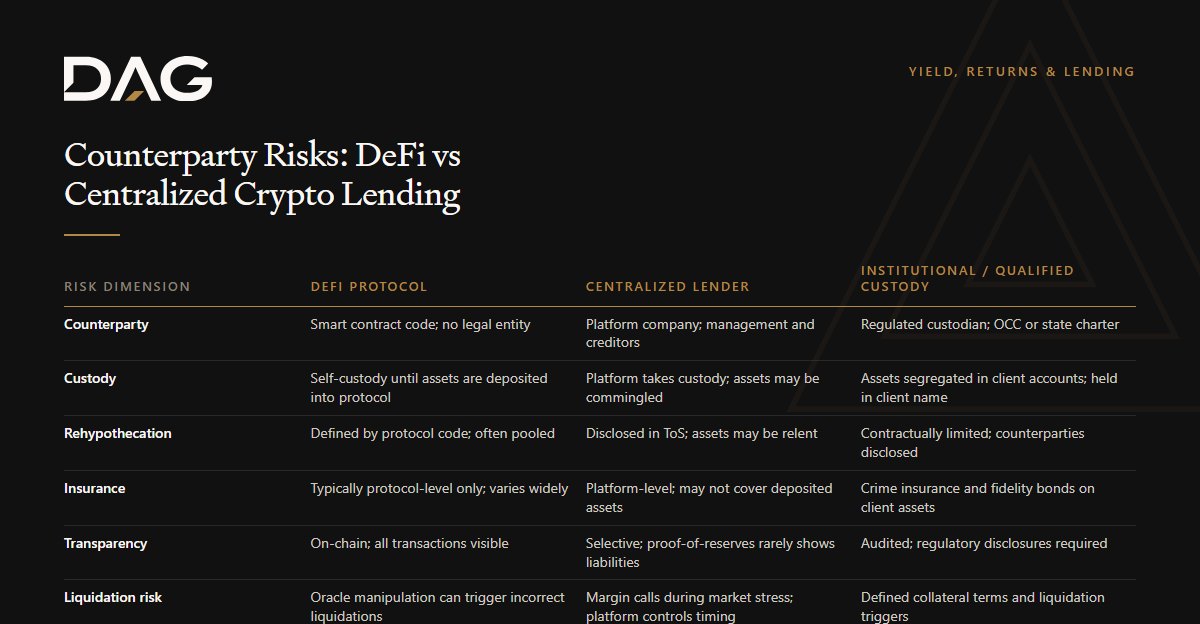
Counterparty risk in DeFi vs centralized lenders vs institutional custody falls into three categories. DeFi protocols carry smart-contract, oracle, and governance risk. Centralized lenders add rehypothecation, insolvency, and limited transparency. Institutional custody generally segregates assets, limits and discloses counterparties, and insures client holdings, at the cost of lower headline yield. This comparison is part of the crypto lending and yield cluster.
What Is Counterparty Risk in Crypto Lending?
Counterparty risk is the probability that the other party in a financial arrangement fails to meet its obligations, leaving the lender with losses, locked assets, or neither. In crypto lending it takes three distinct forms depending on the structure used.
What Counterparty Risks Do DeFi Protocols Carry?
DeFi protocols operate through self-executing smart contracts rather than through any legal entity. There is no counterparty in the traditional sense; the risks come from code and on-chain mechanics.
Smart-contract and exploit risk
Smart contracts execute exactly as written. When the code contains a flaw, attackers can exploit it instantly and at scale, there is no fraud department to call and no reversal mechanism. Smart-contract exploits have accounted for a significant share of crypto asset losses in recent years, and the scale of individual incidents has reached the hundreds of millions of dollars.
Reentrancy attacks are one documented mechanism: an attacker calls a contract function repeatedly before the contract updates its balance, draining funds before the state catches up. Reentrancy vulnerabilities have been cited as the cause of major protocol losses in publicly available post-mortems.
Oracle and flash-loan risk
Price oracles feed real-world or cross-protocol prices into DeFi contracts. When oracle inputs are manipulated, through flash loans or low-liquidity price feeds, contracts liquidate positions at incorrect prices. Flash loans allow an attacker to borrow millions with zero collateral, manipulate a price feed within a single transaction block, trigger profitable liquidations, and repay the loan before the block closes. No capital is required; only technical execution.
Governance risk
Token-based governance means protocol changes pass if a majority of governance tokens vote for them. A well-funded actor who accumulates enough tokens can push through parameter changes or direct funds in ways that harm depositors. Because the protocol is decentralized, no central authority can reverse a governance-approved transaction.
Audits reduce but do not eliminate these risks. Code upgrades, new integrations, and composability with other protocols continuously introduce new attack surfaces.
What Counterparty Risks Do Centralized Crypto Lenders Carry?
Centralized crypto lenders are legal entities that take custody of deposited assets and deploy them to generate yield. That introduces people, balance sheets, and business-model risk that DeFi contracts do not have.
Rehypothecation and hidden leverage
As a category, centralized lending platforms may lend out or otherwise deploy deposited assets to generate the yields they advertise, a practice known as rehypothecation. Whether and how a given platform does this is governed by its own terms of service, which can change; deposited funds may, depending on those terms, be used for the platform's own investments or as collateral for the platform's borrowing. During calm markets, this can generate yield. During market stress, the same leverage can amplify losses. Investors should review each platform's current terms directly rather than assume a uniform practice across the category.
The 2022 credit cycle illustrated the mechanism. As reflected in public bankruptcy filings, a chain of centralized platform failures that year froze customer withdrawals at several centralized crypto lenders that failed in 2022, and was connected to the insolvency of a large crypto hedge fund that had borrowed from multiple lenders. These events are documented in dated court records (see Sources).
Custody and bankruptcy risk
When a centralized lender fails, deposited crypto may, depending on the platform's structure and applicable law, become part of the bankruptcy estate. Creditors, including depositors, may then have to wait for court proceedings to recover any portion of their assets, with no guarantee of recovery or timeline. This differs from segregated qualified custody, where assets generally remain titled to the client.
Regulatory and transparency risk
Regulatory status among centralized lenders varies widely. Some operate under state trust charters; others hold licenses that may not authorize the specific activities they conduct. Proof-of-reserves attestations, when published, typically show assets but not liabilities, rehypothecation agreements, or off-balance-sheet counterparty exposures.
How Does Institutional Custody Lending Compare?
Institutional crypto custody lending operates under a structurally different framework. Federally chartered custodians operate under OCC supervision with capital requirements and audit standards comparable to regulated banking.
Key protections include:
- Bankruptcy remoteness. Assets held in qualified custody are generally segregated from the custodian's own balance sheet. Depending on the structure and jurisdiction, they may not be available to the custodian's creditors in an insolvency. The specific protection varies by charter type and applicable law and should be confirmed for any given custodian.
- Asset-level insurance. Institutional programs may carry crime insurance, fidelity bonds, and cold-wallet coverage intended to insure client assets, distinct from policies that cover only infrastructure or operational errors. Coverage scope and limits vary by provider.
- Disclosed, limited counterparties. Borrowers, collateral terms, and lending conditions are typically specified and disclosed. Assets are generally not pooled with other depositors' holdings and lent to whoever pays the highest rate.
Institutional custody lending yield is generally lower than yield offered through DeFi protocols or centralized platforms. The yield gap reflects the structural risk reduction, limited or no rehypothecation, no pooled collateral, and no smart-contract exploit exposure.
For high-net-worth investors and family offices evaluating qualified custody for RIAs managing digital assets, the institutional track includes regulatory oversight not present in DeFi or most centralized platforms.
Comparison: DeFi vs Centralized Lender vs Institutional Custody
| Risk Dimension | DeFi Protocol | Centralized Lender | Institutional / Qualified Custody |
|---|---|---|---|
| Counterparty | Smart contract code; no legal entity | Platform company; management and creditors | Regulated custodian; OCC or state charter |
| Custody | Self-custody until assets are deposited into protocol | Platform takes custody; assets may be commingled | Assets segregated in client accounts; held in client name |
| Rehypothecation | Defined by protocol code; often pooled | Disclosed in ToS; assets may be relent | Contractually limited; counterparties disclosed |
| Insurance | Typically protocol-level only; varies widely | Platform-level; may not cover deposited assets | Crime insurance and fidelity bonds on client assets |
| Transparency | On-chain; all transactions visible | Selective; proof-of-reserves rarely shows liabilities | Audited; regulatory disclosures required |
| Liquidation risk | Oracle manipulation can trigger incorrect liquidations | Margin calls during market stress; platform controls timing | Defined collateral terms and liquidation triggers |
| Regulatory oversight | None for the protocol itself | Varies widely; some unregulated or minimally chartered | OCC or state trust charter; capital requirements |
| Bankruptcy risk | Protocol cannot go bankrupt; exploits are irreversible | Assets may enter bankruptcy estate if platform fails | Segregated accounts; generally not available to custodian's creditors, depending on structure and jurisdiction |
Where Does Self-Custody Fit?
Self-custody, holding assets in a hardware wallet with private keys offline, eliminates counterparty risk entirely, because no third party has access to the assets. The tradeoff is that self-custodied assets generate no yield unless the holder actively deploys them into a lending protocol, reintroducing counterparty risk. Self-custody is appropriate for core holdings the holder is not willing to lend; the risk calculus for the deployable portion is what this comparison addresses.
For a deeper look at the custody decision itself, see cold storage vs qualified custody and crypto custody options compared.
Related Questions
Can an audited DeFi protocol be hacked?
Yes. Audits reduce the probability of known vulnerability classes but cannot guarantee the absence of all bugs. Protocol upgrades, new integrations, and governance changes can introduce vulnerabilities after an audit is complete. Multiple audited protocols have suffered material exploits post-audit.
Are centralized crypto lenders FDIC- or SIPC-insured?
FDIC insurance covers deposits at insured U.S. banks; SIPC protects brokerage accounts at member firms. Centralized crypto lenders are generally neither U.S. banks nor SIPC members. Any insurance coverage on assets deposited with a centralized lender would be governed by that platform's own arrangements, which may cover infrastructure or operational losses rather than the full market value of deposited assets. Confirm coverage terms directly with the platform before depositing.
Does institutional custody lending eliminate all yield-related risk?
No. Institutional custody structures reduce counterparty, custody, and regulatory risk materially, but lending always involves credit risk (the borrower may default) and market risk (collateral values can fall). The institutional framework limits and discloses those risks rather than eliminating them.
How does rehypothecation affect recovery in a centralized lender bankruptcy?
If a platform has lent out deposited assets and those loans have not been repaid, there may be fewer assets in custody than depositors are owed. Recovery in bankruptcy then depends on whatever proceeds the estate can recover from borrowers, the platform's other assets, and court proceedings, potentially returning substantially less than par.
What distinguishes a qualified custodian from a crypto exchange or CeFi lender?
A qualified custodian is a regulated entity, typically a bank, trust company, or registered broker-dealer, that segregates client assets, maintains capital requirements, and submits to independent audit. Crypto exchanges and CeFi lenders are generally not qualified custodians; client assets held on those platforms are typically unsegregated and exposed to the platform's credit risk. See qualified custodian vs crypto exchange for the full comparison.
Related Topics
- Crypto custody options compared
- What is institutional crypto custody?
- Cold storage vs qualified custody
- Qualified custody for RIAs managing digital assets
- Crypto-backed loans for high-net-worth investors
- Crypto wealth management hub
Sources
- Three Arrows Capital Liquidation, BVI Commercial Court, June 2022 (subsequently recognized in U.S. and Singapore proceedings). See SEC litigation releases and news coverage for public record.
- FTX Trading Ltd. Chapter 11 Filing, U.S. Bankruptcy Court, District of Delaware, Case No. 22-11068, November 2022. https://restructuring.ra.kroll.com/FTX/
- For DeFi exploit loss totals, consult dated primary trackers such as Chainalysis Crypto Crime Reports (https://www.chainalysis.com/) and DeFiLlama (https://defillama.com/hacks). This article describes loss patterns qualitatively rather than citing a specific aggregate figure.
Compliance Note
This article is for educational purposes only and does not constitute legal, tax, investment, or financial advice. Past performance of any platform, protocol, or custody structure does not guarantee future results. Descriptions of specific platform categories are based on publicly available information and are intended to illustrate risk categories, not to serve as endorsements or recommendations. Risk characteristics of individual platforms change over time; verify current terms, regulatory status, and insurance coverage independently before making any decision.
DAG Wealth is a brand of Digital Ascension Group. Investment advisory services are offered through DAG Wealth, an SEC-registered investment adviser. Registration does not imply a certain level of skill or training.
Consult a qualified financial, legal, and tax professional before acting on any information in this article.