
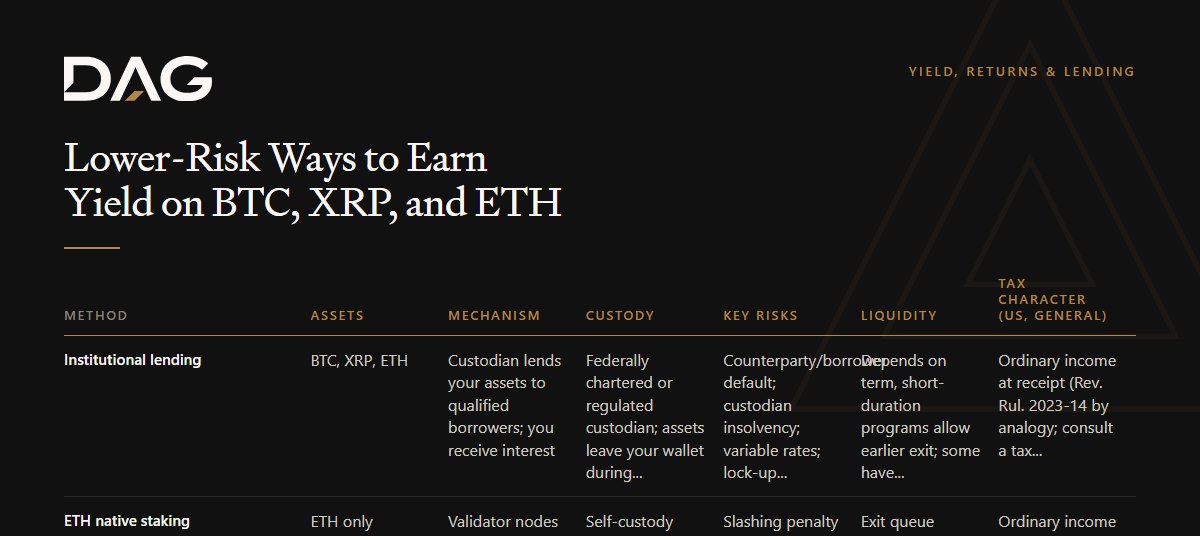
No method is risk-free, but holders seeking lower-risk yield on BTC, XRP, and ETH without selling have three main paths: institutional lending, ETH native staking, and DeFi liquidity provision, all covered in the crypto lending and yield hub. Each carries distinct counterparty, smart-contract, or liquidity risk. A relatively conservative approach pairs custody-preserving lending on a defined slice with self-custody on the rest.
What Does "Yield Without Selling" Mean?
Yield without selling means generating income on a digital asset position while keeping the underlying coins, no disposal, no realized capital gain at the time of deployment. The income itself (lending interest, staking rewards) is generally taxable as ordinary income in the year received, regardless of whether you sell; see the tax section below.
Custody-preserving yield refers specifically to programs where you retain, or can verify, where your assets sit during the yield-generating period: either in a qualifying institutional custodian or, for certain ETH staking setups, in a validator you control. It contrasts with pooled platforms where assets are commingled and the custody chain is opaque.
How Do the Main Yield Methods Compare?
The table below covers the four practical methods available to BTC, XRP, and ETH holders. Note that BTC has no native staking protocol; XRP also has no native staking; ETH can be staked natively through the Ethereum consensus layer or through liquid staking tokens.
| Method | Assets | Mechanism | Custody | Key Risks | Liquidity | Tax character (US, general) |
|---|---|---|---|---|---|---|
| Institutional lending | BTC, XRP, ETH | Custodian lends your assets to qualified borrowers; you receive interest | Federally chartered or regulated custodian; assets leave your wallet during loan term | Counterparty/borrower default; custodian insolvency; variable rates; lock-up periods | Depends on term, short-duration programs allow earlier exit; some have lock-ups | Ordinary income at receipt (Rev. Rul. 2023-14 by analogy; consult a tax professional) |
| ETH native staking | ETH only | Validator nodes lock ETH to secure Ethereum's proof-of-stake consensus | Self-custody (solo validator) or delegated to a node operator / liquid staking token | Slashing penalty if validator misbehaves; smart-contract risk for liquid staking tokens; ~27-hour exit queue | Exit queue exists; liquid staking tokens (stETH, rETH) can be sold but carry their own risks | Ordinary income at receipt per Rev. Rul. 2023-14; liquid staking token sales are separate taxable events |
| DeFi liquidity provision (AMM) | ETH, and wrapped BTC or XRP on some protocols | Deposit asset pairs into automated market-maker pools; earn trading fees and/or protocol tokens | Non-custodial smart contracts, you hold LP tokens, but assets are in the protocol | Smart-contract exploit/hack; impermanent loss (can exceed fee income); protocol token rewards may be volatile or worthless | Generally can withdraw anytime, but impermanent loss is realized on exit | Fees likely ordinary income at receipt; IL treatment is unsettled, consult a tax professional |
| CeFi lending platforms | BTC, XRP, ETH | Centralized platform pools deposits and lends them out | Platform custodied, no segregation guarantee; assets leave your control | Platform insolvency (multiple high-profile failures 2022–2023); no FDIC or SIPC coverage; no bankruptcy-remote accounts | Variable; many platforms have suspended withdrawals in stress periods | Ordinary income at receipt |
Important: No yield method for digital assets is risk-free. Rates advertised on any platform can change without notice. Assets deployed in any yield program are not covered by FDIC insurance or SIPC protection. Some crypto yield and lending products may be deemed securities by the SEC, which can affect how, and whether, they may lawfully be offered to you. Past yields do not indicate future results.
What Makes Institutional Lending Lower-Risk Than CeFi Platforms?
The primary distinctions are regulatory oversight, insurance, and account structure:
- Regulatory charter. A qualified custodian operating under a national bank charter, for example, the Office of the Comptroller of the Currency conditionally approved one digital-asset bank's national trust charter in 2021, is held to federal banking standards rather than state trust-company rules, which vary by jurisdiction. (Charter status is an example of an oversight model, not an endorsement of any specific provider; confirm any custodian's current regulatory standing before relying on it.)
- Crime insurance. Qualifying institutional programs carry crime insurance covering assets in custody, not merely infrastructure. Verify the scope and limits before deploying.
- Bankruptcy-remote accounts. Segregated client accounts held at a qualifying custodian may be treated differently in an insolvency than commingled platform deposits. Confirm the structure in writing.
- Counterparty transparency. Institutional programs that lend to identified, underwritten borrowers differ from pooled programs that lend to whoever pays the highest rate.
DAG Wealth works with institutional-grade custody providers for digital asset wealth management engagements. Clients in these arrangements hold assets at a qualifying custodian under crypto insurance and custody terms that are disclosed before deployment.
Even within institutional programs, terms matter more than headline rate. Short-duration loans reduce the window of counterparty exposure. An extra 0.5% annualized is unlikely to compensate for a 30-, 60-, or 90-day lock-up during a volatile market.
What Yields Can BTC, XRP, and ETH Holders Realistically Expect?
General observations:
- Institutional lending rates for BTC, XRP, and ETH are generally lower than rates offered on unregulated or pooled CeFi platforms, which reflects better credit underwriting and shorter durations.
- ETH native staking yields vary based on network validator count and transaction fee activity; network-wide APY has generally been in the 3%–5% range, though this fluctuates.
- DeFi AMM yields vary enormously by pool, network conditions, and trading volume. High published APYs frequently reflect volatile protocol token emissions that may decline sharply.
Any yield figure from a specific program should be confirmed directly with that provider and compared against your risk tolerance and tax situation.
How Much of Your Holdings Should You Deploy for Yield?
The source article's framing is sound as a general principle: deploy a defined slice, not the whole position. A hypothetical illustration, "if you hold 10 BTC, you might consider 2 in a lending program", is not personalized advice, but the structural logic applies:
- Liquidity reserve. Core holdings need to remain accessible for rebalancing, collateral, estate planning, or market opportunities. Locking 100% of a position in a yield program eliminates optionality.
- Counterparty concentration. Spreading across more than one provider reduces single-point insolvency risk.
- Position context. The appropriate yield-deployment percentage depends on your total balance sheet, liquidity needs, tax situation, and whether the assets are held personally, in an LLC, or in a trust. See bitcoin wealth management and ethereum wealth management for structure-specific considerations.
For holders using crypto-backed loans for high-net-worth investors alongside yield programs, note that assets serving as loan collateral are typically not simultaneously available for yield deployment.
What Are the Tax Implications of Crypto Yield?
Under IRS Revenue Ruling 2023-14, staking rewards are generally includable in gross income at fair market value on receipt. The IRS and most practitioners treat crypto lending interest similarly, as ordinary income at receipt.
Key considerations:
- Yield is income even if you don't sell. Receiving staking rewards or lending interest creates a taxable event in the year received, regardless of what you do with the tokens afterward.
- Cost basis. Tokens received as rewards carry a cost basis equal to the fair market value at receipt. When you eventually sell them, you have a separate capital gain or loss.
- Liquid staking tokens (e.g., stETH) may generate a taxable event when received and again when sold or unwrapped. Treatment is unsettled; consult a qualified tax professional.
- Lock-up periods do not defer income recognition. Interest accrued on a locked position is generally taxable in the year it accrues or is constructively received.
For entity-specific considerations, see crypto staking tax reporting.
How Does Self-Custody Fit Into a Yield Strategy?
Assets not deployed in yield programs should sit in self-custody where you control the private keys, hardware wallets rather than exchange accounts or hot wallets. Self-custody eliminates counterparty risk for idle holdings, though it introduces key-management and estate-planning responsibilities. See crypto insurance and custody for how hardware wallets interact with institutional custody arrangements.
The general structure for a conservative yield approach:
- Core holdings, self-custody hardware wallet; full key control.
- Yield slice, institutional lending program with verified insurance and short terms.
- Nothing in platforms where the custody chain is unverifiable or terms are unclear.
This structure is not a recommendation for any specific allocation. It is a general framework that requires individual analysis.
Related Questions
Does XRP have native staking?
No. XRP operates on the XRP Ledger, which uses a federated consensus mechanism, not proof-of-stake. There is no native staking protocol that allows XRP holders to earn yield by locking tokens as validators. XRP yield, where available, comes through lending programs or, on some DeFi platforms, liquidity provision in XRP-paired pools. XRP holders should verify the custody and counterparty structure of any program offering XRP yield, as the absence of native staking means all XRP yield programs carry some form of third-party credit or smart-contract dependency.
Can yield programs trigger a margin call or forced liquidation?
Generally, no, simple lending programs where you lend assets and receive interest are not the same as using assets as collateral for a loan. However, some platforms offer both yield and collateralized borrowing on the same account, and margin calls can affect overall account positions. Confirm with any provider whether yield-deployed assets can be used as collateral or are subject to platform-level liquidation policies.
Does holding ETH in a liquid staking token count as "not selling"?
Not entirely. Swapping ETH for a liquid staking token (e.g., stETH, rETH) may be a taxable exchange under current IRS guidance, depending on whether the token represents the same underlying asset or a different one. The IRS has not issued specific guidance on liquid staking token treatment. Some practitioners treat the initial deposit as non-taxable; others treat it as a disposal. Consult a qualified tax professional before deploying into liquid staking if tax deferral is a goal.
Is yield on assets held in a trust or LLC treated differently?
The entity structure affects who pays the tax and how the income flows, but does not eliminate the income-recognition event. Revocable trusts are generally ignored for tax purposes; irrevocable trusts and LLCs each have distinct reporting requirements. For entity-specific tax treatment, see crypto tax reporting for family offices.
Sources
- IRS Revenue Ruling 2023-14 (staking rewards as gross income): https://www.irs.gov/pub/irs-drop/rr-23-14.pdf
- Office of the Comptroller of the Currency, conditional approval of a national trust charter for a digital-asset bank (January 2021), as an example of the national-bank oversight model: https://www.occ.gov/news-issuances/news-releases/2021/nr-occ-2021-6.html
- Ethereum Foundation. Staking documentation: https://ethereum.org/en/staking/
- IRS Notice 2014-21 (virtual currency as property): https://www.irs.gov/pub/irs-drop/n-14-21.pdf
Compliance Note
This page is for educational purposes only and does not constitute legal, tax, investment, or financial advice. Digital asset yield programs carry material risks including counterparty insolvency, smart-contract exploits, slashing penalties, variable rates, lock-up periods, and total loss of principal. No digital asset yield program is insured by the FDIC or protected by SIPC. Past yields do not indicate future results. Tax treatment of crypto yield, staking, and liquid staking tokens is evolving; Revenue Ruling 2023-14 addresses staking but does not cover all scenarios. Consult a qualified financial advisor, tax professional, and legal counsel before making any investment decisions.
Specific yield rate figures (such as those cited in the original source article) have been omitted from this page because they are unverified, change with market conditions, and could be misleading if presented as current or typical. Any provider offering a specific program should disclose current rates, terms, custody arrangements, and risk factors in writing.
Advisory services are provided by DAG Wealth, an SEC-registered investment adviser. Please review all applicable disclosures. Registration does not imply a certain level of skill or training.