
Rehypothecation risk in crypto lending is the risk that the collateral you post, or the coins you deposit to earn yield, is reused by the lender for its own purposes, so it may not be there to return if the lender fails. It is a distinct risk from price-driven liquidation: even if your loan never gets margin-called, you can still lose collateral if the platform lent it out, lost it, and then became insolvent. The core question is whether your assets are segregated or commingled and reusable.
What Is Rehypothecation in Crypto Lending?
Hypothecation is pledging an asset as collateral while you still own it. Rehypothecation is when the party holding that collateral, the lender or platform, pledges or lends it again to a third party for its own benefit. In crypto, this commonly looks like a centralized platform taking deposited or pledged coins and lending them, posting them as collateral elsewhere, or using them in trading strategies, often to fund the yield it pays you.
The risk is structural, not about price. When your collateral has been reused, your claim to get it back depends on the platform's solvency and on whether the assets were legally yours, segregated, or pooled into the platform's own balance sheet. This is different from the loan-to-value and liquidation math covered in the hub's LTV section: liquidation is about your position being closed when prices move; rehypothecation is about your assets disappearing into the lender's operations regardless of price.
For the protocol-design side of lending risk, see the DeFi lending protocol comparison. For the tax side of borrowing, see crypto loan tax treatment.
Segregation vs Reuse: What Happens to Your Collateral
The single biggest variable is whether the platform segregates your assets or reuses them. The agreement's terms of service usually decide this, and the language is easy to skim past.
Segregated / custodial holding
In a segregated arrangement, the platform holds your assets for you and does not reuse them. You generally remain the owner, and the assets are meant to be available to return on demand. This more closely resembles custody (though "custody" is a loaded term, see qualified custody vs self-custody for crypto wealth). Segregation does not eliminate operational, security, or fraud risk, but it removes the reuse layer.
Commingled / rehypothecated holding
In a reuse arrangement, your assets are pooled with others and may be lent, pledged, or traded by the platform. The terms of service may state that title transfers to the platform or that it has the right to use the assets. If so, in an insolvency you may be an unsecured creditor of the platform rather than the owner of identifiable assets, a materially worse position.
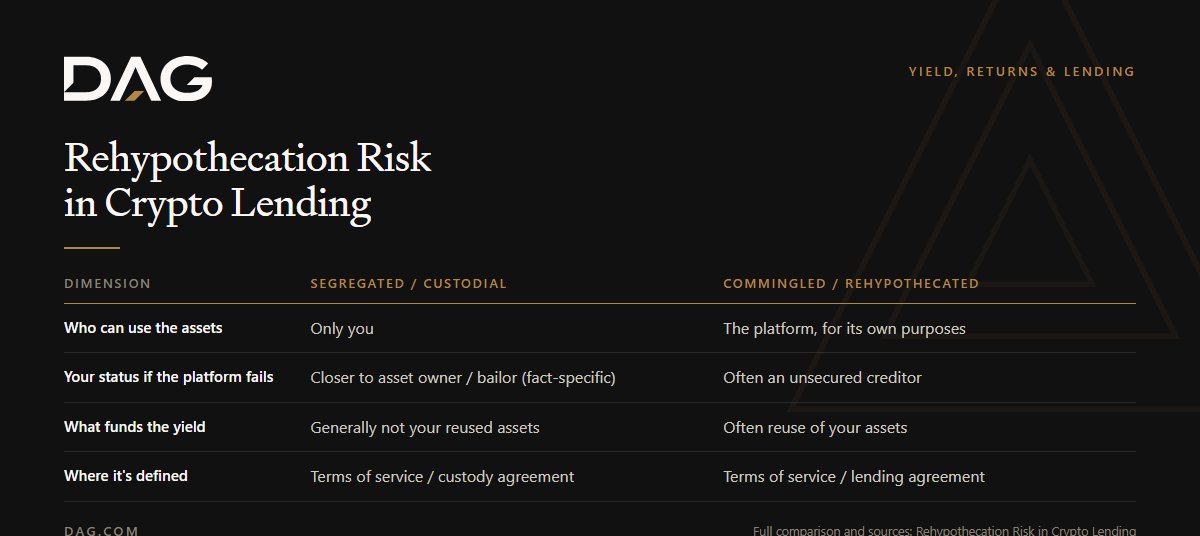
| Dimension | Segregated / custodial | Commingled / rehypothecated |
|---|---|---|
| Who can use the assets | Only you | The platform, for its own purposes |
| Your status if the platform fails | Closer to asset owner / bailor (fact-specific) | Often an unsecured creditor |
| What funds the yield | Generally not your reused assets | Often reuse of your assets |
| Where it's defined | Terms of service / custody agreement | Terms of service / lending agreement |
These are general descriptions; the actual outcome turns on the specific contract, the platform's structure, and how a court characterizes the relationship. Read the terms and have them reviewed.
Why Does This Matter? Post-Failure Outcomes
Rehypothecation becomes concrete when a platform fails. Several large centralized crypto lenders and trading platforms entered bankruptcy in 2022. Across these proceedings, two themes recurred and are worth understanding generally:
- Ownership was contested. Courts and creditors examined whether deposited assets belonged to customers or to the bankruptcy estate, and the answer often turned on the account type and the terms of service. Customers in interest-bearing or lending programs sometimes found their assets treated as part of the estate.
- Recovery was uncertain, partial, and slow. Where customers were treated as unsecured creditors, they generally stood in line behind secured claims, recoveries were often a fraction of deposits, and distributions took a long time. None of this resembled FDIC-insured deposit protection, which does not apply to these platforms.
These are general, historical observations, not legal conclusions about any specific case or a prediction of any future outcome. The lesson is structural: the time to understand reuse is before depositing, not during a bankruptcy.
How Do You Assess Rehypothecation Risk Before Depositing?
- Read the terms of service for title and reuse language. Look for whether title transfers to the platform, whether it may lend, pledge, or rehypothecate, and whether assets are segregated. Ambiguity is itself a risk.
- Ask where the yield comes from. If a platform pays yield, the assets are usually being put to work somewhere. A yield with no clear, disclosed source is a flag, a point the stablecoin yield risk spectrum makes for stablecoins specifically.
- Distinguish lending from custody. Earning yield generally requires giving up some control; pure custody generally does not. Compare the trade-offs in crypto custody options compared and what generally happens in what happens if a crypto custodian fails.
- For entities and fiduciaries, document the analysis. A trustee or LLC manager weighing a yield platform should record the reuse terms and the counterparty risk as part of prudent process; entity yield also flows through tax structure, covered in crypto yield in a trust or entity.
For the broader borrowing-and-yield picture, see the crypto lending and yield hub.
Related Questions
Is rehypothecation the same as liquidation risk?
No. Liquidation risk is your position being closed because the collateral's price fell below a threshold, it is about price and loan-to-value. Rehypothecation risk is your collateral being reused by the platform and possibly unavailable if the platform fails, it is about the lender's solvency and how your assets are held. You can be exposed to one without the other.
How do I know if a lender reuses my collateral?
Read the terms of service and any custody or lending agreement. Look for language about title transfer, the platform's right to lend, pledge, or rehypothecate assets, and whether assets are segregated or commingled. If a platform pays yield, assume the assets are being used somewhere unless the terms clearly say otherwise, and have the agreement reviewed.
What happened to customer collateral when crypto lenders failed?
In the widely reported 2022 bankruptcies of several centralized crypto lenders, ownership of deposited assets was contested, customers in interest-bearing programs were sometimes treated as unsecured creditors of the estate, and recoveries were often partial and slow. These platforms were not FDIC-insured. Outcomes were fact-specific and are not a prediction for any other platform.
Can rehypothecation risk be avoided entirely?
You can reduce it by using genuinely segregated custody rather than yield or lending programs that reuse assets, and by reading the terms before depositing. But earning yield generally requires giving up some control, so the trade-off is real: lower reuse risk usually means lower or no yield. There is no arrangement that pays yield with zero counterparty risk.
Sources
- Investor.gov: Crypto assets
- CFPB: Risks to consumers posed by crypto-asset products
Compliance Note
This article is for educational purposes only and does not constitute legal, tax, investment, or financial advice, and is not a recommendation of or about any platform. Crypto lending and yield programs carry material risk, including rehypothecation and reuse of collateral, counterparty insolvency, and forced liquidation, and assets at these platforms are generally not FDIC- or SIPC-insured; no return is guaranteed and you can lose some or all of your assets. References to past platform failures (the centralized crypto lenders that failed in 2022, referenced above) are historical, general, and fact-specific; they are not legal conclusions about any case or a prediction of any future outcome. Whether your assets are segregated or reusable depends on the specific contract and how a court would characterize it; have any agreement reviewed by qualified counsel before depositing.
DAG Wealth is a brand of Digital Ascension Group. Investment advisory services are offered through DAG Wealth, an SEC-registered investment adviser. Registration does not imply a certain level of skill or training. Consult a qualified legal, tax, and financial professional before acting on any information in this article.