
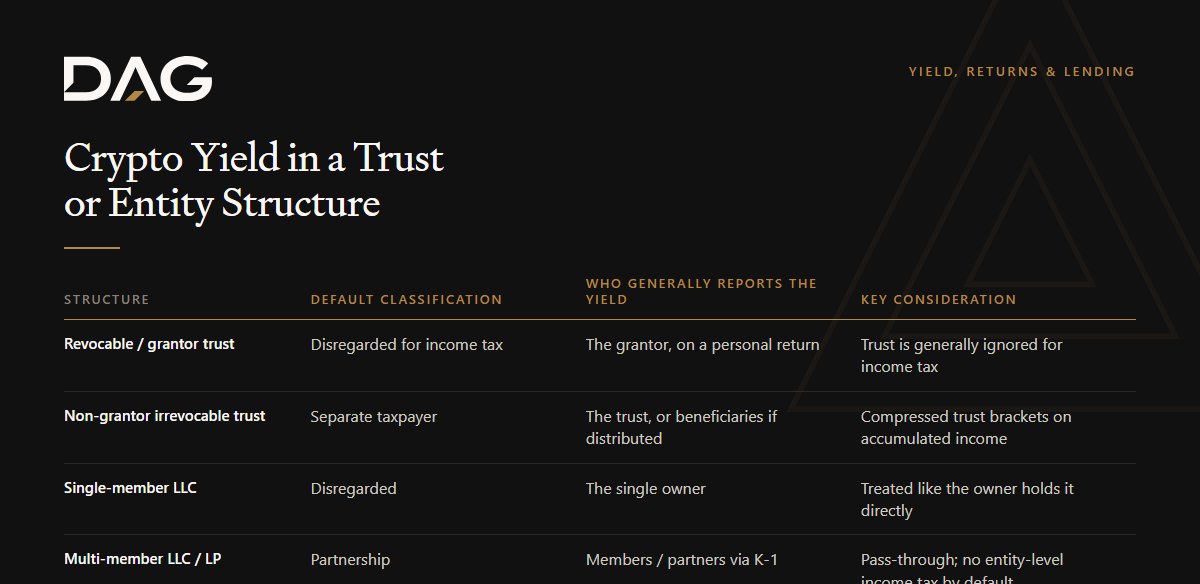
Crypto yield in a trust or entity is taxed according to how the structure is classified, not according to the fact that crypto produced it. Staking and lending rewards earned inside an LLC, LP, or irrevocable trust generally keep their character as ordinary income and flow to whoever the tax rules treat as the owner: the grantor of a grantor trust, the members of a pass-through entity, or the trust itself when income is accumulated. The vehicle changes who reports and when, not whether yield is taxable.
How Is Yield Earned Inside a Trust or Entity Taxed?
Yield from staking, lending, or protocol participation is generally treated as ordinary income at fair market value when the recipient gains control of it, the same baseline that applies to an individual. Putting that activity inside a trust, LLC, or limited partnership does not erase the income; it routes it through the structure's tax classification. The questions that decide the outcome are: who is treated as the tax owner, is the entity a pass-through or a taxpayer in its own right, and does any special rule (such as the unrelated-business-taxable-income rules for tax-exempt holders) apply.
This page is about how yield flows through a structure for tax purposes. For the reporting mechanics of the rewards themselves, see crypto staking tax reporting. For whether the structure is even permitted to earn yield, see can a trust receive staking rewards.
Who Reports the Yield? Structure by Structure
Grantor trust (often a revocable living trust)
If a trust is a grantor trust for income-tax purposes, the IRS generally disregards it as a separate taxpayer and attributes its income to the grantor. Staking or lending yield earned inside the trust is then reported on the grantor's personal return as if the trust did not exist. Many revocable living trusts are grantor trusts, and some irrevocable trusts are intentionally drafted as grantor trusts.
Non-grantor irrevocable trust
A non-grantor trust is a separate taxpayer. Yield it earns is generally taxed to the trust unless the income is distributed to beneficiaries, in which case it may be carried out to them and taxed at their rates (the trust takes a corresponding distribution deduction). Trusts reach the top federal income-tax bracket at a much lower income level than individuals, so accumulated yield inside a non-grantor trust can be taxed at high rates. Whether to distribute or accumulate is a planning decision for the trustee and tax advisor.
LLC or limited partnership (pass-through)
A multi-member LLC and an LP are generally taxed as partnerships by default, and a single-member LLC is generally disregarded. In both pass-through cases, yield earned by the entity is generally not taxed at the entity level; it passes through to the members or partners, who report their share on their own returns. The entity files an information return and issues a Schedule K-1. Electing corporate (including S-corporation) treatment changes this analysis and should be modeled before acting.
Tax-exempt holder and the UBTI trap
If the owner is tax-exempt (for example, a self-directed IRA or a charitable entity), yield that looks like an active trade or business, or that involves debt-financed activity, can generate unrelated business taxable income (UBTI) that is taxable even to the exempt holder. Whether staking or lending rises to that level is fact-specific and unsettled in places. Tax-exempt holders should get specific advice before assuming yield is shielded.
Comparison: Where Yield Lands by Structure
| Structure | Default classification | Who generally reports the yield | Key consideration |
|---|---|---|---|
| Revocable / grantor trust | Disregarded for income tax | The grantor, on a personal return | Trust is generally ignored for income tax |
| Non-grantor irrevocable trust | Separate taxpayer | The trust, or beneficiaries if distributed | Compressed trust brackets on accumulated income |
| Single-member LLC | Disregarded | The single owner | Treated like the owner holds it directly |
| Multi-member LLC / LP | Partnership | Members / partners via K-1 | Pass-through; no entity-level income tax by default |
| Tax-exempt owner (e.g., IRA) | Per exempt rules | The exempt holder, if UBTI applies | UBTI / debt-financed-income exposure |
These are general default positions, not a determination for your facts. Classification can be changed by election, by trust drafting, or by how the entity operates, and state law adds further variation. Confirm with a qualified tax professional and the entity's or trust's governing documents.
What Changes When Yield Is Earned Inside a Structure?
- Authority to act. A trustee or LLC manager must have authority to stake, lend, or use a protocol; the governing document may restrict it. Confirm permission before the structure earns yield, see whether a Wyoming LLC can stake crypto and whether a trust can participate in DeFi.
- Recordkeeping at the entity level. Each reward event has a date and a fair market value that the entity, not just the individual, must capture for its return and K-1s. Entity-level reporting is covered in crypto tax reporting for trusts and crypto tax reporting for LLCs.
- Fiduciary duty. A trustee earning yield takes on prudence and risk-management duties for a volatile, often uninsured activity. Variable returns, liquidation in lending, smart-contract failure, and counterparty default all sit on the fiduciary.
- Choice of vehicle. Whether crypto and its yield belong in a trust, an LLC, or held personally is a structural decision in itself, see crypto LLC vs trust and should crypto be held personally, in an LLC, or in a trust.
For where yield and lending sit in the overall plan, see the crypto lending and yield hub.
Related Questions
Does putting crypto in an LLC or trust make the yield tax-free?
No. The structure changes who reports the income and at what rate, not whether it is taxable. Grantor trusts and disregarded single-member LLCs push the income to the owner; pass-through LLCs and LPs send it to members via K-1; non-grantor trusts are taxed directly or distribute to beneficiaries. There is no general structure that makes staking or lending yield disappear.
What is UBTI and why does it matter for yield?
Unrelated business taxable income is income a tax-exempt holder (such as an IRA) earns from an active business or from debt-financed activity, and it can be taxable even though the holder is otherwise exempt. Whether staking or lending yield counts as UBTI is fact-specific and not fully settled. A tax-exempt holder should get advice before assuming the structure shelters the yield.
Are non-grantor trusts a bad place to accumulate crypto yield?
Not necessarily, but the compressed trust tax brackets mean accumulated ordinary income reaches the top federal rate at a low threshold. Distributing income to beneficiaries can shift it to their (often lower) rates, but that is a trustee decision balancing tax, the trust terms, and the beneficiaries' situations. Model it with a tax professional.
Can an irrevocable trust legally earn staking rewards?
It depends on the trust document and applicable law. The trustee needs authority to hold the asset and to engage in the yield activity, and must weigh fiduciary duties around a volatile, often uninsured strategy. See can a trust receive staking rewards and confirm with trust counsel before acting.
Sources
- IRS: Digital assets
- IRS Revenue Ruling 2023-14 (staking rewards as income on receipt)
- IRS guidance on grantor trusts and the trust income-tax rules (Internal Revenue Code §§671–679 and Form 1041 instructions)- IRS rules on unrelated business taxable income (UBTI), including Publication 598---
Compliance Note
This article is for educational purposes only and does not constitute legal, tax, investment, or financial advice. How crypto yield is taxed inside a trust, LLC, or LP is general and fact-specific: the outcome depends on the entity's classification, the trust's drafting, the use and source of the yield, the holder's tax status, and the jurisdiction, and the law and IRS guidance continue to evolve. Staking and lending carry material risk, variable returns, liquidation, smart-contract failure, and counterparty default, and are generally not FDIC- or SIPC-insured; no yield is guaranteed. Trust drafting, entity formation, and tax-return preparation are professional services that Digital Ascension Group coordinates with qualified attorneys and CPAs, not advice the firm provides directly.
DAG Wealth is a brand of Digital Ascension Group. Investment advisory services are offered through DAG Wealth, an SEC-registered investment adviser. Registration does not imply a certain level of skill or training. Consult a qualified attorney and CPA about your specific structure before acting on any information in this article.