
Crypto lending and yield cover two related questions: how to borrow against digital assets without selling them, and how to earn income on holdings through staking, lending, or other on-chain activity. Both routes carry meaningful risk, variable returns, liquidation, smart-contract failure, and counterparty default, and none is guaranteed or insured the way a bank deposit is. The right approach depends on the asset, custody model, and tax facts, so any plan should be reviewed with qualified professionals.
What Crypto Lending and Yield Is
Crypto lending and yield describe the strategies an investor uses to generate liquidity or income from digital assets. Borrowing means pledging crypto as collateral for a loan, which is generally not a taxable sale but can trigger forced liquidation if the collateral falls in value. Yield means earning a return through staking, lending, or protocol participation, where rewards are variable, not promised, and generally taxed as ordinary income when received. For how these fit into a broader plan, see what is crypto wealth management and the Crypto Wealth Management Hub.
Core Questions
- Can I borrow against my crypto without selling it?
- What is a responsible loan-to-value ratio, and when does liquidation happen?
- How is borrowing taxed compared with selling?
- What yield can I realistically expect from staking or lending, and is it guaranteed?
- How are staking and lending rewards taxed?
- What counterparty and smart-contract risks come with DeFi versus centralized platforms?
- Is any of this protected by FDIC or SIPC insurance?
Borrowing Against Crypto
Borrowing lets a holder access cash without triggering a sale, but the loan is secured by collateral that can be liquidated if its value drops. Start with the trade-off between the two paths in bitcoin-backed loan vs selling bitcoin and the institutional overview in crypto-backed loans for high-net-worth investors. For asset-specific mechanics, see borrowing against ETH: rates and platforms, how to borrow against Bitcoin for passive income, and the step-by-step walkthrough in how do I borrow against my crypto as collateral without selling it. Specific use cases are covered in crypto loans using XRP as collateral for real estate, borrowing against crypto for a real estate purchase, and using crypto collateral for business loans.
LTV, Liquidation, and Loan Risk
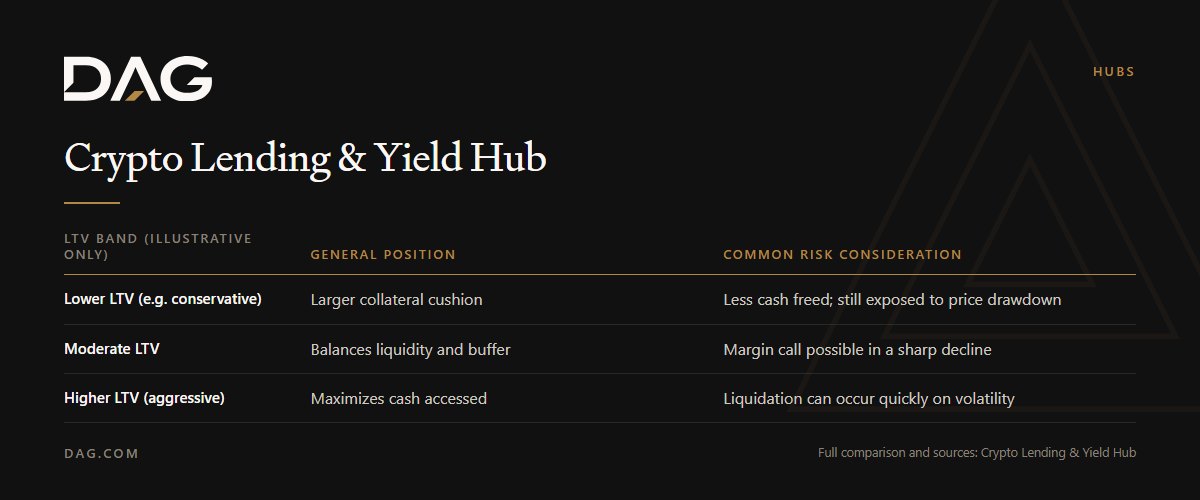
The single most important variable in a crypto-backed loan is the loan-to-value (LTV) ratio, because it determines how far prices can fall before a margin call or forced liquidation. Work through what counts as a responsible band in what is a responsible loan-to-value (LTV) ratio for borrowing against my crypto, and plan for ongoing carrying costs in how do I cover interest payments on a crypto-backed loan. Borrowing is generally not a sale, but a liquidation forced by falling collateral usually is a taxable disposition, a distinction these spokes return to repeatedly.
| LTV band (illustrative only) | General position | Common risk consideration |
|---|---|---|
| Lower LTV (e.g. conservative) | Larger collateral cushion | Less cash freed; still exposed to price drawdown |
| Moderate LTV | Balances liquidity and buffer | Margin call possible in a sharp decline |
| Higher LTV (aggressive) | Maximizes cash accessed | Liquidation can occur quickly on volatility |
These bands are illustrative, not a recommendation; actual thresholds, margin-call triggers, and liquidation mechanics vary by platform and asset.
Earning Yield: Staking and Lending
Yield strategies range from staking and delegation to lending assets in custody, and returns are always variable rather than fixed. Begin with the conservative framing in the safest way to earn yield on BTC, XRP, and ETH without selling and the income angle in generating monthly income from crypto without selling. For asset-specific approaches, see yield options for XRP and other assets held in custody, what yield can I expect from XRP in institutional custody, delegating FTSO for rewards on Flare, yield strategies for XDC, Songbird, and Flare, and generating yield on HBAR without selling. Stablecoin yield deserves its own scrutiny, because a token's advertised return rarely signals its real risk: the stablecoin yield risk spectrum separates fiat-reserve coins, tokenized-Treasury products, and algorithmic designs by backing and depeg history. Any quoted APY is a variable, point-in-time figure, not a promised return.
DeFi vs Centralized: Counterparty Risk
Where yield comes from matters as much as how much it is. DeFi protocols carry smart-contract and protocol risk; centralized platforms carry counterparty and insolvency risk; neither is FDIC- or SIPC-insured. Compare these failure modes directly in counterparty risks with DeFi lending protocols versus centralized crypto lenders, then go protocol-by-protocol in the DeFi lending protocol comparison of the major lending protocols. A counterparty risk specific to centralized lenders is what they do with your deposit once it arrives: the rehypothecation risk in crypto lending page covers whether collateral is segregated or reused, and what past platform failures showed about recovering it. For how entities engage these venues, see whether a trust can participate in DeFi and whether a trust can receive staking rewards, and contrast staking routes in spot Ethereum ETF vs staking Ethereum.
Tax Treatment of Yield and Income
Yield is not free money, and its tax treatment is easy to underestimate. Staking and lending rewards are generally taxed as ordinary income at fair market value when received, with a later capital gain or loss on disposal. See crypto staking tax reporting for reward reporting mechanics. Borrowing has its own tax angle: loan proceeds are generally not income, but liquidation is a disposition and interest deductibility depends on use, covered in crypto loan tax treatment. When yield is earned inside a structure rather than personally, the vehicle changes who reports it and at what rate: crypto yield in a trust or entity walks through grantor-trust, pass-through, and UBTI treatment. A common edge case is using yield for a defined purpose, such as endowing a scholarship fund with yield generated from stablecoins, which layers entity and charitable-tax questions on top. Confirm any treatment with a qualified tax professional, since facts and rules change.
Related Questions
Is borrowing against my crypto a taxable event?
Generally, no, pledging crypto as collateral for a loan is not itself a sale, so it usually does not trigger a taxable disposition. However, if the collateral falls and the lender liquidates it, that forced sale is generally taxable. Confirm the specifics with a qualified tax professional.
Is crypto yield guaranteed or insured?
No. Staking, lending, and DeFi returns are variable and not promised, and the underlying platforms are generally not covered by FDIC or SIPC insurance. Rewards depend on protocol conditions, platform solvency, and market factors, all of which can change or fail.
How is staking or lending income taxed?
The IRS generally treats staking and lending rewards as ordinary income at their fair market value when you gain control of them, with a separate capital gain or loss when you later sell. Recordkeeping at the time of receipt matters. Consult a qualified tax professional.
Sources
- IRS: Digital assets
- IRS Revenue Ruling 2023-14 (staking rewards)
- CFPB: Risks to consumers posed by crypto-asset products
- Investor.gov: Crypto assets
Compliance Note
This hub is educational and does not provide legal, tax, investment, lending, or custody advice. Crypto lending and yield strategies carry significant risk, including variable returns, liquidation, margin calls, smart-contract failure, and counterparty default, and are generally not FDIC- or SIPC-insured. No return is guaranteed. Strategies should be reviewed with qualified professionals before acting.