
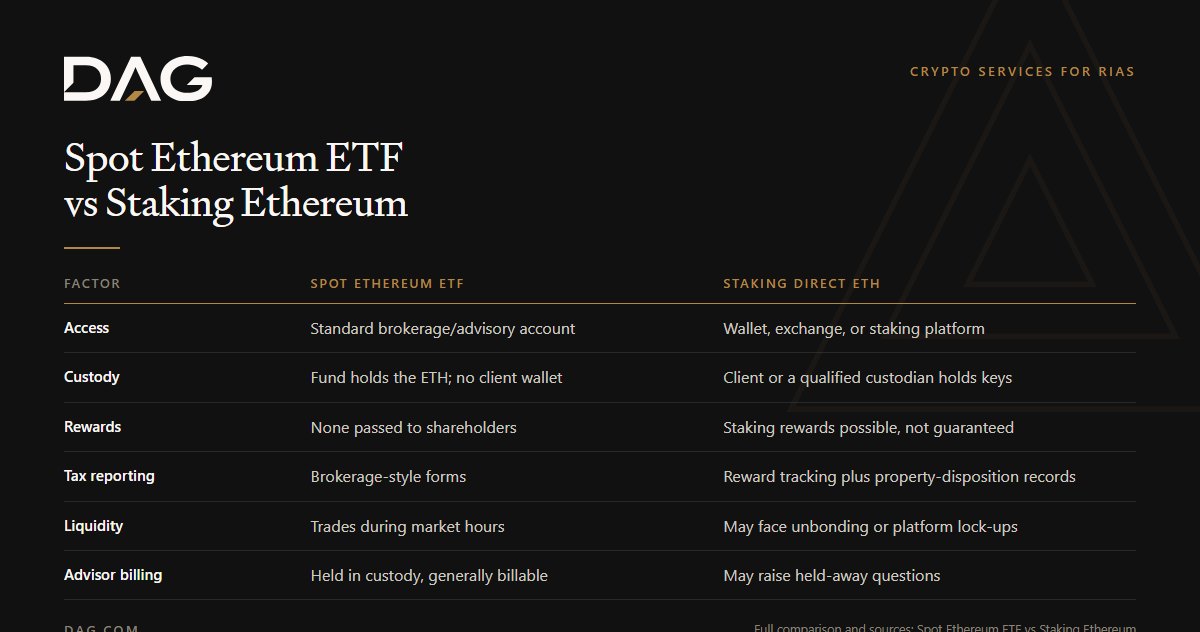
In a spot Ethereum ETF vs staking Ethereum comparison, a spot ETF delivers ETH price exposure through a familiar fund wrapper with brokerage-style reporting, while staking direct ETH can generate rewards but adds custody, validator, liquidity, and tax-record obligations. Neither path removes market, custody, or tax risk, and the right choice depends on each client's facts.
A spot Ethereum ETF is an exchange-traded fund that holds ether and gives investors price exposure without their owning the underlying token directly. Staking Ethereum means holding ETH and committing it to help validate the network, which can produce rewards but requires controlling or selecting a validator and managing the resulting tax records. The decision is not only about potential returns; it also turns on custody, tax reporting, operational risk, liquidity, and advisor compliance, themes covered across the Crypto Wealth Management Hub.
Comparison at a Glance
| Factor | Spot Ethereum ETF | Staking Direct ETH |
|---|---|---|
| Access | Standard brokerage/advisory account | Wallet, exchange, or staking platform |
| Custody | Fund holds the ETH; no client wallet | Client or a qualified custodian holds keys |
| Rewards | None passed to shareholders | Staking rewards possible, not guaranteed |
| Tax reporting | Brokerage-style forms | Reward tracking plus property-disposition records |
| Liquidity | Trades during market hours | May face unbonding or platform lock-ups |
| Advisor billing | Held in custody, generally billable | May raise held-away questions |
This mirrors the broader spot Bitcoin ETF vs direct Bitcoin trade-off, where the wrapper trades operational features for simplicity.
Spot Ethereum ETF
An ETF generally fits existing brokerage and advisory workflows and can simplify reporting compared with direct wallets. The trade-off is that shareholders typically do not receive staking rewards and do not control the underlying ether. Fund disclosures, expense ratios, and the sponsor's custody arrangements should be reviewed before any recommendation. For RIAs weighing exchange-traded crypto exposure generally, see Can RIAs Recommend Bitcoin ETFs?.
Staking Ethereum
Staking can generate rewards, but it introduces protocol, validator, custody, liquidity, and tax-record questions. The IRS has issued guidance addressing the timing of income recognition for certain staking rewards, and digital assets are generally treated as property for federal tax purposes. Staked ETH may be subject to lock-up or unbonding periods that affect liquidity, and the party controlling the validator bears operational and slashing risk. None of this implies a guaranteed yield; rewards vary with network conditions. Advisors comparing crypto exposures more broadly may also find the spot Bitcoin ETF vs direct Bitcoin framework useful when mapping ETH staking against a fund wrapper.
Advisor Evaluation Checklist
Use a documented, repeatable process before recommending either structure:
- Confirm whether the client needs price exposure or direct ownership of ETH.
- Assess whether staking is suitable given the client's liquidity needs and risk tolerance.
- Identify who controls the validator or staking provider and what slashing risk applies.
- Verify the custodian can support the chosen structure (SOC 1/SOC 2 reports, segregation of assets).
- Define how rewards will be tracked and reported, including cost basis and disposition records.
- Memorialize the rationale in writing per your crypto documentation standards.
Related Questions
Do spot Ethereum ETF holders earn staking rewards?
Generally no. Most spot ether ETF structures pass through price exposure rather than staking rewards, though product terms vary. Always read the fund's prospectus and current disclosures, and consult a qualified professional, because features can change.
Is staking Ethereum taxable?
The IRS has issued guidance indicating certain staking rewards are includible in income, and digital assets are generally treated as property, so later sales can trigger capital gains or losses. The treatment depends on the facts; consult a qualified tax professional.
Can an RIA bill on a client's staked ETH?
It depends on whether the assets are held away or under the firm's custody and oversight. Held-away crypto raises distinct billing and custody-rule questions, discussed in Can RIAs Bill on Held-Away Crypto?. Confirm your approach with compliance counsel.
Sources
Compliance Note
This article is educational and does not provide legal, tax, compliance, investment, fiduciary, staking, or custody advice. Advisors should review product disclosures and professional guidance. Registration does not imply a certain level of skill or training.