
The most common crypto mistakes for RIAs are advising without defining scope, handling client keys or seed phrases casually, misreading the custody rule, billing on held-away assets without compliance review, weak documentation, conflating product types, thin vendor due diligence, and missing tax and estate handoffs. Each is generally avoidable with a deliberate process.
A "common crypto mistake for RIAs" here means a recurring gap between how a firm actually handles digital assets and what its fiduciary duty, the SEC custody rule, and its own disclosures require. Crypto belongs in an advisory process intentionally, not bolted on after a client asks. For the broader picture, see the Crypto Services for RIAs Hub.
Mistakes to Avoid
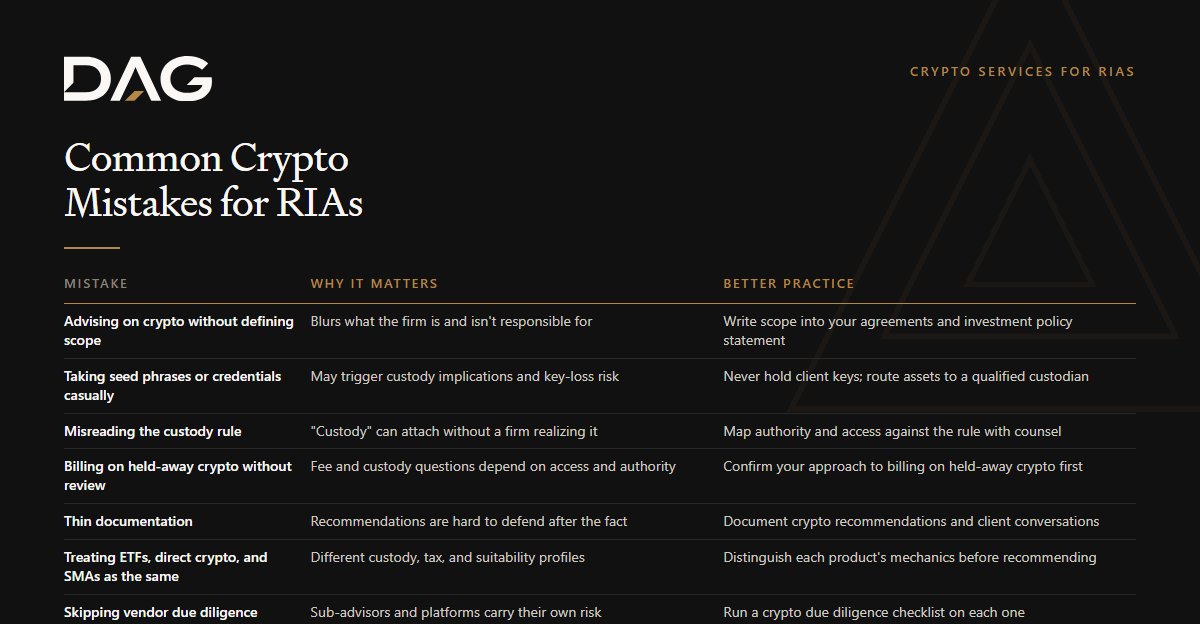
| Mistake | Why it matters | Better practice |
|---|---|---|
| Advising on crypto without defining scope | Blurs what the firm is and isn't responsible for | Write scope into your agreements and investment policy statement |
| Taking seed phrases or credentials casually | May trigger custody implications and key-loss risk | Never hold client keys; route assets to a qualified custodian |
| Misreading the custody rule | "Custody" can attach without a firm realizing it | Map authority and access against the rule with counsel |
| Billing on held-away crypto without review | Fee and custody questions depend on access and authority | Confirm your approach to billing on held-away crypto first |
| Thin documentation | Recommendations are hard to defend after the fact | Document crypto recommendations and client conversations |
| Treating ETFs, direct crypto, and SMAs as the same | Different custody, tax, and suitability profiles | Distinguish each product's mechanics before recommending |
| Skipping vendor due diligence | Sub-advisors and platforms carry their own risk | Run a crypto due diligence checklist on each one |
| Ignoring tax and estate handoffs | The IRS generally treats digital assets as property | Coordinate reporting and estate planning early |
A Better Process
This is a general sequence, not a guarantee; the right approach depends on your firm's facts and registration.
- Define the crypto services you actually offer, and put scope in writing.
- Update Form ADV and client disclosures to match what you do.
- Build discovery questions so you know what each client already holds.
- Document recommendations and the reasoning behind them.
- Confirm custody: use a qualified custodian and review their SOC 1 / SOC 2 reports rather than holding keys yourself.
- Review sub-advisors and platforms on a recurring basis.
- Coordinate with compliance counsel before launch and as rules evolve.
No process removes market, custody, or tax risk; crypto remains volatile, and registration alone does not guarantee skill or a good outcome. The goal is a defensible, repeatable approach.
Related Questions
Does taking a client's seed phrase give an RIA custody?
Possibly. Holding keys or credentials can constitute custody under the SEC custody rule because it generally means access to client assets. Most firms avoid this entirely and rely on a qualified custodian. Confirm the specifics with compliance counsel.
Can an RIA bill on held-away crypto?
It depends on the facts, including how the firm accesses the account and whether that access creates custody. The fee and authority questions are fact-specific, so review them case by case with counsel.
Are a spot Bitcoin ETF and direct crypto the same recommendation?
No. They differ on custody, tax treatment, and suitability, even when the underlying asset overlaps. Treating them interchangeably is a common error; weigh each product's mechanics, and see spot Bitcoin ETF vs direct Bitcoin for a structured comparison.
Sources
- SEC: Custody rule compliance guide
- SEC: Commission Interpretation Regarding Standard of Conduct for Investment Advisers
- SEC: Investment Adviser Public Disclosure
Compliance Note
This article is educational and does not provide legal, compliance, tax, investment, fiduciary, or custody advice. RIAs should consult compliance counsel before offering crypto services. Registration does not imply a certain level of skill or training.