
A crypto sub-advisor for RIAs is a third-party investment adviser an RIA engages to handle digital asset research, portfolio construction, model management, custody coordination, and reporting for client accounts. The RIA keeps the primary client relationship and fiduciary duty, and remains responsible for evaluating the sub-advisor's scope, legal status, fees, conflicts, and custody process.
What a Crypto Sub-Advisor Is
In a sub-advisory arrangement, the RIA stays the client-facing fiduciary while delegating specialized digital asset work to a registered adviser with that expertise. The structure parallels traditional sub-advisory: the lead adviser oversees suitability, disclosure, and the overall relationship, and the sub-advisor supplies the asset-class capability. This differs from a pure technology vendor, see crypto sub-advisory for the underlying model and crypto outsourcing for RIAs for how delegation choices fit a firm's operations.
What a Crypto Sub-Advisor May Provide
- Digital asset research.
- Portfolio construction.
- Model management.
- Trade recommendations or discretionary management.
- Custody workflow support.
- Advisor education.
- Client reporting support.
- Due diligence documentation.
The exact scope depends on the engagement and should be documented in writing. A firm comparing in-house management against delegation can weigh these capabilities alongside the time and compliance load of building them internally.
RIA Due Diligence Questions
Use a consistent checklist so each prospective sub-advisor is evaluated against the same standard. A structured crypto due diligence checklist for RIAs can hold the documentation:
- Is the sub-advisor registered as an investment adviser, and does its Form ADV (Parts 1 and 2) describe digital asset services? Registration alone does not guarantee skill or results, so review the substance, not just the status.
- Who holds discretion over client accounts, and how is that delegation papered?
- How are client assets custodied, through a qualified custodian, and under what controls (cold storage, multi-sig, SOC 1/SOC 2 reporting)?
- Are fees, compensation arrangements, and conflicts of interest disclosed?
- What client reporting is available, and does it support tax reconciliation (for example, Form 1099-DA and cost-basis tracking)?
- How does the provider handle staking, forks, airdrops, or unsupported assets?
- What compliance materials are provided to the lead RIA?
Coordinating custody is usually the most consequential item; qualified custody for RIAs managing digital assets covers the SEC custody rule and qualified-custodian expectations in more depth.
Sub-Advisor vs Platform
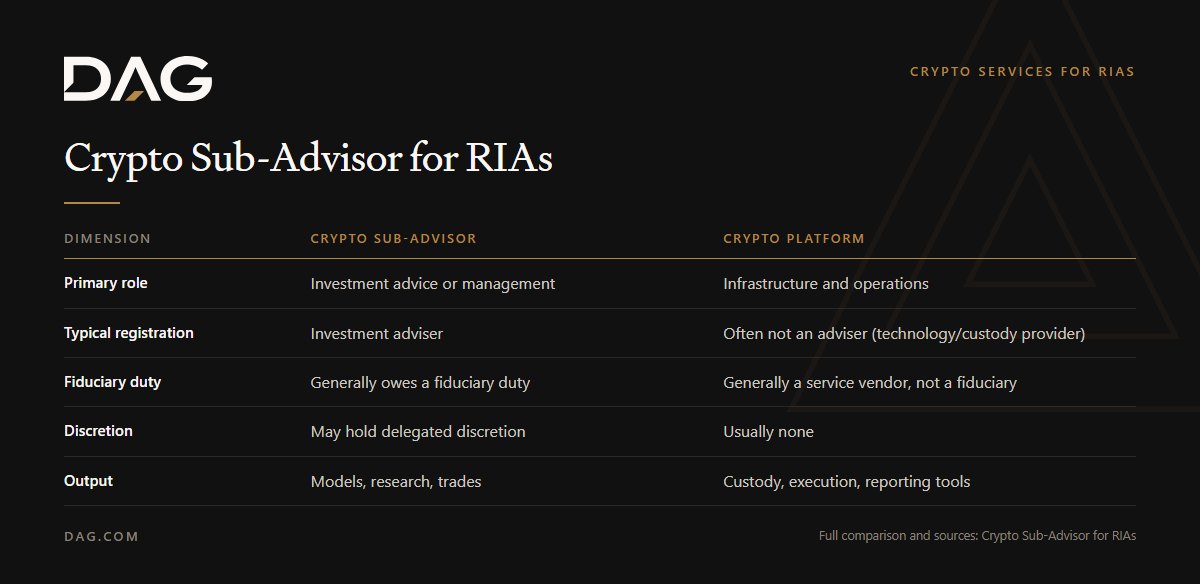
These are related but distinct roles. A sub-advisor delivers investment advice or management as a fiduciary; a platform provides infrastructure such as custody, trading, reporting, or account administration. Many firms use both, a sub-advisor for the advice layer and a platform for execution and records.
| Dimension | Crypto Sub-Advisor | Crypto Platform |
|---|---|---|
| Primary role | Investment advice or management | Infrastructure and operations |
| Typical registration | Investment adviser | Often not an adviser (technology/custody provider) |
| Fiduciary duty | Generally owes a fiduciary duty | Generally a service vendor, not a fiduciary |
| Discretion | May hold delegated discretion | Usually none |
| Output | Models, research, trades | Custody, execution, reporting tools |
Choosing between them depends on what the RIA already has in place; some firms compare a sub-advisor to a self-directed crypto advisor platform before deciding.
Related Questions
Does using a crypto sub-advisor remove the RIA's fiduciary duty?
No. Delegating digital asset work does not transfer the lead RIA's fiduciary duty to clients. The RIA generally remains responsible for suitability, oversight, and disclosure, and should document its supervision of the sub-advisor. Consult compliance counsel on how delegation is reflected in your agreements and Form ADV.
Can a crypto sub-advisor take custody of client assets?
That depends on the facts and the structure. Custody questions turn on the SEC custody rule and whether a qualified custodian holds the assets. Many arrangements keep assets with a separate qualified custodian rather than the sub-advisor. Confirm the specific custody chain and controls before engaging, and consult a qualified professional.
How is a crypto sub-advisor different from a Bitcoin ETF allocation?
A sub-advisor manages a strategy across assets and may include direct holdings, while an ETF is a single product allocation. The trade-offs differ on custody, tax, and control; see spot Bitcoin ETF vs direct Bitcoin for advisors. No structure removes market, custody, or tax risk.
This page sits within the Crypto Services for RIAs Hub, which collects related guidance for advisory firms evaluating digital asset support.
Sources
Compliance Note
This article is educational and does not provide legal, compliance, tax, investment, or custody advice. RIAs should consult compliance counsel before engaging a crypto sub-advisor. Registration does not imply a certain level of skill or training.