
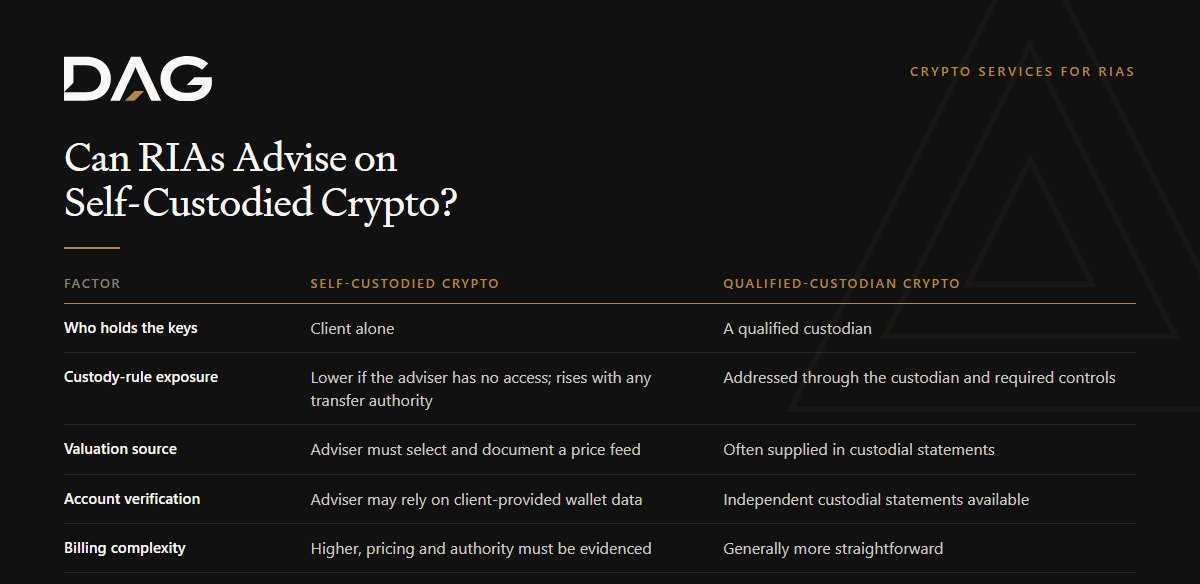
An RIA can generally advise on self-custodied crypto, but only after the firm reviews custody, valuation, billing, supervision, disclosures, documentation, and the client's exclusive control of the wallet. Self-custody sharpens these operational boundaries because the adviser typically gives advice on an asset it cannot move, so the engagement's scope must be defined and documented.
Short Answer
RIAs may be able to advise on self-custodied crypto, but the firm must review custody implications, valuation, billing, supervision, disclosures, documentation, client authority, and whether the advice fits the firm's compliance program. Self-custody makes the operational boundaries especially important.
What "Self-Custodied Crypto" Means Here
Self-custodied crypto is digital assets the client holds directly, typically in a hardware or software wallet where the client alone controls the private keys or seed phrase. No qualified custodian sits between the client and the asset, which is the distinction that drives most of the analysis below. Because the adviser holds no keys and cannot transfer the assets, the advice is given on holdings outside the firm's control, and that fact shapes custody, billing, and supervision answers. This sits inside the broader question of whether financial advisors can recommend crypto at all and connects up to the firm's crypto services for RIAs.
Why This Matters
Self-custodied crypto may be material to a client's net worth, but the advisor may not control the wallet. The firm needs to decide whether the asset is planning-only, advised-on, billed, included in reports, or outside scope. Getting that boundary wrong is one of the common crypto mistakes RIAs make, because the SEC custody rule turns on whether the adviser has authority to access or move client assets, not on whether the adviser can see them.
How It Works
The RIA should review:
- Exclusive control. Confirm the client retains sole control of keys and seed phrase; document that the adviser holds no withdrawal authority.
- Adviser access. Check whether the firm has any ability, credentials, multi-sig key, or transfer rights, to move assets, which can implicate the custody rule.
- Discretion. Decide whether advice is discretionary or non-discretionary, and reflect that in the advisory agreement.
- Valuation. Set a consistent pricing source and timestamp convention, since crypto prices vary across venues.
- Billing. Determine whether fees include the assets; if so, see how RIAs handle billing on held-away crypto.
- Documentation. Record how recommendations are made and the basis for them.
- Tax records. Coordinate cost-basis and disposition records; the IRS generally treats digital assets as property, and Form 1099-DA reporting is being phased in.
- Risk disclosures. Disclose market, custody, key-loss, and tax risks in plain terms.
Evidence Standard
This article identifies issues and does not provide compliance advice for any specific RIA.
Self-Custody vs. Qualified-Custodian Crypto
The table below contrasts the two arrangements on the points that usually decide scope. It describes general distinctions, not the rules for any one firm.
| Factor | Self-custodied crypto | Qualified-custodian crypto |
|---|---|---|
| Who holds the keys | Client alone | A qualified custodian |
| Custody-rule exposure | Lower if the adviser has no access; rises with any transfer authority | Addressed through the custodian and required controls |
| Valuation source | Adviser must select and document a price feed | Often supplied in custodial statements |
| Account verification | Adviser may rely on client-provided wallet data | Independent custodial statements available |
| Billing complexity | Higher, pricing and authority must be evidenced | Generally more straightforward |
For the standards a custodian should meet, see qualified custody for RIAs managing digital assets.
When It May Help
- Clients hold crypto in personal wallets.
- Advisors want to include crypto in planning.
- The firm is evaluating held-away reporting.
- Clients ask for allocation advice.
- Compliance needs a policy framework.
When It May Not Be Enough
Self-custody can create complicated custody and supervision questions. The firm should consult compliance counsel before billing on or taking discretion over assets it cannot independently verify. No policy framework removes market, custody, or tax risk; it only defines how the firm manages and discloses that risk.
Related Questions
Does seeing a wallet address create custody?
Viewing public, on-chain information is generally different from having authority to move assets, but the facts control. If the firm holds credentials, a key, or transfer rights, custody analysis changes, consult compliance counsel.
Can an RIA bill on self-custodied crypto?
Possibly, but billing raises valuation, disclosure, custody, and supervision issues that should be resolved first. The mechanics overlap heavily with billing on held-away crypto.
Should advisors hold seed phrases?
Generally this is high risk and can itself create custody and security concerns, because holding the seed phrase is functionally holding the asset. Most firms avoid it; document the decision either way.
How should a firm document advice on assets it cannot control?
Generally, write down the scope, the recommendation, the basis for it, and what the firm does not control. See how RIAs should document crypto recommendations for a fuller approach.
Bottom Line
RIAs can discuss self-custodied crypto only with clear boundaries. The firm should define what it advises on, what it does not control, and how the process is documented. Registration as an investment adviser does not by itself guarantee skill or a particular result.
Sources
Compliance Note
This article is for general educational purposes and is not legal, compliance, tax, custody, or investment advice.