
Crypto model portfolios for financial advisors are predesigned digital asset allocation frameworks that an RIA can apply across client accounts to make exposure consistent and documentable. They standardize allocation, eligible assets, and rebalancing, but they do not remove the need for custody review, suitability analysis, risk disclosure, tax coordination, and ongoing monitoring.
What a Crypto Model Portfolio Is
A crypto model portfolio is a defined target allocation to digital assets, paired with rules for which assets or products are eligible, how the position is rebalanced, and what risk limits apply. The model is guidance the firm maintains; it is distinct from an account-level implementation such as a crypto SMA, which holds and trades the assets inside a specific client account.
Why This Matters
Advisors often face client demand for crypto before they have an internal investment process. A model portfolio can help define approved exposure, but digital assets are not the same as adding another equity sleeve. Crypto introduces custody, trading, valuation, tax, and volatility issues that a documented framework has to address rather than assume away. These crypto model portfolios sit alongside the broader set of crypto services for RIAs.
How It Works
A crypto model typically defines:
- Target digital asset allocation and the role it plays in the overall portfolio.
- Eligible assets or products (for example, direct Bitcoin and Ethereum, or spot ETFs).
- Rebalancing bands and the trigger for acting on them.
- Risk limits, including a maximum portfolio weight.
- Custody requirements, typically a qualified custodian under the SEC custody rule, with SOC 1/SOC 2 review.
- Tax and reporting workflow, including cost-basis tracking and Form 1099-DA handling.
- Client education materials and risk disclosures.
- Investment committee review cadence.
Model vs. SMA vs. ETF
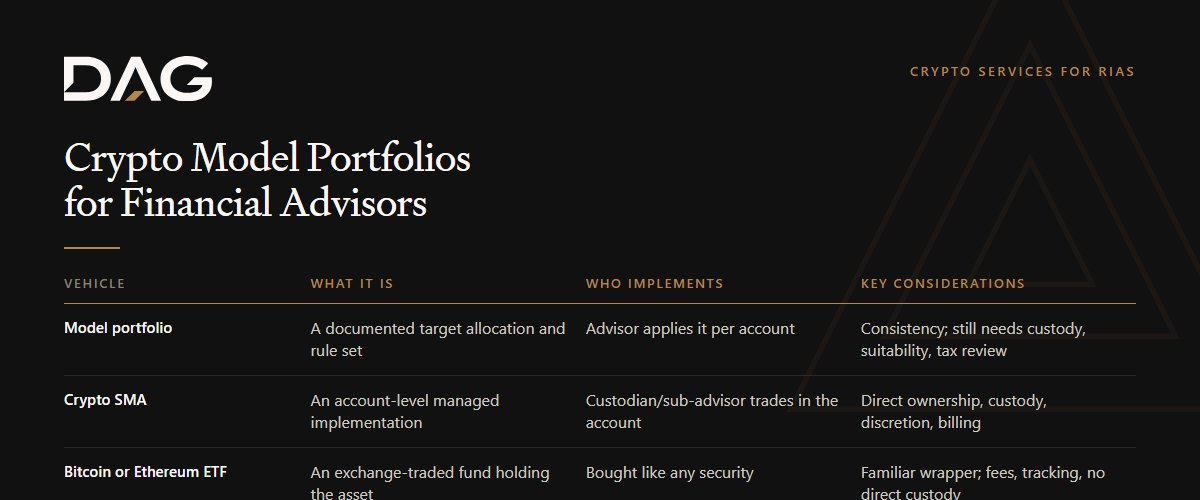
| Vehicle | What it is | Who implements | Key considerations |
|---|---|---|---|
| Model portfolio | A documented target allocation and rule set | Advisor applies it per account | Consistency; still needs custody, suitability, tax review |
| Crypto SMA | An account-level managed implementation | Custodian/sub-advisor trades in the account | Direct ownership, custody, discretion, billing |
| Bitcoin or Ethereum ETF | An exchange-traded fund holding the asset | Bought like any security | Familiar wrapper; fees, tracking, no direct custody |
Choosing a vehicle changes implementation, not the underlying allocation, risk, tax, or client-fit questions.
Evidence Standard
This article is a general framework and does not recommend any model portfolio or claim performance results. Naming a product or provider is not an endorsement, and a comparison here does not imply any vehicle is superior or any competitor is deficient.
When It May Help
- An RIA wants a repeatable crypto allocation process.
- Clients ask about Bitcoin, Ethereum, or broader digital assets.
- The firm wants to avoid one-off allocation decisions.
- Investment committees need a documented framework, which supports documenting crypto recommendations.
- Advisors need client-facing education.
When It May Not Be Enough
A model portfolio is not a compliance program. Advisors still need to review custody, discretion, billing, suitability or fiduciary process, disclosures, conflicts, and supervision, much of which belongs in a crypto compliance checklist. No model removes market, custody, or tax risk; crypto carries no guaranteed yield, no stable peg, and no FDIC or SIPC coverage.
Related Questions
Are crypto model portfolios managed accounts?
Not necessarily. A model can be guidance, while an SMA is an account-level implementation. The legal and operational structure generally determines custody, discretion, and billing treatment, so confirm it before client use.
Can advisors use crypto ETFs instead?
They may. An ETF changes the implementation vehicle but does not eliminate allocation, risk, tax, or client-fit questions, and the decision depends on the client's facts and the firm's policy.
Who should approve the model?
The firm's investment committee, compliance team, and relevant qualified professionals should review the model before client use. Documenting that approval supports a defensible crypto investment policy statement.
Does registration as an RIA cover crypto models?
Registration sets the regulatory framework but does not by itself guarantee skill or suitability for digital assets. Each model still needs its own diligence, disclosures, and supervision.
Bottom Line
Crypto model portfolios can help advisors move from reactive client conversations to a documented process. The model is one part of the firm's digital asset framework, not a substitute for custody, suitability, tax, and compliance work. Consult qualified legal, tax, and compliance professionals before putting a model into client use.
Sources
Compliance Note
This article is for general educational purposes and is not legal, compliance, tax, or investment advice.