
Whether RIAs should ask every client about crypto is a firm-policy question, but a standard discovery question is generally defensible: held-away digital assets can materially affect a client's risk profile, taxes, liquidity, and estate plan. Many firms add one screening question to intake and define what happens when a client answers yes. Confirm your approach with compliance.
What "Asking About Crypto" Means
In an RIA context, asking about crypto means treating digital assets as part of routine client discovery, the same way you would ask about real estate, private business interests, or outside brokerage accounts. The goal is to identify material assets the firm does not custody so they can be reflected in the financial plan. It does not, by itself, mean the firm advises on, recommends, or bills on those assets. How held-away crypto is handled after discovery is a separate policy decision.
Why Ask?
Clients may own crypto outside the advisor's platform. If the firm never asks, it can miss material assets that affect allocation, tax reporting, and beneficiary planning. A client with a meaningful self-custodied position has concentration and key-management risks the plan should account for. Surfacing those holdings early also clarifies whether the engagement calls for recommending crypto, reporting only, or a referral.
What to Ask
A short, neutral set of questions keeps intake consistent without steering the client toward any product:
- Do you own crypto or other digital assets?
- Where are they held, an exchange, a qualified custodian, or self-custody (hardware wallet, multi-sig)?
- Roughly what portion of your net worth do they represent?
- Do you keep cost-basis and transaction records for tax purposes?
- Are any assets held inside a trust, LLC, or IRA?
- Do you want advice, reporting, or education on these assets?
Capturing custody and recordkeeping early matters because self-custodied assets sit outside the SEC custody rule and any qualified-custodian arrangement, and because the IRS generally treats digital assets as property, which makes cost-basis tracking and Form 1099-DA reporting relevant. A structured crypto client questionnaire helps standardize these answers across the firm.
Decide What Happens After "Yes"
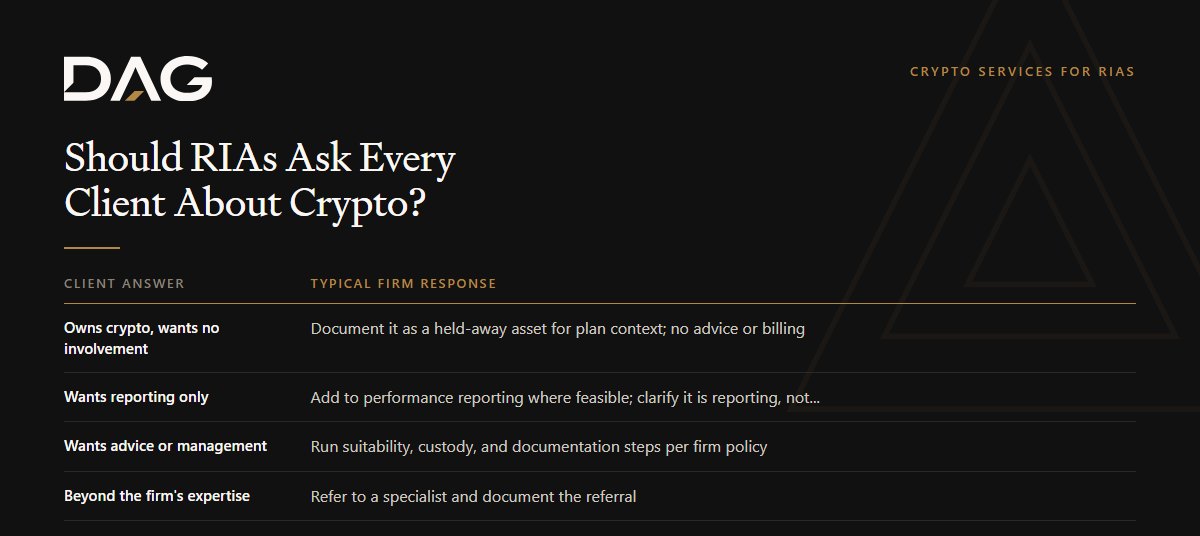
A discovery question creates an obligation to have a next step. Define the paths in advance so the answer is consistent across advisers:
| Client answer | Typical firm response |
|---|---|
| Owns crypto, wants no involvement | Document it as a held-away asset for plan context; no advice or billing |
| Wants reporting only | Add to performance reporting where feasible; clarify it is reporting, not advice |
| Wants advice or management | Run suitability, custody, and documentation steps per firm policy |
| Beyond the firm's expertise | Refer to a specialist and document the referral |
Whether a firm can charge on assets it does not custody is fact-specific; see billing on held-away crypto and confirm with compliance.
Compliance Considerations
The firm should define what happens after a client says yes, and document that the question was asked and how the answer was handled. Asking about crypto does not commit the firm to advising on it; conflating discovery with a recommendation is a common pitfall a crypto compliance checklist is designed to catch. Note that adding a screening question does not remove market, custody, or tax risk for the client, and that SEC registration alone does not guarantee skill or a particular outcome. Consult a qualified compliance professional before changing client discovery processes.
Related Questions
Do RIAs have to ask clients about crypto?
There is generally no rule requiring a specific crypto question, but a complete picture of a client's assets supports suitable advice. Many firms add the question for that reason. Whether it becomes mandatory in your intake is a firm-policy and compliance decision.
What should an RIA do if a client self-custodies crypto?
Self-custodied assets sit outside the firm's qualified-custodian arrangements, so document the holding, note key-management and concentration risk, and decide whether to advise, report, or refer. The specifics depend on the facts and your firm's policy; consult compliance.
Does asking about crypto mean the firm has to advise on it?
No. Discovery and advice are separate. A firm can record a held-away digital asset for planning context without recommending, managing, or billing on it, provided the engagement and disclosures are clear.
Sources
Compliance Note
This article is educational and does not provide legal, compliance, tax, investment, fiduciary, or custody advice. RIAs should consult compliance counsel before changing client discovery processes. Registration does not imply a certain level of skill or training.