
A crypto investment policy statement for RIAs is a client-specific document that defines whether digital assets are permitted, how much may be held, which assets and custody arrangements qualify, and how the position is rebalanced, taxed, and reported. It sets expectations in writing and should stay consistent with the adviser's compliance obligations.
What Is a Crypto Investment Policy Statement?
An investment policy statement (IPS) is the written framework that governs how a client's portfolio is managed: objectives, constraints, permitted holdings, and the process for changing them. A crypto IPS extends that framework to digital assets, addressing the volatility, custody, and tax questions that are specific to this asset class. It is part of how RIAs document crypto recommendations and connects to the broader work covered in the Crypto Services for RIAs Hub.
What the IPS May Address
A useful crypto IPS is specific rather than generic. Common provisions include:
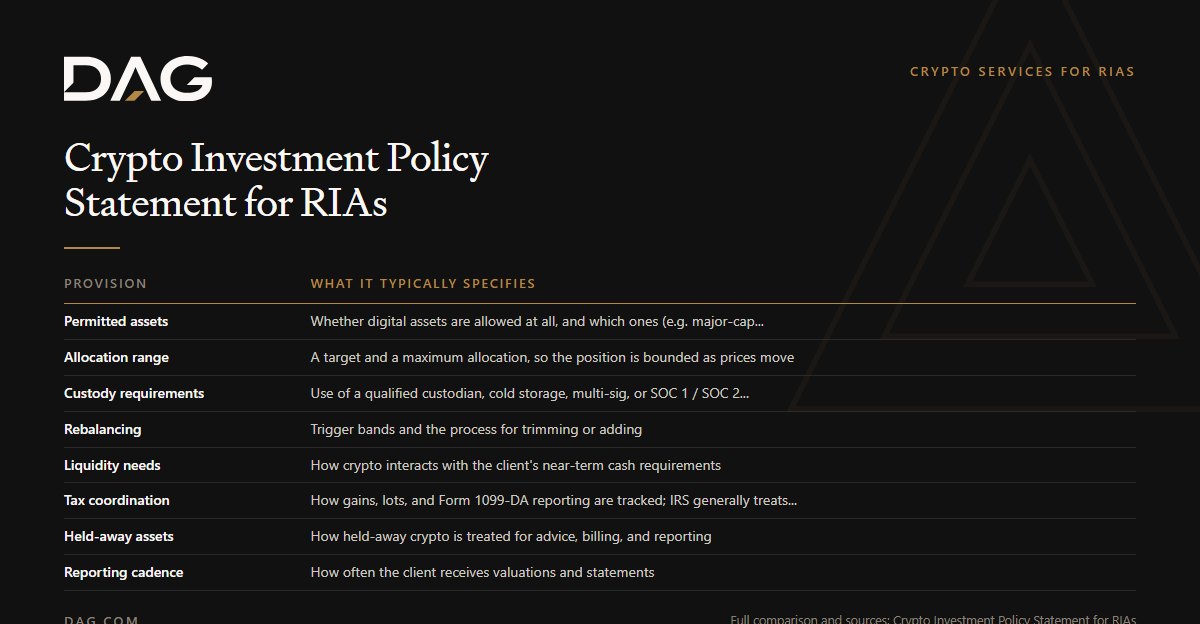
| Provision | What it typically specifies |
|---|---|
| Permitted assets | Whether digital assets are allowed at all, and which ones (e.g. major-cap tokens vs. broad universe) |
| Allocation range | A target and a maximum allocation, so the position is bounded as prices move |
| Custody requirements | Use of a qualified custodian, cold storage, multi-sig, or SOC 1 / SOC 2 reporting standards |
| Rebalancing | Trigger bands and the process for trimming or adding |
| Liquidity needs | How crypto interacts with the client's near-term cash requirements |
| Tax coordination | How gains, lots, and Form 1099-DA reporting are tracked; IRS generally treats digital assets as property |
| Held-away assets | How held-away crypto is treated for advice, billing, and reporting |
| Reporting cadence | How often the client receives valuations and statements |
| Risk disclosures | Plain-language acknowledgment of market, custody, and tax risk |
Advisor Questions to Resolve Before Drafting
- Is the adviser recommending crypto, or only reporting on a position the client already holds?
- Are the assets discretionarily managed, held away, or custodied by a third party?
- Does the client understand that no IPS removes market, custody, or tax risk?
- How will tax reporting be coordinated across exchanges and wallets?
- Are fees and conflicts of interest disclosed consistent with Form ADV?
These map closely to a crypto due diligence checklist and to a firm's broader crypto compliance checklist.
Why a Written IPS Helps
A written IPS reduces ambiguity when markets move quickly and documents the role crypto is intended to play in the client's broader portfolio. It also gives the adviser a record of the client's stated risk tolerance and the agreed allocation bounds, which supports a defensible, consistent process. It does not, however, guarantee any outcome or eliminate the volatility inherent in digital assets. Firms weighing whether to build this capability in-house often compare it against crypto outsourcing for RIAs.
Related Questions
Does an RIA need a separate IPS for crypto?
Not necessarily. Many firms add crypto provisions to the existing client IPS rather than maintaining a standalone document. The key is that the language is specific to the client's facts and consistent with the firm's policies; consult compliance counsel on the right structure.
What custody language belongs in a crypto IPS?
Generally, the IPS references the use of a qualified custodian and may specify expectations such as cold storage, multi-signature controls, or SOC 1 / SOC 2 reporting. The appropriate language depends on the custody arrangement and the firm's obligations under the SEC custody rule.
Can an IPS cover crypto the client holds elsewhere?
It can describe how held-away digital assets are treated for advice, billing, and reporting, but the adviser should confirm what authority and visibility it actually has. Treatment of held-away positions depends on the facts and on the firm's policies.
Sources
- SEC: Investment Adviser Public Disclosure
- SEC: Custody rule compliance guide
- SEC Investor.gov: Crypto Assets
Compliance Note
This article is educational and does not provide legal, compliance, tax, investment, or custody advice. RIAs should consult compliance counsel before implementing crypto IPS language. Registration with the SEC does not guarantee skill or any particular result, and no policy statement removes market, custody, or tax risk. Registration does not imply a certain level of skill or training.