
Crypto for financial advisors means building a repeatable process for client digital asset questions: inventory, custody, allocation sizing, tax records, estate documents, and compliance disclosures. The job is supervision, documentation, and coordination scoped to the firm's authority and registration, not predicting prices or selecting tokens.
What "Crypto for Financial Advisors" Means
Advisors apply the same planning discipline they use for any asset class to digital assets. The work covers position sizing, custody arrangements, concentration risk, cost-basis and tax records, and estate documents, not token selection or market timing. It sits inside the broader practice of crypto services for RIAs.
Most advisory firms handle crypto across four core jobs:
- Sizing exposure, reviewing what proportion of net worth is in digital assets and whether that concentration is addressed in the plan.
- Confirming custody, determining where assets are held and who controls the keys.
- Producing tax and performance reporting, coordinating cost-basis records and Form 1099-DA obligations with the client's tax professional.
- Documenting recommendations, recording the basis for advice and the limits of the advisory role.
Crypto does not remove market, custody, or tax risk. No allocation or structure makes digital assets a guaranteed or insured holding. Many firms handle these jobs by partnering with a crypto sub-advisor rather than building the capability in-house.
Why This Work Matters
Many clients already own crypto outside the advisory relationship. When the advisor ignores it, those assets still affect taxes, estate planning, risk, liquidity, and family wealth. A documented process replaces ad hoc answers with consistent ones and demonstrates that the firm has addressed the question, useful in an examination or a client dispute.
For the held-away case specifically, clients who hold digital assets on a personal wallet or exchange, the analysis is distinct. See crypto held away from the advisor.
Common Client Questions
- Should crypto be part of my portfolio?
- Should I use an ETF, SMA, direct custody, or self-custody?
- How much is too much?
- How do I report crypto for taxes?
- Can my trust or LLC own crypto?
- What happens to crypto if I die?
- Can my advisor see or manage held-away crypto?
- Should I buy or hold crypto now?
The right answer depends on the client's facts, the custody arrangement, and the firm's own registration and compliance posture.
Advisor Workflow
A workable process runs in order:
- Ask whether the client owns digital assets, ideally as a standard intake question, not an exception.
- Inventory holdings: tokens, amounts, and the platform or wallet each sits in.
- Identify custody location, spot ETF, exchange account, self-custody wallet, trust account, or LLC account.
- Document held-away assets where appropriate, including wallet type and custodian.
- Review concentration risk against the rest of the plan and the client's liquidity needs.
- Clarify the advisor's role, advising, reporting, or discretionary management, and put it in writing.
- Coordinate with the client's tax professional on cost basis and Form 1099-DA reporting as it phases in.
- Coordinate with estate counsel so digital assets and access keys are addressed in the plan.
- Establish a client communication framework so questions get a consistent answer.
- Evaluate whether firm-approved crypto solutions exist, or whether a crypto sub-advisor is the better route.
- Document recommendations and limitations in the file.
Documenting that last step well is its own discipline; how RIAs should document crypto recommendations covers what a defensible file looks like.
Custody and Holding Types
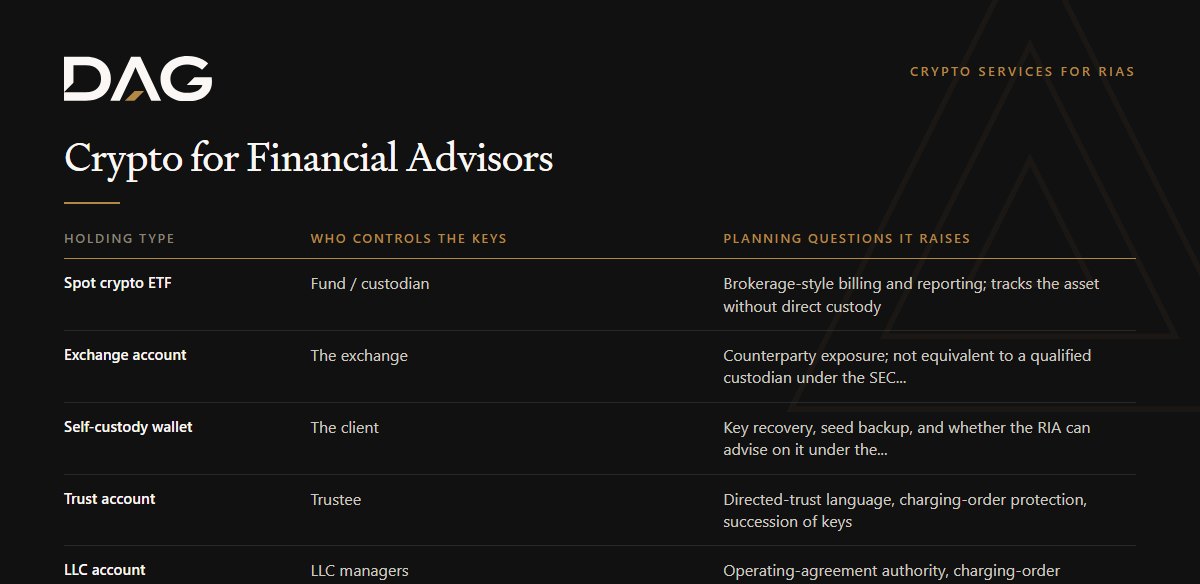
Crypto advice depends on how the asset is held. Each structure raises different planning, billing, compliance, and reporting questions.
| Holding type | Who controls the keys | Planning questions it raises |
|---|---|---|
| Spot crypto ETF | Fund / custodian | Brokerage-style billing and reporting; tracks the asset without direct custody |
| Exchange account | The exchange | Counterparty exposure; not equivalent to a qualified custodian under the SEC custody rule |
| Self-custody wallet | The client | Key recovery, seed backup, and whether the RIA can advise on it under the firm's policies |
| Trust account | Trustee | Directed-trust language, charging-order protection, succession of keys |
| LLC account | LLC managers | Operating-agreement authority, charging-order protection, signing control |
Where the firm takes custody or is deemed to have it, the SEC custody rule and the qualified-custodian standard apply, see qualified custody for RIAs managing digital assets. For tax records, the IRS generally treats digital assets as property, so each disposition can be a taxable event. Treat these as general points and confirm specifics with qualified tax and custody professionals.
Compliance Checkpoints Before Acting
Before an advisor acts on crypto for a client, a few items generally need to be in place:
- Authority and disclosures. Confirm the activity fits the firm's Form ADV, advisory agreement, and compliance program.
- Qualified custody. Where the firm has custody, the SEC custody rule generally requires a qualified custodian; review SOC 1/SOC 2 reports during due diligence, see crypto custody due diligence questions for RIAs.
- Documentation. Keep a record of the rationale behind any recommendation.
- Risk disclosure. No process removes market, custody, or tax risk. Crypto carries no guaranteed yield, stable peg, or FDIC/SIPC coverage.
When a Specialist Referral Is Appropriate
Advisors should not exceed their expertise, authority, or compliance program. Crypto work may require firm approval, additional disclosures, custody review, or specialist support. When the facts get complex, large positions, multi-entity structures, estate coordination, or active DeFi participation, it can be appropriate to refer the client to a specialist.
Related Questions
Can financial advisors recommend crypto to clients?
Generally yes, within the firm's policies and a documented suitability process, but the answer depends on the firm's registration, disclosures, and the client's circumstances. Registration alone does not guarantee skill or a good outcome. See can financial advisors recommend crypto.
Should advisors ask every client about crypto?
Often yes. Even when the advisor does not manage the assets, held-away crypto can affect tax, estate, and risk planning, so it generally belongs in the client picture. The answer depends on the firm's policies and scope. See should RIAs ask every client about crypto.
Do advisors need a qualified custodian for client crypto?
If the firm has custody of client digital assets, the SEC custody rule generally requires a qualified custodian. The facts of the arrangement control, so consult compliance counsel.
Should advisors help with wallet access?
Be careful. Handling wallet access can create custody and security issues and may implicate the custody rule. Coordinate with compliance and custody professionals rather than taking possession of keys.
How is client crypto taxed?
The IRS generally treats digital assets as property, so selling, swapping, or spending crypto can trigger a taxable gain or loss. Clients should keep cost-basis records. Specifics depend on the transactions and the client's situation; a qualified tax professional should confirm.
When should an advisor refer a crypto client to a specialist?
When the facts exceed the advisor's expertise, authority, or compliance program, large positions, complex entity structures, estate coordination, or active on-chain activity. See when should an advisor refer crypto clients to a specialist.
Sources
- SEC Investor.gov: Crypto Assets
- SEC custody rule compliance guide
- IRS: Digital assets
- SEC investment adviser public disclosure search
Compliance Note
This article is for general educational purposes and does not provide legal, compliance, tax, investment, or custody advice. Advisors should consult compliance counsel before implementing crypto workflows. Digital Ascension Group provides services through affiliated entities; advisory services are provided through DAG Wealth, an SEC-registered investment adviser. Registration does not imply a certain level of skill or training.