
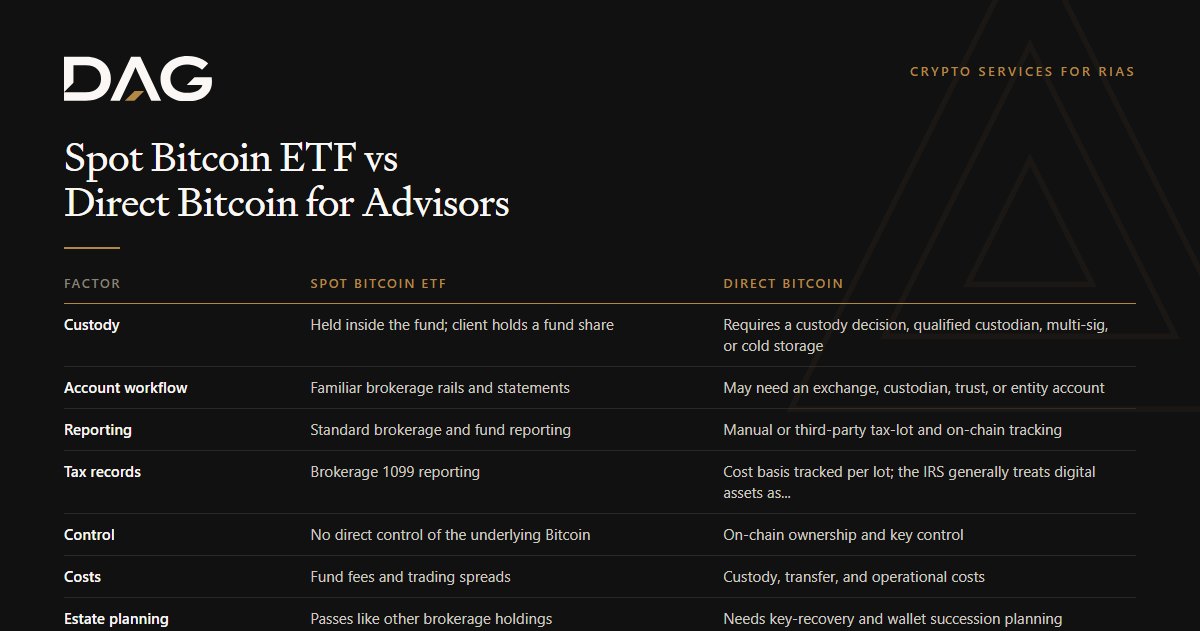
In the spot Bitcoin ETF vs direct Bitcoin decision, an advisor chooses between Bitcoin exposure through a regulated, exchange-traded fund and ownership of the asset itself via a wallet, exchange, qualified custodian, trust, or entity account. The two routes differ in custody, reporting, tax-lot tracking, client experience, and operational complexity, and each carries its own market, custody, and tax risk.
What Each Approach Means
A spot Bitcoin ETF holds Bitcoin and trades as a fund share in a standard brokerage account, so the client gains price exposure without directly holding the asset. Direct Bitcoin means the client (or the advisory structure) controls the actual Bitcoin through keys, a custodian, or a trust. Choosing between them is one of several decisions that sit under crypto wealth management for advisors and their clients.
Comparison Table
| Factor | Spot Bitcoin ETF | Direct Bitcoin |
|---|---|---|
| Custody | Held inside the fund; client holds a fund share | Requires a custody decision, qualified custodian, multi-sig, or cold storage |
| Account workflow | Familiar brokerage rails and statements | May need an exchange, custodian, trust, or entity account |
| Reporting | Standard brokerage and fund reporting | Manual or third-party tax-lot and on-chain tracking |
| Tax records | Brokerage 1099 reporting | Cost basis tracked per lot; the IRS generally treats digital assets as property |
| Control | No direct control of the underlying Bitcoin | On-chain ownership and key control |
| Costs | Fund fees and trading spreads | Custody, transfer, and operational costs |
| Estate planning | Passes like other brokerage holdings | Needs key-recovery and wallet succession planning |
ETF fees, fund structure considerations, and the absence of direct asset control are trade-offs for the operational simplicity of the fund route. Direct ownership can offer on-chain control but adds custody, transfer-policy, and recordkeeping work. Neither route removes market, custody, or tax risk, and a Bitcoin ETF is not FDIC- or SIPC-protected against price loss.
Advisor Decision Checklist
- Is the client seeking price exposure or direct asset ownership?
- Can the advisory platform support the chosen exposure, and how will you document the recommendation?
- How will custody be handled, fund share, or a qualified custodian for direct holdings?
- How will cost basis and taxes be tracked per lot?
- Does direct ownership require estate planning for wallet succession?
For the threshold question of whether RIAs can recommend Bitcoin ETFs at all, and the related question of whether RIAs can advise on self-custodied crypto, see those pages before settling on a structure.
Related Questions
Is a spot Bitcoin ETF safer than holding Bitcoin directly?
Neither is inherently safe. An ETF removes key-management burden but still carries full Bitcoin price risk and is not FDIC- or SIPC-protected against losses. Direct holdings shift custody and key-recovery risk to the client or custodian. The right fit depends on the client's facts; consult a qualified professional.
Which option is better for tax tracking?
ETF shares generally produce standard brokerage 1099 reporting, while direct Bitcoin requires per-lot cost-basis tracking. The IRS generally treats digital assets as property, and reporting rules continue to evolve. A qualified tax professional should confirm treatment for a specific client.
Can an advisor offer both ETF and direct Bitcoin exposure?
Often, yes, depending on the advisory platform, custody arrangements, and the client's investment policy. Many advisors blend the two or refer direct-custody work to a specialist. Confirm that your platform and compliance program support each path before recommending it.
Sources
Compliance Note
This article is educational and does not provide legal, tax, compliance, investment, fiduciary, or custody advice. Advisors should review product disclosures and compliance requirements before making recommendations. Registration does not imply a certain level of skill or training.