
A stablecoin yield scholarship endowment is possible, but the yield is variable and not guaranteed, depeg, counterparty, and smart-contract risk can interrupt income. The legal structure (private foundation, donor-advised fund, or 501(c)(3)) governs scholarship procedures, self-dealing rules, and taxation. Like a traditional endowment, principal stays invested and scholarships are paid from income, not principal. This guide covers one use case within the broader field of crypto charitable giving.
How Does a Stablecoin Yield Endowment Actually Work?
The mechanics follow the same pattern as any endowment. You fund a charitable vehicle, a private foundation or donor-advised fund, with assets dedicated to scholarships. Inside that structure, stablecoins are deposited into yield-generating protocols. The yield flows to the charitable entity; that yield funds the scholarships. The principal remains invested.
The difference from a bond-funded endowment is the yield source: stablecoin protocols rather than fixed-income markets. That changes the risk profile materially.
What Charitable Structures Can Hold Stablecoin Yield?
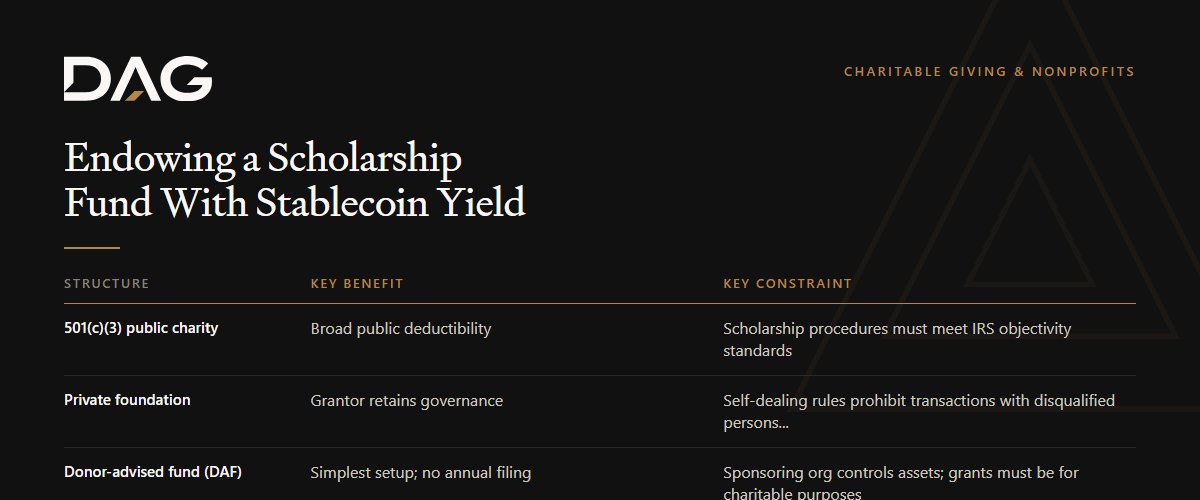
| Structure | Key Benefit | Key Constraint |
|---|---|---|
| 501(c)(3) public charity | Broad public deductibility | Scholarship procedures must meet IRS objectivity standards |
| Private foundation | Grantor retains governance | Self-dealing rules prohibit transactions with disqualified persons; scholarship procedures require IRS advance approval (Rev. Proc. 76-47); minimum 5% distribution requirement |
| Donor-advised fund (DAF) | Simplest setup; no annual filing | Sponsoring org controls assets; grants must be for charitable purposes |
Private foundations face the most restrictive rules: stablecoin yield counts as investment income subject to the 1.39% excise tax on net investment income (IRC §4940); scholarship grants to individuals require advance IRS procedure approval; and self-dealing rules prohibit lending or transactions with foundation insiders.
DAFs avoid most of these constraints but transfer asset control to the sponsoring organization. The sponsoring org may restrict which asset classes the DAF can hold, verify stablecoin eligibility before funding.
What Are the Tax Consequences of Stablecoin Yield Inside a Charitable Structure?
Stablecoin yield is generally treated as ordinary income in the year received. For private foundations, this income is subject to the excise tax on net investment income. For public 501(c)(3) organizations, yield from lending or DeFi protocols may constitute unrelated business taxable income (UBTI) under IRC §512 if it arises from debt-financed property or active business activity, consult a tax attorney before deploying into leveraged protocols.
For the donor funding the charitable vehicle with appreciated crypto, the contribution may generate a charitable deduction at fair market value (if held longer than one year) and avoid capital gains on the appreciation. This is an area of active IRS guidance; verify current rules with a qualified tax professional.
DAG coordinates crypto charitable giving for high-net-worth investors within a broader tax and estate strategy, working alongside the donor's tax and legal advisers; the firm does not provide legal advice.
How Should Protocol Risk Be Evaluated?
Yield variability is the structural risk most donors underestimate. A protocol advertising 15% annual yield may be subsidizing returns through token emissions that are unsustainable. Others offering 8% may be lending to real counterparties with audited collateral. The difference matters enormously for an endowment that is supposed to fund scholarships year after year.
Key evaluation criteria:
- Collateralization: Is lending over-collateralized? What collateral types are accepted?
- Smart-contract audit history: Has the protocol been audited by reputable firms, and have those reports been published?
- Counterparty transparency: Are borrowers known entities with legal standing, or anonymous?
- Protocol track record: How has yield behaved through prior market downturns?
- Custodial arrangement: Are assets held in a qualified custodian or in a protocol-controlled address?
No stablecoin protocol is a substitute for U.S. Treasuries as a counterparty. An endowment governance policy should define acceptable protocol risk parameters and a fallback plan if yield drops or a protocol is compromised.
See crypto due diligence for family offices for a structured evaluation framework.
What Governance Documents Does the Endowment Need?
A well-structured stablecoin endowment needs at minimum:
- Investment policy statement (IPS): Defines acceptable protocols, concentration limits, minimum credit/audit standards, and the trigger conditions for exiting a protocol.
- Scholarship award procedures: For private foundations, must satisfy IRS advance approval requirements. For 501(c)(3) public charities, must meet objectivity and non-discrimination standards.
- Custodial policy: Specifies where assets are held, who has signing authority, and how keys or access credentials are managed.
- Payout policy: Sets the annual distribution rate as a percentage of yield (not principal), with a buffer for years when yield is lower than expected.
See digital asset investment policy statement for family offices and crypto governance for family offices for template frameworks.
What Is the Right Payout Rate?
Traditional endowments typically distribute 4–5% of a trailing asset average annually. With stablecoin yield, the calculation is different because you are drawing from income, not asset value. If a protocol yields 8% and you distribute 100% of yield as scholarships, one bad year eliminates scholarships entirely. A conservative approach distributes 50–70% of expected annual yield and retains a reserve for volatility.
Never draw down principal to make scholarship payments. Once a foundation begins liquidating the underlying stablecoin balance to fund grants, it is operating a spending account, not an endowment.
Related Questions
Does a private foundation need IRS approval before awarding scholarships?
Yes. Private foundations must obtain advance approval from the IRS under Rev. Proc. 76-47 before making scholarship grants to individuals. The application describes selection criteria, award amounts, and procedures to ensure objectivity. Public 501(c)(3) organizations face less stringent requirements but still must use objective, non-discriminatory criteria.
Can stablecoin yield generate UBTI for a tax-exempt organization?
Potentially. Yield from DeFi lending protocols may constitute UBTI if the activity is treated as a trade or business regularly carried on (IRC §513), or if the assets are debt-financed under IRC §514. The analysis is fact-specific and the IRS has not issued definitive guidance on DeFi income for exempt organizations. Legal counsel review is required before deploying.
Is a donor-advised fund a simpler path than a private foundation for a stablecoin scholarship?
Generally yes, for donors who want lower administrative overhead. DAFs avoid excise taxes on investment income, self-dealing rules, and the advance scholarship procedure requirement. The tradeoff is that the sponsoring organization controls the assets and the grant-making; the donor has advisory, not legal, control. Some DAF sponsors do not currently accept crypto assets or stablecoin positions, verify before funding.
What happens to the endowment if the stablecoin depegs?
A depeg can reduce or eliminate the yield-generating capacity of the endowment and may impair principal if the stablecoin loses value. An investment policy should specify maximum allocation to any single stablecoin, diversification across multiple stablecoins (USDC, USDT, PYUSD, etc.), and a trigger threshold below which the foundation exits the position and moves to traditional assets. See stablecoin treasury management for family offices.
Sources
- IRS, Private Foundations (current)
- IRS, Rev. Proc. 76-47, Scholarship and Fellowship Grant Programs
- IRC §4940 (excise tax on net investment income of private foundations)
- IRC §509 (definition of private foundation)
- IRC §512–514 (unrelated business taxable income)
- IRS Notice 2023-34 and related digital asset guidance (verify current)
- IRS, Donor-Advised Funds (current)
Compliance Note
This page is educational only and does not constitute legal, tax, or investment advice. Stablecoin yield is variable and not guaranteed; principal is subject to depeg, smart-contract, and counterparty risk. Tax treatment of digital asset income inside charitable structures is subject to IRS guidance that continues to evolve, and stablecoin yield is generally taxed as ordinary income. Private foundation scholarship procedures require IRS advance approval, and self-dealing rules apply. Entity formation and foundation, trust, and governance documents are legal services; DAG coordinates these with qualified outside counsel and does not provide legal advice. Any yield figures referenced are illustrative only, verify current protocol rates and legal requirements with qualified legal, tax, and investment professionals before proceeding. Advisory services are provided by DAG Wealth, an SEC-registered investment adviser. Registration does not imply a certain level of skill or training.