
Crypto charitable giving covers the vehicles and tax rules that apply when donors give digital assets to charity, donor-advised funds, private foundations, and public 501(c)(3) organizations. Because the IRS treats cryptocurrency as property, the structure, holding period, and appraisal requirements can shape the outcome, so any gift should be reviewed with qualified tax and legal professionals.
What Crypto Charitable Giving Is
Crypto charitable giving is the donation of digital assets, rather than cash, to a qualified charitable organization, using a structure such as a donor-advised fund, a private foundation, or a direct gift to a public charity. The IRS generally treats cryptocurrency as property, not currency, so a crypto gift is a non-cash charitable contribution subject to property rules: holding-period analysis, percentage-of-AGI deduction limits, and substantiation requirements. For a broader view of how giving fits into a family's plan, see crypto charitable giving and crypto charitable giving for high-net-worth investors.
Core Questions
- Can a donor-advised fund accept direct crypto contributions?
- What nonprofit structures exist for holding digital assets?
- When does a crypto donation require a qualified appraisal?
- How are NFTs and illiquid tokens substantiated?
- Can a charity be funded with yield generated from stablecoins?
- How do AGI limits affect a cryptocurrency charitable deduction?
- What records and forms does a crypto gift require?
Choosing a Giving Vehicle
The first decision is usually which vehicle will receive the gift, because control, cost, and reporting differ across structures. Donors who want a simple, lower-cost way to give often start with setting up a donor-advised fund that accepts direct crypto contributions. Those weighing more control and a dedicated entity should review the full menu in nonprofit structure options for digital assets, and donors set on a controlled entity should understand the trade-offs before they donate crypto to a private foundation, where the deduction is generally basis-limited. Groups that want to give together. DAOs and token communities, can review options for a crypto giving circle structure, and anyone intending to run a charity directly can follow the steps to start a 501(c)(3) that accepts crypto.
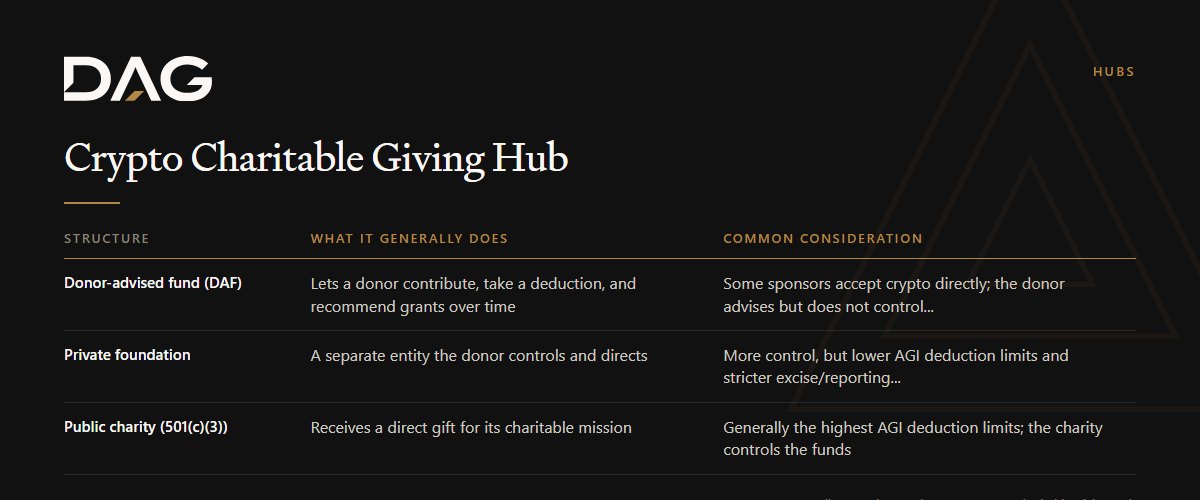
| Structure | What it generally does | Common consideration |
|---|---|---|
| Donor-advised fund (DAF) | Lets a donor contribute, take a deduction, and recommend grants over time | Some sponsors accept crypto directly; the donor advises but does not control grants |
| Private foundation | A separate entity the donor controls and directs | More control, but lower AGI deduction limits and stricter excise/reporting rules |
| Public charity (501(c)(3)) | Receives a direct gift for its charitable mission | Generally the highest AGI deduction limits; the charity controls the funds |
Appraisal and Substantiation
Substantiation is where crypto gifts most often go wrong. For non-cash gifts over $5,000, the IRS generally requires a qualified appraisal and a completed Form 8283, Section B, and there is no exception for cryptocurrency comparable to the publicly traded securities exception, even for coins quoted on an exchange. Handling the qualified appraisal requirements for donating NFTs or illiquid tokens over $5,000 walks through the appraisal and form mechanics. Donors should keep contemporaneous records of the gift; for the broader recordkeeping framework, see the Crypto Tax Records Hub.
Tax Treatment of a Crypto Gift
The deduction depends heavily on how long the asset was held. Crypto held more than one year is generally a long-term capital asset, which may allow a donor to deduct fair market value (subject to AGI limits that vary by asset type and recipient) without recognizing the unrealized capital gain, but this is not guaranteed and depends on the facts. Crypto held one year or less is generally limited to cost basis. A donor who wants charitable impact but still needs some cash back can consider a bargain sale of crypto to charity, where basis is allocated between the sale and gift portions so only part of the gain is recognized. None of these outcomes is automatic, and the available crypto charitable giving overview should be paired with advice from a qualified tax professional.
Yield, Stablecoins, and Funding Sources
Some donors want to fund charitable goals from on-chain income rather than principal. Endowing a scholarship fund using yield generated from stablecoins explains the structuring questions involved, who holds the assets, how yield is characterized, and what the receiving entity must track. These arrangements intersect with entity choice and custody, so coordinate them with the Crypto Trust Structures Hub and the broader Crypto Wealth Management Hub.
Related Questions
Can I deduct the full market value of donated crypto?
It depends on the facts. Crypto held more than one year and given to a public charity may allow a fair-market-value deduction subject to AGI limits, while assets held a year or less are generally limited to cost basis. No deduction is guaranteed. Confirm the treatment with a qualified tax professional.
Does a crypto donation over $5,000 always need an appraisal?
Generally, yes. The IRS requires a qualified appraisal and Form 8283, Section B for non-cash gifts over $5,000, and cryptocurrency does not qualify for the publicly traded securities exception, even when quoted on an exchange. The appraisal requirement applies to NFTs and illiquid tokens as well.
Is a donor-advised fund or a private foundation better for crypto?
Both are used. A DAF is generally simpler and lower-cost with higher AGI deduction limits, while a private foundation offers more control at the cost of stricter rules and lower limits. The right choice depends on the donor's goals, the assets, and applicable law.
Sources
- IRS: Frequently asked questions on virtual currency transactions
- IRS Publication 526, Charitable Contributions
- IRS Publication 561, Determining the Value of Donated Property
- IRS: About Form 8283, Noncash Charitable Contributions
Compliance Note
This hub is educational and does not provide legal, tax, fiduciary, investment, or accounting advice. Charitable giving structures and the tax treatment of donated digital assets should be reviewed with qualified professionals before any gift is made.