
A bargain sale of crypto to charity is a single transaction split into two parts: you sell crypto to a charity for less than its fair market value, and the difference between that value and the price is treated as a charitable gift. Because it is part sale and part gift, your cost basis is allocated proportionally between the two portions, so you recognize gain on the sale part only.
What Is a Bargain Sale of Crypto to Charity?
A bargain sale is a sale of property to a qualified charity at a price below fair market value. The IRS treats it as two simultaneous events: a sale (for the cash or property you receive) and a charitable contribution (for the bargain element, the value you gave up). It is useful for a donor who wants to support a charity but still needs to recover some cash from a position, rather than giving it away entirely as a direct crypto charitable giving for high-net-worth investors gift.
This differs from a straight donation, where no cash comes back and no gain is recognized, and from a donor-advised fund crypto contributions gift, where the full asset is contributed. The defining feature of a bargain sale is partial cash back and partial gift in one move.
How Basis Is Allocated in a Bargain Sale
This is the core mechanic. Under IRC §1011(b) and Treas. Reg. §1.1011-2, when you sell appreciated property to a charity in a bargain sale, your cost basis is not fully offset against the cash you receive. Instead, basis is allocated in proportion to the sale portion:
Basis allocated to the sale = Total basis × (Amount realized ÷ Fair market value)
You recognize gain equal to the amount realized minus that allocated basis. The remaining basis attaches to the gift portion. The result: even though you sold for less than full value, you still recognize some gain, because only part of your basis shelters the cash you took out.
Illustrative example (figures illustrative, dated mid-2026)
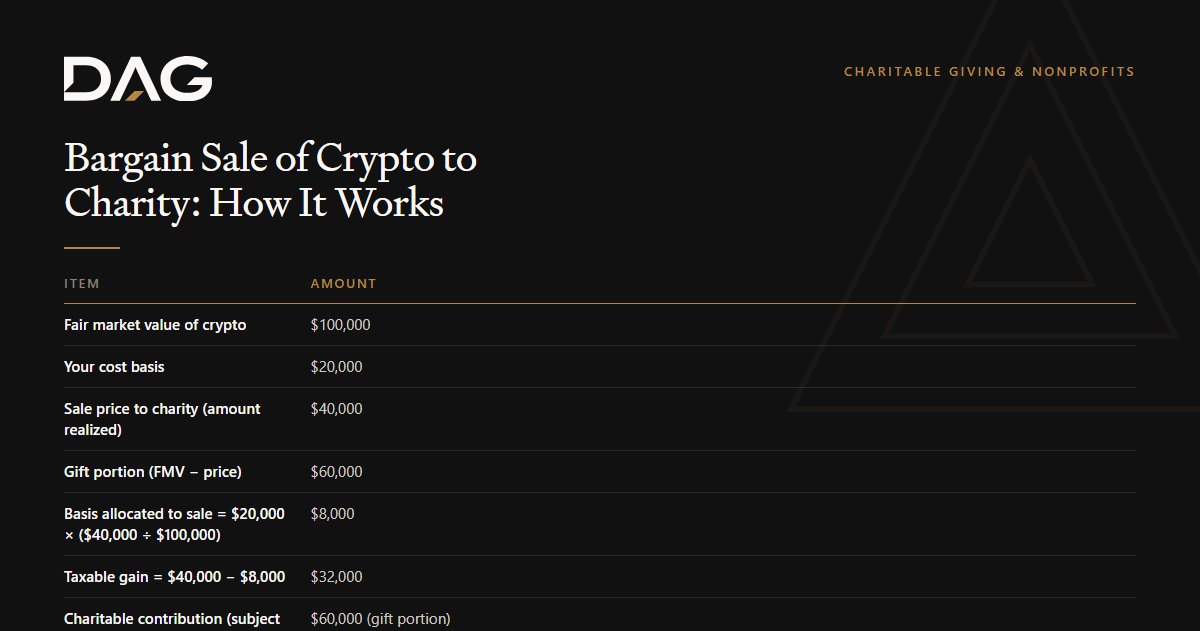
| Item | Amount |
|---|---|
| Fair market value of crypto | $100,000 |
| Your cost basis | $20,000 |
| Sale price to charity (amount realized) | $40,000 |
| Gift portion (FMV − price) | $60,000 |
| Basis allocated to sale = $20,000 × ($40,000 ÷ $100,000) | $8,000 |
| Taxable gain = $40,000 − $8,000 | $32,000 |
| Charitable contribution (subject to deduction rules) | $60,000 (gift portion) |
These numbers are illustrative only. Actual gain, the deductible amount, AGI limits, and holding-period treatment depend on your facts; verify with a qualified tax professional.
How a Bargain Sale of Crypto Works Step by Step
- Confirm the charity will buy at a bargain price. Not every charity is set up to purchase property; the receiving organization and price must be documented.
- Establish fair market value with a qualified appraisal. For the gift portion over $5,000, the IRS generally requires a qualified appraisal and Form 8283, Section B, crypto does not get the publicly-traded-securities exception. Solidify basis records first; see crypto cost basis cleanup for HNW investors.
- Allocate basis between sale and gift using the IRC §1011(b) ratio above.
- Recognize the gain on the sale portion (long-term if held more than a year), and report it for the tax year.
- Claim the charitable deduction for the gift portion, subject to AGI limits and the property rules.
- Document everything, appraisal, sale agreement, transfer confirmations, and acknowledgment.
When a Bargain Sale Makes Sense
A bargain sale is most relevant when a donor wants charitable impact but also needs liquidity from a concentrated, low-basis position, for example, after a large crypto tax planning for HNW investors event. It produces a smaller deduction and some recognized gain compared with a full gift, but returns cash. A donor who needs no cash back is generally better served by a straight donation or a DAF, which recognizes no gain at all. The choice should be modeled against the donor's full tax picture.
Related Questions
Why do I still owe tax if I sold the crypto below market value?
Because of basis allocation. Under IRC §1011(b), only the portion of your basis that corresponds to the sale price offsets the cash you received, the rest of your basis is assigned to the gift. So a low-basis asset still produces recognized gain on the sale portion even at a discounted price. Confirm the calculation with a qualified tax advisor.
Is a bargain sale better than just donating the crypto?
It depends on whether you need cash. A straight donation of appreciated crypto held over a year generally avoids all gain and can produce a larger deduction; a bargain sale returns cash but recognizes gain on the sale portion and yields a smaller deduction. See crypto charitable giving for high-net-worth investors for the full-gift alternative.
Does a bargain sale of crypto need an appraisal?
For the gift portion over $5,000, the IRS generally requires a qualified appraisal and Form 8283, Section B. Cryptocurrency does not qualify for the publicly-traded-securities appraisal exception even when quoted on an exchange. The appraisal supports the value of the gift element of the transaction.
Sources
- IRC §1011(b). Bargain sale to a charitable organization: https://www.law.cornell.edu/uscode/text/26/1011
- Treas. Reg. §1.1011-2. Bargain sale to a charitable organization: https://www.law.cornell.edu/cfr/text/26/1.1011-2
- IRC §170. Charitable contributions and gifts: https://www.law.cornell.edu/uscode/text/26/170
- IRS Publication 526. Charitable Contributions: https://www.irs.gov/publications/p526
- IRS Publication 544. Sales and Other Dispositions of Assets: https://www.irs.gov/publications/p544
- IRS Notice 2014-21. Virtual currency treated as property: https://www.irs.gov/irb/2014-16_IRB#NOT-2014-21
Compliance Note
This page is educational only and does not constitute legal, tax, investment, or financial advice. Bargain-sale treatment, basis allocation, gain recognition, appraisal requirements, and deduction limits are complex and subject to change. The figures in the example are illustrative only and not a prediction of any donor's result; all calculations should be verified against current IRS guidance for the applicable tax year. Tax filing and charitable structuring are professional services the firm coordinates with your CPA and attorney and does not itself provide. Consult a qualified tax attorney and CPA before executing a bargain sale of digital assets to charity.
Advisory services are provided by DAG Wealth, an SEC-registered investment adviser. Registration does not imply a certain level of skill or training.