
Crypto charitable giving for high-net-worth investors lets a donor contribute appreciated digital assets to a donor-advised fund, private foundation, or charitable remainder trust. Donating long-term assets in-kind may avoid the capital gain a sale would trigger and may support a fair-market-value deduction. Outcomes depend on the donor's facts and require review with qualified tax and legal professionals.
What Crypto Charitable Giving Means for HNW Families
The IRS treats digital assets as property. A crypto donation is therefore a gift of property, not cash, which drives the substantiation and appraisal rules that apply. The key tax consideration for appreciated crypto held longer than one year is that donating directly to a qualified charitable vehicle generally avoids realizing the gain that a sale would trigger, while a deduction based on fair market value at the time of the gift may still be available.
For an HNW family, charitable giving rarely happens in isolation. It intersects with crypto tax planning for HNW investors, estate and succession planning, and the documentation discipline required across crypto tax reporting for family offices. Structure choice matters as much as the gift amount.
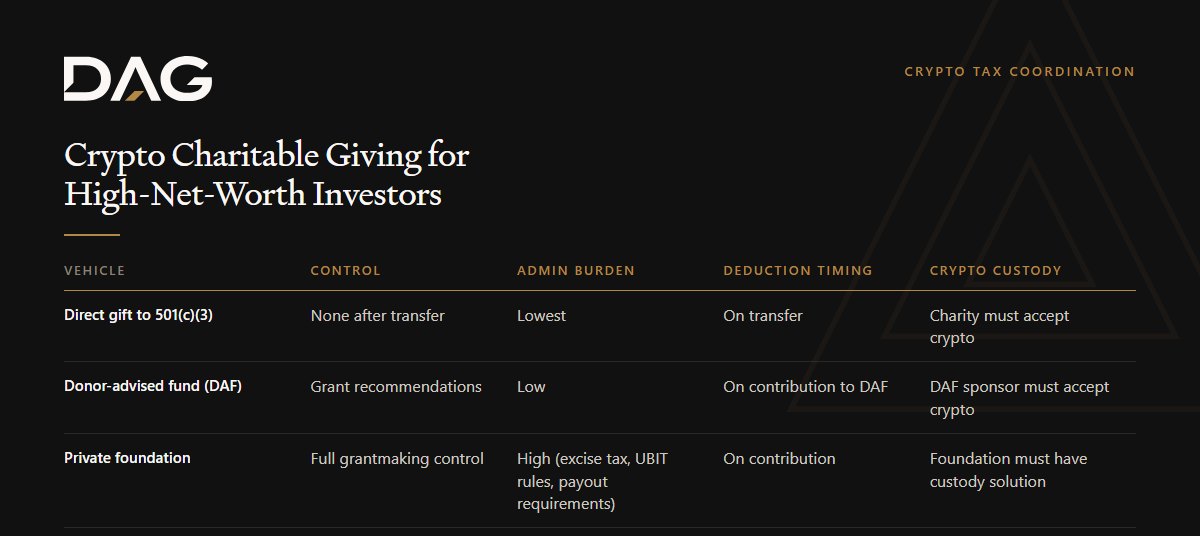
Charitable Vehicles Compared
| Vehicle | Control | Admin burden | Deduction timing | Crypto custody |
|---|---|---|---|---|
| Direct gift to 501(c)(3) | None after transfer | Lowest | On transfer | Charity must accept crypto |
| Donor-advised fund (DAF) | Grant recommendations | Low | On contribution to DAF | DAF sponsor must accept crypto |
| Private foundation | Full grantmaking control | High (excise tax, UBIT rules, payout requirements) | On contribution | Foundation must have custody solution |
| Charitable remainder trust (CRT) | Income stream retained | Moderate | Partial, at contribution | Trustee must be able to hold asset |
Each vehicle serves a different goal. A DAF accepts a single funding event, lets the donor recommend grants to multiple organizations over time, and typically offers a more streamlined crypto-acceptance workflow than a private foundation. A private foundation gives families ongoing grantmaking control and multi-generational involvement, but requires investment management, annual payout compliance, and an entity that can hold digital assets. A CRT can provide an income stream to the donor or named beneficiary before the remainder passes to charity, but requires careful structuring and trustee competence with digital assets.
The right vehicle depends entirely on the family's charitable intent, asset size, and operational capacity. These are legal and tax decisions, not just financial ones.
Donating Appreciated Crypto to a Family Foundation
When a family foundation cannot hold cryptocurrency directly, which is common because traditional custodians are not equipped for digital assets, one approach used in practice is an LLC wrapper: the crypto is transferred into an LLC, and the LLC membership interest is then contributed to the foundation. The foundation owns the LLC; the LLC holds the crypto through a qualified digital asset custodian. This structure keeps the custody mechanics workable while allowing the foundation to benefit from the asset.
This approach involves entity formation, operating agreements, custodial relationships, and coordination with a tax professional on valuation and appraisal timing. It requires qualified legal and tax review before implementation. Execution errors in on-chain transfers are irreversible.
Planning Steps Before Any Transfer
- Identify the specific asset and lot, and confirm the cost basis and holding period from your crypto tax records.
- Confirm the charitable vehicle can receive and hold the specific digital asset.
- Determine whether a qualified appraisal is required for the donated amount and arrange it in advance.
- Obtain and verify the recipient wallet address; do not rely on a single communication channel.
- Complete internal authorization consistent with your custody controls (withdrawal allowlist, multi-signature, etc.).
- Execute the transfer and immediately record the transaction hash, timestamp, and lot detail.
- Collect the contemporaneous written acknowledgment from the recipient organization.
- Coordinate with your tax professional on Form 8283 and any appraisal attachment requirements.
If cost-basis records are incomplete, see how to reconstruct crypto cost basis before valuing any gift.
Qualified Appraisals
For non-cash property donations above IRS thresholds, a qualified appraisal is generally required, and a price screenshot does not meet the standard. IRS Publication 561 covers valuation of donated property. A qualified appraisal must be prepared by a qualified appraiser no earlier than 60 days before the date of the contribution and no later than the due date (including extensions) for the return on which the deduction is claimed. Coordinate the appraisal date with the transfer date to avoid a timing mismatch.
The IRS generally requires a qualified appraisal for non-cash gifts valued at more than $5,000 per item or group of similar items, reported in Section B of Form 8283; the IRS treats donated crypto as a noncash contribution subject to this rule. For non-cash gifts valued at more than $500,000, the qualified appraisal generally must be attached to the return. Thresholds and your specific facts should be confirmed with a tax professional.
Custody and Address Verification
Crypto transfers are irreversible. Before any charitable transfer, verify the recipient address character by character through a confirmed communication channel, not solely through email that could be spoofed. Where a qualified custodian holds the assets, confirm the custodian's process for outbound charitable transfers and whether any withdrawal allowlist or multi-signature authorization step applies. Retain the transaction hash, transfer confirmation, and any custody records as part of your donation documentation.
Family Office Coordination
Family offices managing multi-generational charitable giving programs typically coordinate multiple entities: donors, custodians, a private foundation or DAF sponsor, tax professionals, and estate counsel. Written procedures, covering authorization, address verification, appraisal timing, and recordkeeping, reduce the risk of a failed or undocumented transfer. This documentation discipline connects directly to crypto tax reporting for family offices and to digital asset wealth management for high-net-worth families.
Related Questions
Is donating appreciated crypto directly more tax-efficient than selling it and donating cash?
For long-term appreciated crypto, donating directly to a qualified charitable vehicle may avoid realizing the gain that a sale would trigger, and the deduction may be based on fair market value rather than cost basis. The outcome depends on the asset's holding period, basis, the donor's tax situation, and whether the charitable vehicle can accept the asset. These variables must be reviewed with a qualified tax professional before any transfer.
What is the most tax-efficient way to donate appreciated crypto to a family foundation?
Donating the appreciated asset in-kind rather than selling first generally avoids the capital gain the donor would otherwise recognize on a sale. Because many private foundations cannot hold cryptocurrency directly, an LLC wrapper, transferring the crypto into an LLC and then contributing the LLC membership interest to the foundation, is one structure used to preserve in-kind treatment while maintaining workable custody. Qualified appraisal, address verification, and coordination with tax and legal counsel are required. This is a complex transaction and is not suitable for a DIY approach.
What is a donor-advised fund and how does it work for crypto donations?
A donor-advised fund is a charitable account sponsored by a qualifying organization (a community foundation, financial institution, or dedicated DAF sponsor). The donor contributes assets to the DAF, takes an immediate deduction, and then recommends grants to qualified charities over time. Many DAF sponsors accept crypto, liquidate it, and hold the proceeds for grant deployment. The donor still handles appraisal and substantiation requirements. DAFs are generally simpler operationally than private foundations and suit families who want deduction-timing flexibility without ongoing entity overhead.
How does a charitable remainder trust work with digital assets?
A CRT is an irrevocable trust that receives an asset (such as appreciated crypto) and can sell it inside the trust without the trust recognizing capital gains tax on the sale, then invests the proceeds to pay an income stream to the donor or named beneficiary for a period of years or for life. At the trust's termination, the remaining assets pass to the designated charity. The donor takes a partial charitable deduction at contribution based on the actuarial present value of the charitable remainder. CRTs require a qualified trustee who can manage digital assets, valuation at contribution, and careful compliance with annuity or unitrust payout rules. This is a legal structure that requires an attorney to draft and a trustee equipped to handle the asset class.
Do I need a qualified appraisal to donate cryptocurrency?
Generally yes, when the donated property value exceeds IRS thresholds (typically $5,000 per item or group of similar items in a tax year). A price screenshot from an exchange does not satisfy the qualified-appraisal standard. The appraisal must be conducted by a qualified appraiser within the IRS-defined window relative to the contribution date. See IRS Publication 561 and confirm your specific facts with a tax professional.
Can a private foundation accept and hold Bitcoin or other crypto?
A private foundation can hold digital assets if it has appropriate custody, but most traditional foundation custodians are not equipped for this. Practical solutions include a qualified digital asset custodian or an LLC wrapper (the foundation owns an LLC that holds the crypto). The foundation is a tax-exempt entity, so sales inside it generally do not trigger capital gains tax, but excise tax rules, self-dealing prohibitions, and minimum distribution requirements still apply. Operating a foundation requires ongoing legal, tax, and investment oversight.
What records does the donor need to keep after donating crypto?
At minimum: the transaction hash and on-chain confirmation, the specific lot donated (including cost basis and acquisition date), the qualified appraisal if required, the contemporaneous written acknowledgment from the recipient, and any Form 8283 filed with the return. Family offices should maintain these records in the same system used for other crypto tax records.
Sources
- IRS: Digital assets
- IRS Publication 526: Charitable Contributions
- IRS Publication 561: Determining the Value of Donated Property
- IRS Form 8283: Noncash Charitable Contributions
Compliance Note
This article is educational and does not constitute legal, tax, philanthropic, investment, or custody advice. Charitable giving structures involving digital assets, including donor-advised funds, private foundations, charitable remainder trusts, and LLC wrappers, are complex and depend on facts specific to the donor, asset, and charitable vehicle. All strategies described here must be reviewed with qualified tax counsel, an attorney, and other relevant professionals before implementation. No outcome described is guaranteed; tax treatment may change, and crypto assets carry market, custody, and liquidity risk in addition to the planning considerations discussed.