
Crypto planning for CPAs is the work of assembling reliable transaction records, reviewing cost basis, classifying digital asset activity, coordinating entity ownership, and supporting accurate tax reporting for clients who hold cryptocurrency. Because the IRS generally treats digital assets as property, most of this work depends on data quality before technical tax analysis can begin.
What "Crypto Planning for CPAs" Means
For a CPA, crypto planning is less about a single return and more about reconstructing a defensible record of every taxable event across wallets, exchanges, and entities. The core term covers four things: the source data (who held what, where, and when), the classification of each event (transfer, sale, swap, staking reward, airdrop, unlock), the ownership layer (individual, trust, or LLC), and the reporting outputs (Form 8949, and the new Form 1099-DA broker reporting). Each layer can introduce errors that only surface at filing time.
A practical sequence many CPAs follow appears in the broader Crypto Tax Records Hub, which frames records, classification, and reporting as one coordinated workflow rather than separate tasks.
CPA Review Areas
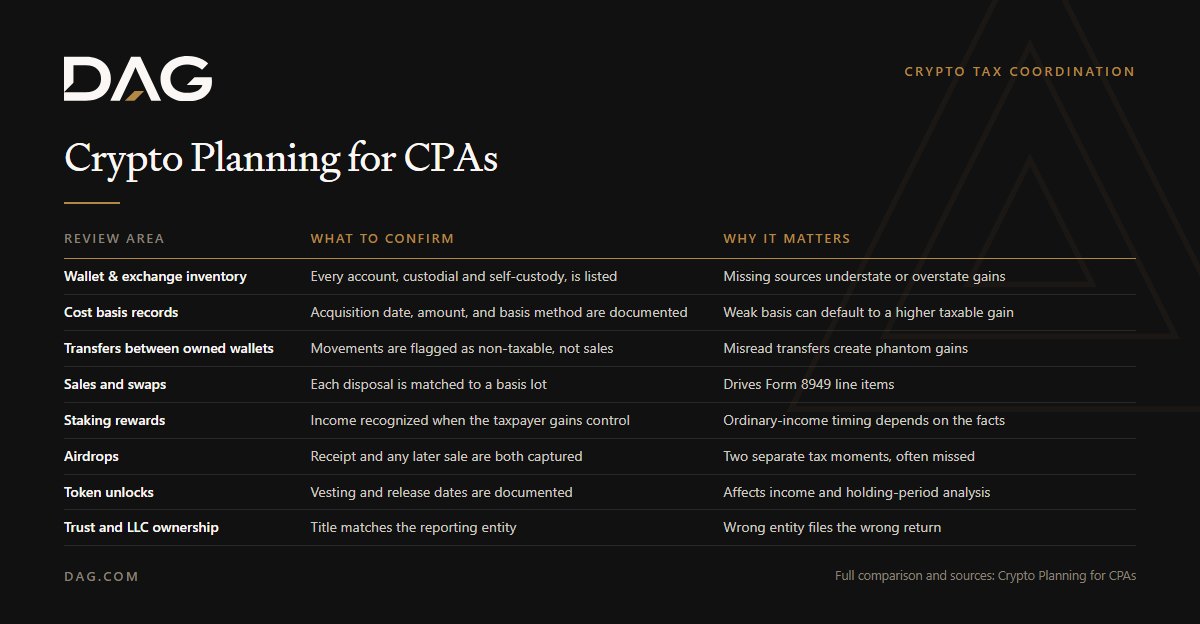
| Review area | What to confirm | Why it matters |
|---|---|---|
| Wallet & exchange inventory | Every account, custodial and self-custody, is listed | Missing sources understate or overstate gains |
| Cost basis records | Acquisition date, amount, and basis method are documented | Weak basis can default to a higher taxable gain |
| Transfers between owned wallets | Movements are flagged as non-taxable, not sales | Misread transfers create phantom gains |
| Sales and swaps | Each disposal is matched to a basis lot | Drives Form 8949 line items |
| Staking rewards | Income recognized when the taxpayer gains control | Ordinary-income timing depends on the facts |
| Airdrops | Receipt and any later sale are both captured | Two separate tax moments, often missed |
| Token unlocks | Vesting and release dates are documented | Affects income and holding-period analysis |
| Trust and LLC ownership | Title matches the reporting entity | Wrong entity files the wrong return |
| Form 8949 / 1099-DA data | Broker figures reconcile to client records | Mismatches invite IRS notices |
| Estimated tax planning | Liquidity exists to cover the liability | Gains can arrive without cash to pay |
For the mechanics behind several rows above, see Form 8949 for Crypto Investors and the approach to specific identification, which can change how basis lots are matched depending on the client's records and elections.
Common Data Problems
The recurring issues are missing wallets, duplicate transfers counted as sales, unsupported assets that import platforms drop, incomplete exchange histories (often from closed venues), missing cost basis, and no documentation of who legally owns each entity. When basis cannot be located, CPAs generally work from the best available evidence rather than assuming a zero basis; the trade-offs are covered in What If I Cannot Prove My Crypto Cost Basis?. None of these clean-up steps removes the underlying market, custody, or tax risk in a client's portfolio; they only make the reporting defensible.
Family Office Coordination
For family offices, a CPA usually needs a repeatable workflow for collecting records across individuals, trusts, LLCs, qualified custodians, and reporting platforms, with a clear owner for each source. Consolidating those inputs ahead of filing is the focus of Crypto Tax Reporting for Family Offices, and a documented intake list helps avoid the gaps described above.
Related Questions
Do CPAs need special credentials to handle crypto tax work?
No specific crypto license is required to prepare a return, but the analysis depends heavily on the facts and on current IRS guidance, which continues to evolve. CPAs generally apply professional standards and document their basis for each position; clients with complex holdings should consult a qualified tax professional.
How should a CPA treat transfers between a client's own wallets?
Moving crypto between wallets the same taxpayer controls is generally not a taxable sale, but it must be documented as a transfer so it is not mistaken for a disposal. Distinguishing the two is its own task, outlined in How to Separate Crypto Transfers From Taxable Sales.
What records should a client gather before meeting their CPA?
A complete account inventory, full transaction histories, cost basis where available, and documentation of any trust or LLC ownership. Preparing these in advance shortens the engagement and reduces errors; a structured starting point is the Crypto Tax Records Checklist.
Sources
- IRS: Digital assets
- IRS: Frequently asked questions on digital asset transactions
- IRS: About Form 8949
- IRS: About Form 1099-DA
Compliance Note
This article is educational and does not provide legal, tax, accounting, investment, or custody advice. CPAs should apply professional standards and current IRS guidance.