
If your crypto tax records are missing, the first step is to build a complete inventory of every wallet, exchange, custodian, transfer, and known transaction, then work with a qualified tax professional to reconstruct cost basis and the support behind each figure. Document the reconstruction process itself; do not guess at numbers without recording how you reached them.
What "Missing Crypto Tax Records" Actually Means
Missing crypto tax records is a broad problem, not just a missing cost-basis figure. It can include absent exchange statements or 1099s, unrecorded income events (staking, airdrops, mining), wallet histories you can no longer access, transaction data from a closed exchange, and DeFi activity that no platform summarized for you. Cost basis is one piece; the full picture is every fact the IRS expects you to substantiate when you report a disposition. Because the IRS generally treats digital assets as property, each sale, swap, or spend is a taxable event that needs a date acquired, a date disposed, proceeds, and a basis, and any of those inputs can go missing independently.
This page covers the broader triage across all of those gaps. For the step-by-step of rebuilding a basis figure specifically, see how to reconstruct crypto cost basis.
Recovery Workflow
- List every wallet, exchange, and custodian you have used, including ones you think are empty or closed.
- Export all available transaction histories. CSV and API exports from each active account, plus any prior downloads sitting in old emails.
- Identify your on-chain wallet addresses so you can pull public ledger history for self-custodied or DeFi activity.
- Match deposits and withdrawals across accounts to connect transfers that span two platforms.
- Separate internal transfers from taxable sales so wallet-to-wallet moves are not double-counted as dispositions. See how to separate crypto transfers from taxable sales for the distinction.
- Locate bank records and purchase confirmations that tie fiat on-ramps to specific buys.
- Review prior tax filings for basis already reported and carryforwards.
- Flag items with unknown cost basis rather than inventing one.
- Document your assumptions and the method behind each reconstructed figure.
- Have a tax professional review the result before it reaches a return.
Where to Retrieve Each Type of Missing Record
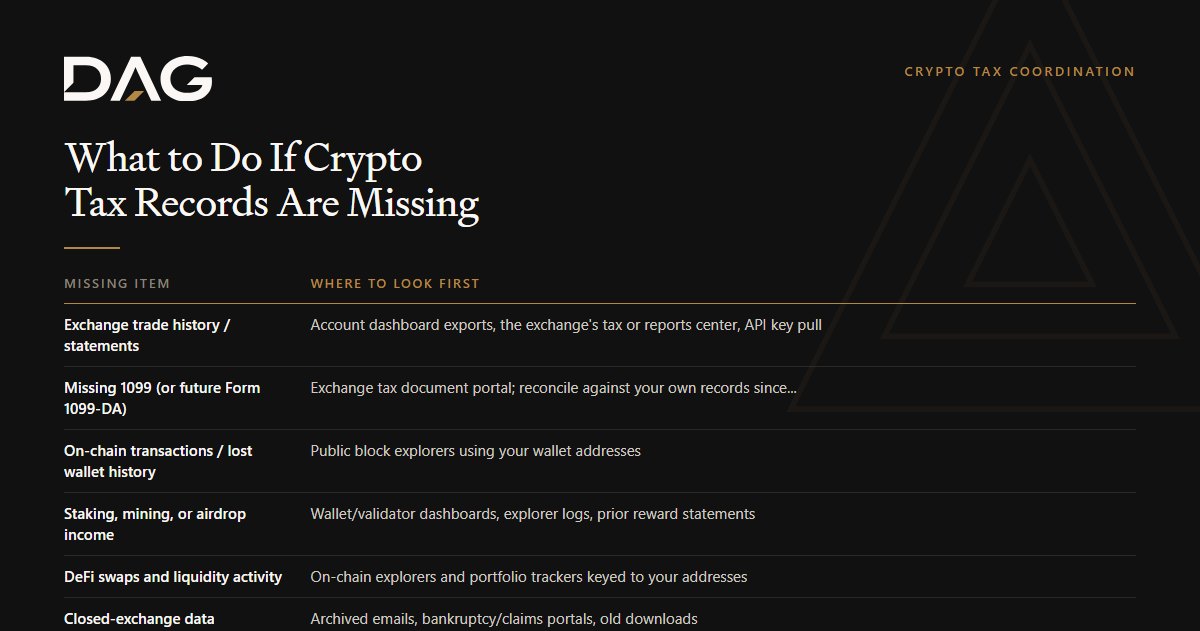
| Missing item | Where to look first |
|---|---|
| Exchange trade history / statements | Account dashboard exports, the exchange's tax or reports center, API key pull |
| Missing 1099 (or future Form 1099-DA) | Exchange tax document portal; reconcile against your own records since reporting can be incomplete |
| On-chain transactions / lost wallet history | Public block explorers using your wallet addresses |
| Staking, mining, or airdrop income | Wallet/validator dashboards, explorer logs, prior reward statements |
| DeFi swaps and liquidity activity | On-chain explorers and portfolio trackers keyed to your addresses |
| Closed-exchange data | Archived emails, bankruptcy/claims portals, old downloads |
| Fiat on-ramp / cost confirmations | Bank and card statements, payment processor receipts |
If an exchange has shut down, the retrieval path is different enough to warrant its own steps, see how to handle crypto from a closed exchange. When you cannot substantiate a basis at all after exhausting these sources, what if I cannot prove my crypto cost basis walks through the conservative options.
Common Sources of Missing Data
Gaps usually trace back to a handful of causes: a closed or acquired exchange, a wallet you lost access to, exports that were never saved, assets a tracking tool did not support, DeFi activity with no statement, staking rewards recorded only on-chain, and personal-to-entity transfers that were never labeled. Knowing the cause points you to the right retrieval source.
Why Documentation Matters
When records are incomplete, the cleanup trail and the assumptions behind it can matter as much as the final spreadsheet. A reconstruction supported by a clear, consistent method and contemporaneous sources is easier to stand behind than a number with no explanation. Keep the working papers, not just the result, so a CPA can follow your reasoning, see how to prepare crypto records for a CPA.
Related Questions
Can I estimate crypto cost basis if I have no records at all?
You can reconstruct an estimate using public price data and a consistent, documented method, but the IRS generally expects a reasonable, supportable basis rather than a guess. A figure you cannot substantiate may be treated unfavorably, so the approach and its limits depend on your specific facts. Discuss any estimate with a qualified tax professional before filing.
Does a missing 1099 mean I do not owe crypto tax?
No. Tax generally applies to a taxable disposition whether or not you received a 1099, and an exchange's reporting can be incomplete or absent. You are still responsible for reporting from your own records, so reconcile any forms you do receive against your full transaction history.
Will Form 1099-DA fix missing crypto records going forward?
It may reduce some gaps because brokers will report certain digital-asset transactions, but it will not retroactively fill historical holes and may not capture self-custody or DeFi activity. Treat it as one input to reconcile against your own records, not a complete substitute for them.
Sources
- IRS: Digital assets
- IRS: Frequently asked questions on digital asset transactions
- IRS: About Form 8949
Compliance Note
This article is educational and does not provide legal, tax, accounting, investment, or custody advice. Missing crypto tax records should be reconstructed with qualified tax professionals. Reconstructing records does not eliminate market, custody, or tax risk, and outcomes depend on your specific facts.