
A crypto tax records cleanup playbook is a step-by-step process for reconstructing your transaction history, cost basis, transfers, income events, and entity ownership before you file. It turns scattered wallet and exchange data into an organized record a tax professional can work from. It does not remove tax liability or audit risk, and results depend on your facts.
What This Playbook Covers
Cost basis is the original value of a digital asset for tax purposes, used to calculate gain or loss when you sell, swap, or spend it. The IRS generally treats digital assets as property, so each disposal is a potentially taxable event reported on Form 8949. Cleanup is reconstruction, not estimation, it begins with accounts and wallets, not tax forms, because the forms can only be completed once the underlying transfers and disposals are mapped. This playbook sits within DAG Wealth's crypto tax records hub and supports broader crypto tax planning for HNW investors.
Start with a complete inventory. A missed wallet is the most common reason a basis figure later falls apart.
Cleanup Steps
- List every wallet, exchange, and custodian, including closed accounts, hardware wallets, and any accounts held inside a trust or LLC. A missing account is the most common source of unexplained transfers later.
- Export complete transaction histories, full-date-range CSV or API exports from each venue, not just the current tax year.
- Match transfers between accounts, tag movements between your own wallets as non-taxable transfers and pair the send and receive sides so the same assets are not counted twice as sales.
- Separate taxable disposals from transfers, sales, crypto-to-crypto swaps, and payments are generally taxable events; moving assets between your own wallets generally is not.
- Identify income events, staking rewards, airdrops, mining, and interest are generally taxed as ordinary income at fair market value when received.
- Reconstruct cost basis, where acquisition records are missing or incomplete, document a reasonable, consistent method and its assumptions. See how to reconstruct crypto cost basis for the underlying approach.
- Separate personal, trust, and LLC activity, each entity is a distinct taxpayer or reporting unit; keep each ledger distinct so ownership and reporting line up.
- Review prior tax filings, reconcile what was previously reported against the reconstructed record and flag potential amendments to discuss with your CPA.
- Document all assumptions, record every estimate, pricing source, and judgment call, with the reason, so the file is defensible on review.
- Send organized records to a tax professional, hand a qualified CPA or tax attorney clean, labeled exports rather than raw data dumps.
Pre-Handoff Recordkeeping Checklist
Before sending records to a tax professional, confirm each item is in place:
- Complete inventory of every wallet, exchange, and custodian, including closed accounts
- Full-history exports reconciled against any issued Form 1099-DA
- Internal transfers tagged and excluded from disposals
- Disposals labeled with acquisition date, disposal date, proceeds, and cost basis
- Income events (staking, airdrops, mining, interest) separated from disposals
- Personal vs. entity activity cleanly split across returns
- Written log of assumptions, reconstruction methods, and pricing sources
Common Problem Areas
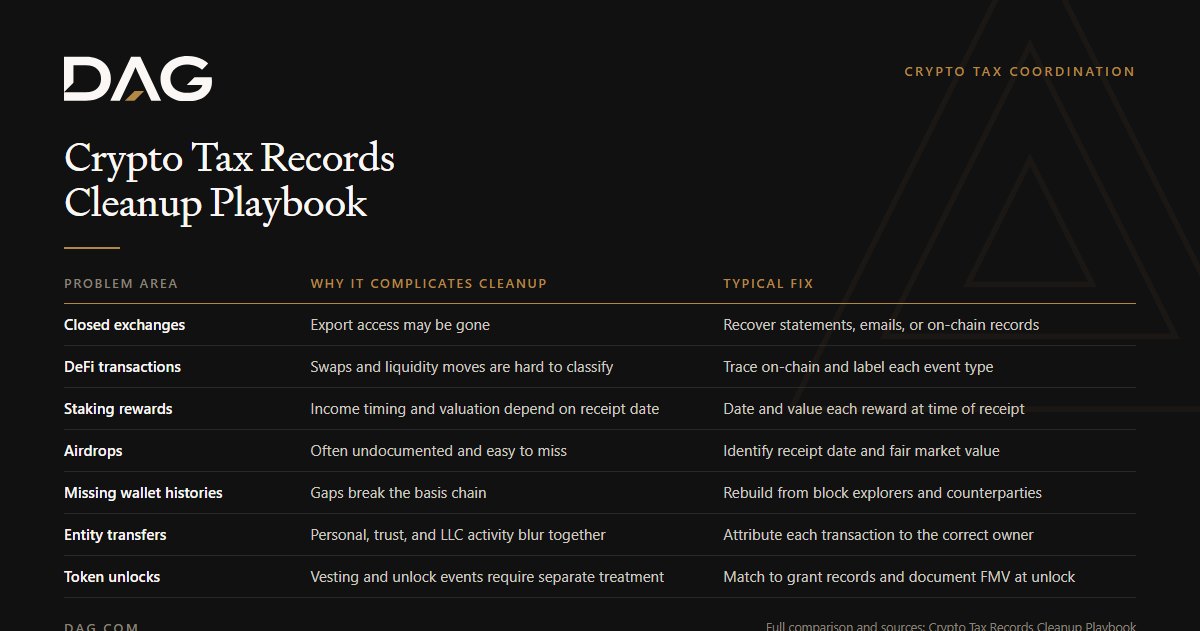
| Problem area | Why it complicates cleanup | Typical fix |
|---|---|---|
| Closed exchanges | Export access may be gone | Recover statements, emails, or on-chain records |
| DeFi transactions | Swaps and liquidity moves are hard to classify | Trace on-chain and label each event type |
| Staking rewards | Income timing and valuation depend on receipt date | Date and value each reward at time of receipt |
| Airdrops | Often undocumented and easy to miss | Identify receipt date and fair market value |
| Missing wallet histories | Gaps break the basis chain | Rebuild from block explorers and counterparties |
| Entity transfers | Personal, trust, and LLC activity blur together | Attribute each transaction to the correct owner |
| Token unlocks | Vesting and unlock events require separate treatment | Match to grant records and document FMV at unlock |
Records held with a qualified crypto custodian are generally easier to reconcile, since institutional statements tend to be more complete than ad hoc exchange exports. When crypto is held in a Wyoming digital asset LLC or trust, those transactions belong on the entity's return, not the individual's.
Form 1099-DA, the broker reporting form for digital asset proceeds, is being phased in and may not cover earlier years or self-custodied activity. A reconstructed record fills those gaps and lets you reconcile against any 1099-DA you do receive. See what is Form 1099-DA? for how that form fits in.
Related Questions
Why is crypto cost basis so hard to reconstruct?
Assets move across many wallets and exchanges, some of which close or limit historical exports, and pre-2025 activity often predates broker reporting requirements. Gaps generally have to be rebuilt from block explorers, counterparties, and contemporaneous records, then documented. A qualified tax professional should review the result.
Are transfers between my own wallets taxable?
Generally no. Moving the same assets between wallets you control is typically not a disposal, but both sides must be matched so the transfer is not mistaken for a sale. Misclassified transfers are a frequent source of overstated gains. Confirm the treatment of your specific transactions with a tax professional.
How far back should a crypto tax cleanup go?
Cleanup should generally cover every year with open filing exposure. How many prior years to reconstruct depends on your facts and the applicable statute of limitations. A tax professional can help you determine the appropriate scope.
Does receiving a Form 1099-DA mean my crypto taxes are already handled?
No. Form 1099-DA reports certain transactions to you and the IRS, but it may be incomplete or omit cost basis. It generally needs to be reconciled against your own records rather than treated as a finished return.
Can I reconstruct cost basis if exchange records are missing?
Often yes, using blockchain history, third-party tools, and documented assumptions. The method should be reasonable and consistently applied. Because results depend on your specific facts, confirm your approach with a qualified tax professional.
Should crypto held in an LLC or trust be tracked separately?
Generally yes. Each entity is a distinct taxpayer or reporting unit, so personal, trust, and LLC activity should be kept on separate ledgers. Clean attribution supports both accurate filing and the entity structures discussed in common crypto tax record mistakes. The appropriate structure for your situation warrants professional advice.
Sources
Compliance Note
This playbook is educational and does not provide legal, tax, accounting, investment, or custody advice. Crypto tax cleanup involves judgments that depend on your specific facts. Work with qualified tax professionals before filing or amending any return.