
Crypto tax software for family offices is the category of tools that ingest transactions across exchanges, wallets, and on-chain activity and produce cost basis and the figures needed for tax forms. For high-net-worth investors and family offices, the right tool is decided by capabilities, wallet coverage, per-account basis tracking, lot-selection methods, entity support, and auditability, not by a star rating. This page is a neutral buyer's guide to what to evaluate, not a ranked endorsement of any product.
What This Software Does
Crypto tax software connects to your venues (via API, CSV, or on-chain address import), normalizes the transactions, classifies them (trade, transfer, income, fee), computes cost basis under a selected method, and exports the numbers used for reporting, typically supporting Form 8949 and Schedule D output and income summaries. The output is only as good as the input: missing wallets, mislabeled transfers, and unmatched deposits all flow through to the return. For why that matters, see common crypto tax record mistakes.
The software does not replace a professional. It produces figures a CPA reconciles and signs off on. How to hand those figures over is covered in how to prepare crypto records for a CPA.
How Should an HNW Investor or Family Office Evaluate Crypto Tax Software?
Use a capability checklist rather than a leaderboard. The capabilities below are described generally; specific product features and limits change frequently, so verify each directly with the vendor before relying on it.
- Coverage breadth. Does it support every exchange, wallet, chain, and protocol you actually use, including DeFi, staking, and NFTs? Gaps usually become manual work. See how do I report crypto from multiple exchanges.
- Per-wallet / per-account basis. Can it track basis per wallet or account, as recent rules generally require, rather than only pooling? See crypto cost basis methods.
- Lot-selection methods. Does it support FIFO, HIFO, and Specific Identification with adequate substantiation records?
- Transfer matching. Can it reliably match a withdrawal on one venue to the deposit on another so internal moves are not booked as sales? See are crypto wallet transfers taxable.
- Entity and multi-account support. Can it segregate and report by entity (LLC, trust, family-office accounts) and by family member, with permissions? This matters for crypto tax reporting for family offices.
- Reconstruction tools. Can it handle missing history, closed exchanges, and basis cleanup? See how to reconstruct crypto cost basis.
- Auditability and exports. Does it produce a clean audit trail, source-data retention, and standard exports (Form 8949, gain/loss, income)? See Form 8949 for crypto investors.
- Security and access controls. Read-only API keys, SSO, role-based access, and clear data-handling practices.
- 1099-DA handling. Can it reconcile broker statements as the new reporting form rolls out? See what is Form 1099-DA.
- Professional collaboration. Does it offer a CPA/accountant workspace and clean handoff?
- Pricing model and scale limits. Per-transaction tiers can become costly for active or large portfolios; confirm limits and total cost.
A Neutral Evaluation Scorecard
Score each candidate against your own facts. This framework is illustrative; weight the rows to your situation and verify each capability with the vendor.
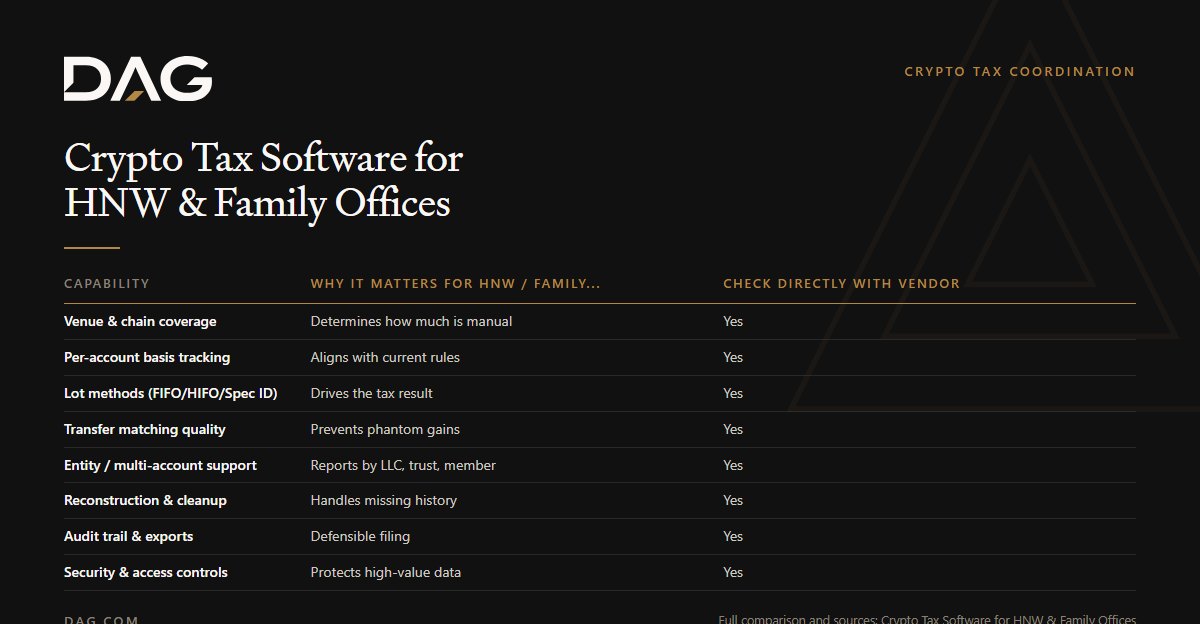
| Capability | Why it matters for HNW / family offices | Check directly with vendor |
|---|---|---|
| Venue & chain coverage | Determines how much is manual | Yes |
| Per-account basis tracking | Aligns with current rules | Yes |
| Lot methods (FIFO/HIFO/Spec ID) | Drives the tax result | Yes |
| Transfer matching quality | Prevents phantom gains | Yes |
| Entity / multi-account support | Reports by LLC, trust, member | Yes |
| Reconstruction & cleanup | Handles missing history | Yes |
| Audit trail & exports | Defensible filing | Yes |
| Security & access controls | Protects high-value data | Yes |
| Pricing at your volume | Avoids surprise cost | Yes |
No single tool is best for everyone, and capabilities described here may have changed. The decision belongs inside a coordinated process; see the broader crypto tax records hub and, for larger estates, crypto tax planning for HNW investors.
Related Questions
What is the best crypto tax software for a family office?
There is no universal best. The right tool depends on which venues and protocols you use, whether it tracks basis per account, supports your lot-selection method, segregates entities, and handles your transaction volume. Evaluate candidates against a capability checklist and verify each feature with the vendor.
Can crypto tax software replace a CPA?
No. The software produces figures; a qualified CPA reviews, reconciles, and signs the return and exercises judgment on ambiguous items. Treat the software as a data engine that feeds the professional, not a substitute for one.
Does the software handle the per-wallet basis rule?
Some tools support per-wallet or per-account basis tracking and some do not, and capabilities change. Because recent rules generally require per-account tracking, confirm directly with the vendor that the tool meets the current requirement before relying on it.
Sources
- IRS, "Digital Assets" (guidance and FAQs). https://www.irs.gov/filing/digital-assets
- IRS, "About Form 8949." https://www.irs.gov/forms-pubs/about-form-8949
- IRS, "About Form 1099-DA." https://www.irs.gov/forms-pubs/about-form-1099-da
- IRS Publication 551, Basis of Assets.
Compliance Note
This article is for educational purposes only and does not constitute tax, legal, investment, fiduciary, accounting, or product-purchase advice, and it is not an endorsement, ranking, or recommendation of any software vendor. Product capabilities, pricing, and limits change frequently and vary by plan; descriptions here are general and dated 2026-06-02, and you should verify each capability directly with the vendor. Software output must be reviewed by a qualified professional; no tool guarantees an accurate or audit-proof return. The firm coordinates with qualified tax professionals and does not itself provide tax advice. Digital assets carry risk, including the potential loss of principal. Advisory services are provided by DAG Wealth, an SEC-registered investment adviser. Consult a qualified CPA or tax attorney about your specific facts. Registration does not imply a certain level of skill or training.