
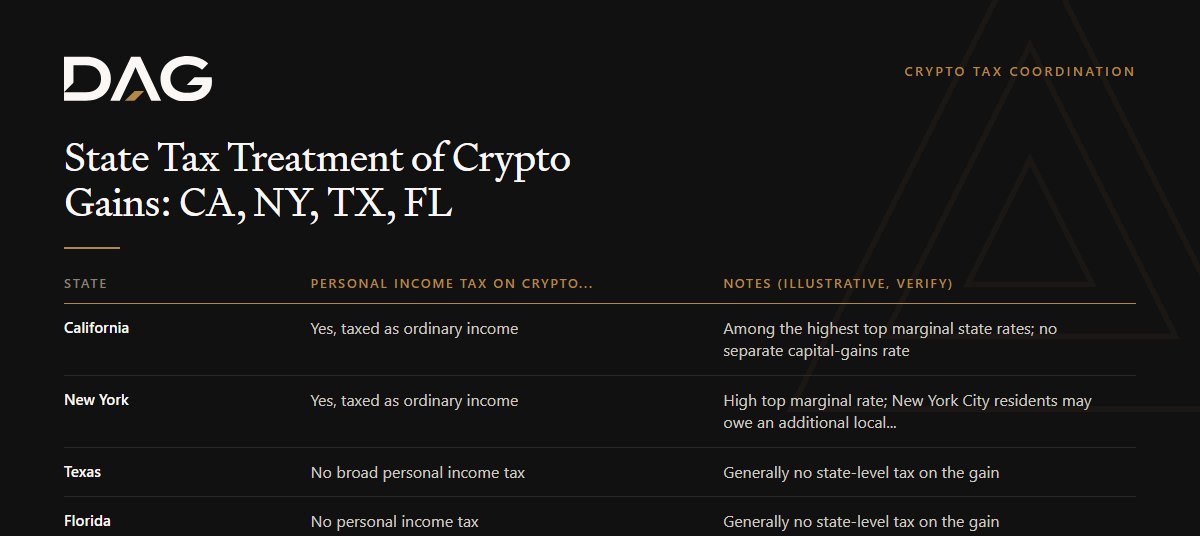
State tax treatment of crypto gains depends on where you are a tax resident. Most states that levy an income tax start from your federal taxable income, so a crypto gain that is taxable federally is generally also taxed by your state, and most states tax capital gains as ordinary income, with no separate long-term rate. States with no broad personal income tax, such as Texas and Florida, generally do not tax the gain at the state level. This is general and dated; verify with your state.
Why State Treatment Follows Federal. Usually
For federal purposes the IRS generally treats digital assets as property, so selling, trading, or spending crypto is generally a taxable event. Most states with an income tax compute taxable income starting from federal adjusted gross income or federal taxable income, then apply state-specific additions, subtractions, and rates. As a result, a federally taxable crypto gain usually flows into the state return automatically. What differs by state is the rate, whether capital gains get any preferential treatment (most states give none), and whether the state has an income tax at all. The federal mechanics behind the gain are covered in crypto cost basis methods and Form 8949 for crypto investors.
How Do High-Tax and No-Tax States Compare?
The contrast below is general and dated 2026-06-02. State rates, brackets, and rules change; the rate descriptions are illustrative, and you should verify current law with your state's department of revenue or a qualified tax professional.
| State | Personal income tax on crypto gains | Notes (illustrative, verify) |
|---|---|---|
| California | Yes, taxed as ordinary income | Among the highest top marginal state rates; no separate capital-gains rate |
| New York | Yes, taxed as ordinary income | High top marginal rate; New York City residents may owe an additional local tax |
| Texas | No broad personal income tax | Generally no state-level tax on the gain |
| Florida | No personal income tax | Generally no state-level tax on the gain |
The headline point: in California or New York, a large crypto gain can carry a meaningful additional state (and possibly local) tax on top of federal, generally at ordinary-income rates because those states do not give capital gains a break. In Texas or Florida, there is generally no state income tax on the gain. The size of that difference depends on your bracket and the gain, and the figures change, so confirm current rates.
Residency Is the Hard Part, Not the Rate
The bigger trap is not the rate, it is determining which state gets to tax you. A high-tax state generally taxes the worldwide income of its residents, and states with aggressive residency rules look at domicile, days present, and where your life is centered. Simply having a property or spending part of the year elsewhere does not necessarily change residency. Some states also have rules that can reach income with a source in the state even for nonresidents, and a move mid-year can split a gain across two states.
Realizing a large gain before genuinely changing residency, or while a former high-tax state may still claim you, is a common and high-stakes mistake. Residency, sourcing, and the timing of a gain relative to a move are fact-specific and state-specific; do not assume a move solves the tax. This planning sits alongside crypto tax planning for HNW investors and the broader crypto tax records discipline, and for those expecting estimated payments, crypto estimated tax planning.
Other State-Level Wrinkles
- Entities. Crypto held in an LLC or trust can change which state's rules apply, based on where the entity and its owners are taxed. See crypto tax reporting for LLCs.
- Local taxes. Some cities levy their own income tax on top of the state, which can add to the total.
- No preferential capital-gains rate. Most income-tax states tax the gain at ordinary rates regardless of holding period, unlike the federal long-term rate.
- Estimated payments. A large gain can create a state estimated-tax obligation, with its own penalties for underpayment.
Related Questions
Do I pay state tax on crypto gains if I live in Florida or Texas?
Generally no state personal income tax applies in Florida or Texas, so a crypto gain is generally not taxed at the state level there. You still owe any applicable federal tax. Confirm your residency and current state rules with a qualified tax professional.
Does California tax long-term crypto gains at a lower rate?
Generally no. California, like most income-tax states, taxes capital gains as ordinary income with no separate long-term capital-gains rate, so a long-held crypto gain is generally taxed at your ordinary California rate. Rates change; verify the current figures.
Can I avoid state tax by moving before I sell my crypto?
Maybe, but it is not automatic and it is high-risk. Residency depends on domicile, days present, and where your life is centered, and a former high-tax state may still claim you if the move is not genuine or is poorly timed. Sourcing and timing rules vary by state; get state-specific advice before relying on a move.
Does my state follow the federal treatment of crypto as property?
Most income-tax states start from your federal taxable income, so the federal treatment of crypto as property generally carries into the state return. States differ on rates and adjustments, and a few have specific rules. Verify with your state's department of revenue or a tax professional.
Sources
- IRS, "Digital Assets" (federal treatment as property). https://www.irs.gov/filing/digital-assets
- California Franchise Tax Board. https://www.ftb.ca.gov/
- New York State Department of Taxation and Finance. https://www.tax.ny.gov/
- Texas Comptroller of Public Accounts. https://comptroller.texas.gov/
- Florida Department of Revenue. https://floridarevenue.com/
Compliance Note
This article is for educational purposes only and does not constitute tax, legal, investment, fiduciary, or accounting advice. State tax rates, brackets, residency rules, and sourcing rules are fact-specific and vary by state, and they change frequently; the rate descriptions and comparisons here are general, illustrative, and dated 2026-06-02, and you should verify current law with your state's department of revenue or a qualified professional. Residency planning and the timing of gains relative to a move are high-stakes and fact-specific. The firm coordinates with qualified tax professionals and does not itself provide tax or legal advice. Digital assets carry risk, including the potential loss of principal; nothing here implies guaranteed tax savings. Advisory services are provided by DAG Wealth, an SEC-registered investment adviser. Consult a qualified CPA or tax attorney about your specific facts and state. Registration does not imply a certain level of skill or training.