
Crypto tax reporting for family offices is the coordinated record system that reconciles digital assets across every wallet, custodian, exchange, entity, and trust the family controls. It ties cost basis, income, transfers, staking, airdrops, forks, and Form 1099-DA data into CPA-ready workpapers, giving principals, trustees, and the investment committee one governed view of digital asset wealth.
What Family Office Crypto Tax Reporting Is
Family office crypto tax reporting is the process of consolidating digital asset activity held by multiple owners, entities, trusts, and generations into a single reconciled record set. It maps who owns what, separates internal transfers from taxable dispositions, and documents cost basis and fair market value so a CPA can file accurate returns. It also serves as the primary governance artifact that makes digital assets legible to principals, trustees, and the investment committee alongside traditional assets.
This page sits within our broader Crypto Tax Records Hub and connects to the Crypto Family Office Hub.
Why This Matters
Family offices often hold crypto across many owners, entities, and generations. When records are fragmented across exchanges and self-custody wallets, reporting can turn into a year-end reconstruction project, raising both cost and the risk of error. Beyond tax compliance, leaving digital assets off the consolidated balance sheet hides material risk, liquidity, tax, and estate exposure from trustees and the investment committee. Building the record system early keeps the work continuous rather than seasonal.
The 10-Step Reporting Workflow
- Wallet and account inventory. List every exchange account, custodial account, and on-chain address.
- Ownership mapping. Assign each wallet or account to a person, trust, LLC, or fund, noting qualified-custodian status where it applies, reporting obligations differ by entity. See crypto tax reporting for trusts.
- Transaction history exports. Pull full history per source, including pre-1099-DA years where third-party reporting did not exist.
- Transfer matching. Pair outbound and inbound movements so internal wallet-to-wallet transfers are not miscounted as taxable sales. See how to separate crypto transfers from taxable sales.
- Cost basis and fair market value records. Capture acquisition date, basis, and proceeds; specific identification generally requires contemporaneous records under current rules.
- Staking, airdrop, and fork classification. Document income events and the date and fair market value at recognition.
- Form 1099-DA reconciliation. Compare broker-reported figures against your own records and resolve gaps.
- CPA workpapers. Assemble Form 8949-ready detail and supporting schedules.
- Beneficiary and fiduciary reporting where a trust or estate requires it. See crypto tax reporting for LLCs.
- Annual cleanup and a forward process so the next year starts reconciled.
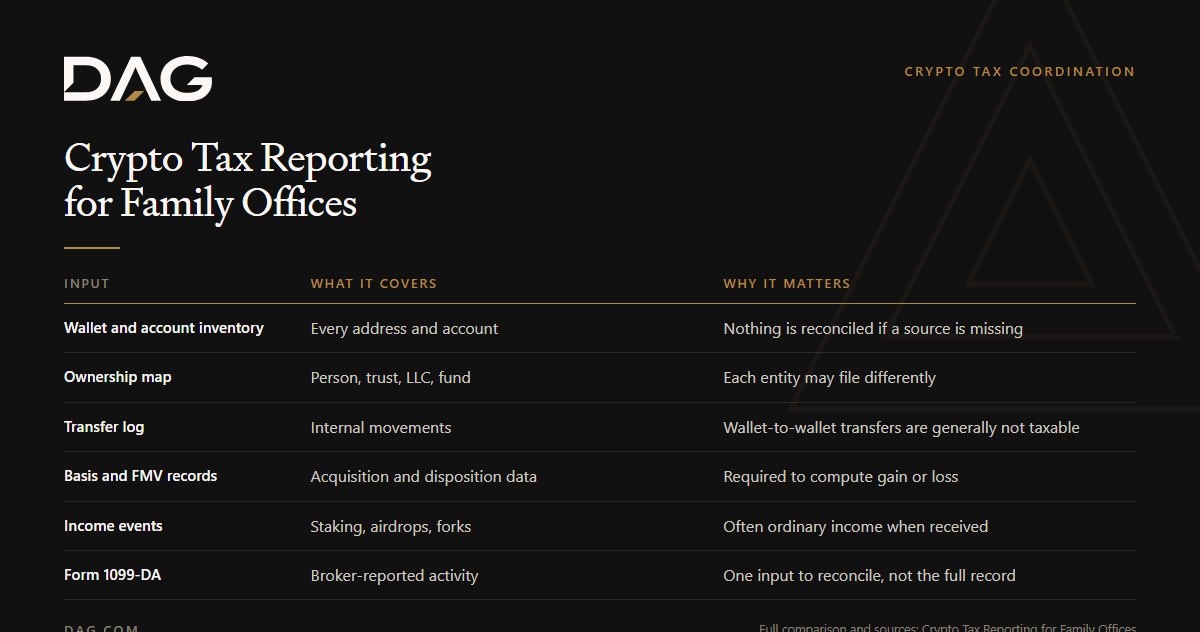
Reporting Inputs at a Glance
| Input | What it covers | Why it matters |
|---|---|---|
| Wallet and account inventory | Every address and account | Nothing is reconciled if a source is missing |
| Ownership map | Person, trust, LLC, fund | Each entity may file differently |
| Transfer log | Internal movements | Wallet-to-wallet transfers are generally not taxable |
| Basis and FMV records | Acquisition and disposition data | Required to compute gain or loss |
| Income events | Staking, airdrops, forks | Often ordinary income when received |
| Form 1099-DA | Broker-reported activity | One input to reconcile, not the full record |
Reporting Method: Strengths and Limits
Most family offices combine multiple methods rather than relying on any single source:
| Method | What it captures well | Where it falls short |
|---|---|---|
| Custodian and exchange statements | Positions and basis the platform tracks | Misses self-custodied and cross-platform transfers |
| On-chain wallet tracking | Self-custodied holdings and transfers | Needs labeling; raw addresses are not audit-ready |
| Portfolio aggregation tooling | A consolidated multi-venue view | Only as accurate as the feeds and basis records behind it |
| Manual entity and trust mapping | Ownership and governance context | Labor-intensive; must be kept current as structures change |
What the Report Delivers Beyond Tax Records
A complete family office crypto report covers more than tax records. A useful reporting package also includes:
- Holdings by asset and location.
- Custodian or wallet location, with qualified-custodian status noted.
- Entity or trust ownership for each position.
- Unrealized gain and loss by position.
- Concentration and approved-versus-unapproved assets measured against the family's digital asset investment policy statement.
- Custody and signer status (single-sig, multi-sig, thresholds).
- Governance notes, including items for the Digital Asset Reporting Dashboard.
Self-custodied assets should appear in the report with care around sensitive access information, a report should reflect holdings and signer arrangements without ever exposing private keys or seed phrases.
Report Distribution and Cadence
Report access generally follows the family's digital asset governance policy and the principle of least privilege. Typical recipients include principals, authorized family office staff, trustees, tax professionals, and advisors as appropriate.
Most families pair a monthly or quarterly position report with event-driven updates when large transfers or structure changes occur. Timing should be confirmed with the relevant fiduciaries.
When a Reporting System May Help
- Multiple family entities own digital assets.
- Wallets and custody accounts are spread across providers.
- Staking or airdrops raise income-timing questions.
- Trusts or LLCs hold crypto.
- A CPA needs consolidated records.
- Trustees or the investment committee need risk visibility alongside traditional assets.
When It May Not Be Enough
Reporting depends on data quality. Wallet labels, transfer matching, basis records, and custodian feeds often need cleanup before a report is trustworthy. A clean report does not remove market, custody, or tax risk, it makes that risk visible. Tax classification, filing positions, and entity-level reporting obligations require professional review. Consult a qualified tax professional on your specific facts.
Related Questions
Should transfers be tracked separately from sales?
Generally yes. Wallet-to-wallet transfers between accounts the same owner controls are typically not taxable, while sales and swaps usually are. Matching transfers prevents internal movements from being misread as taxable dispositions, but a tax professional should confirm treatment for your specific facts.
Should each trust be reported separately?
That depends on the trust type and its tax status. Some trusts file their own returns while others pass through to grantors or beneficiaries. A qualified tax professional should determine the filing obligations for each structure.
Does Form 1099-DA solve family office reporting?
No. Form 1099-DA is one input. It generally does not capture self-custody activity, pre-reporting years, or full cost basis across providers, so the family office still needs complete independent records to reconcile against it.
How far back should records go?
Far enough to support every open tax year and the basis of assets still held, which can predate any broker reporting. Reconstructing older history is generally easier with a continuous process than a one-time scramble.
Should crypto appear with traditional assets on the family balance sheet?
Generally yes, if it is material. Leaving digital assets off the consolidated view tends to hide real risk, liquidity, and estate exposure. Crypto may warrant separate detail, but it should not be invisible to the investment committee or trustees.
Who should receive the family office crypto report?
Principals, authorized family office staff, trustees, tax professionals, and advisors as appropriate. Access generally tracks the family's governance policy and the principle of least privilege, never expose private keys or seed phrases in a distributed document.
How often should a family office produce a crypto report?
Many families pair a monthly or quarterly position report with event-driven updates when large transfers, structural changes, or material price moves occur. Cadence should be confirmed with the relevant fiduciaries and investment committee.
Sources
Compliance Note
This article is for general educational purposes and is not tax, legal, accounting, or investment advice. Consult a qualified tax and legal professional before making decisions about your specific situation.