
A family office should report crypto by consolidating every wallet, custodian, exchange, fund, ETF, SMA, trust, and LLC into one governed view that shows holdings, cost basis, unrealized gain or loss, concentration, custody status, and tax notes. Good family office crypto reporting makes digital assets legible to principals, trustees, CPAs, and the investment committee, not just to whoever holds the keys.
What Crypto Reporting Means for a Family Office
Crypto reporting is the recurring package that pulls fragmented on-chain and exchange positions into the family balance sheet alongside traditional assets. It is not a price screen. It answers ownership (which entity or trust holds the asset), location (which custodian or wallet), basis (what was paid and when), and control (who can sign). A useful report ties each line back to source data a CPA or auditor can reconcile. This sits inside broader crypto wealth management and supports the way an investment committee reviews crypto.
Why This Matters
Crypto often sits outside traditional portfolio reporting. If a family office only sees brokerage assets, it can miss material risk, liquidity, tax, and estate exposure. Bringing digital assets onto the reporting dashboard lets trustees and the investment committee see the whole picture, and it gives CPAs the tax-ready detail they need at year end.
What Goes in the Report
A crypto reporting package generally includes:
- Holdings by asset and location.
- Custodian or wallet location, with qualified-custodian status noted where it applies.
- Entity or trust ownership for each position.
- Cost basis and unrealized gain/loss.
- Income from staking or rewards, flagged as taxable in the year received under general IRS treatment of digital assets.
- Transfers and on-chain transaction activity.
- Concentration risk against the family's allocation policy.
- Approved versus unapproved assets per the investment policy statement.
- Custody and signer status (single-sig, multi-sig, thresholds).
- Tax and reporting notes, including items relevant to Form 1099-DA reconciliation.
Reporting Method: Strengths and Limits
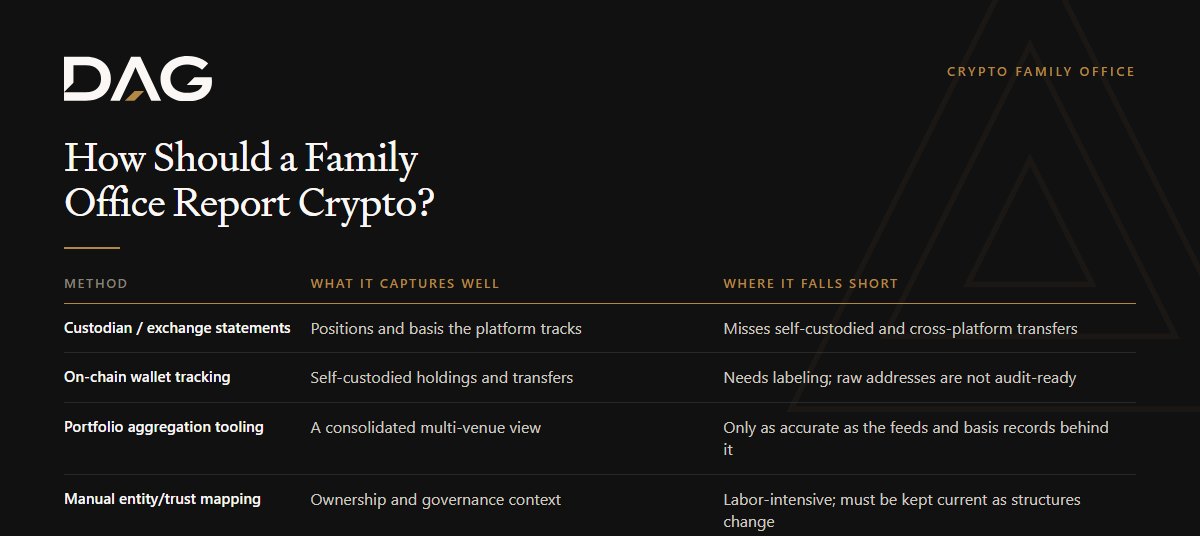
| Method | What it captures well | Where it falls short |
|---|---|---|
| Custodian / exchange statements | Positions and basis the platform tracks | Misses self-custodied and cross-platform transfers |
| On-chain wallet tracking | Self-custodied holdings and transfers | Needs labeling; raw addresses are not audit-ready |
| Portfolio aggregation tooling | A consolidated multi-venue view | Only as accurate as the feeds and basis records behind it |
| Manual entity/trust mapping | Ownership and governance context | Labor-intensive; must be kept current as structures change |
Most family offices combine these rather than relying on any single source.
Evidence Standard
This article is a reporting framework and does not describe a specific family office report. Third parties named in Sources are referenced for general context, not as endorsements or comparative claims.
When It May Help
- Digital assets are held across multiple platforms.
- A trust or LLC owns part of the exposure, see how this fits the family's custody policy.
- CPAs need tax-ready data.
- Trustees need oversight.
- Investment committees need risk visibility.
When It May Not Be Enough
Reporting depends on data quality. Wallet labels, transfer matching, basis records, and custodian feeds often need cleanup before a report is trustworthy. A clean report does not remove market, custody, or tax risk; it makes that risk visible so the family can manage it. Decisions about structure and disclosure generally depend on the facts and should be reviewed with a qualified tax and legal professional.
Related Questions
Should crypto appear with traditional assets?
Generally yes, if it is material to the family balance sheet. It may warrant separate detail, but leaving it off the consolidated view tends to hide real exposure.
Should self-custodied assets be reported?
Yes, with care around sensitive access information. A report should reflect holdings and signer arrangements without ever exposing private keys or seed phrases.
Who should receive the report?
Principals, authorized family office staff, trustees, tax professionals, and advisors as appropriate. Access generally tracks the family's governance policy and the principle of least privilege.
How often should a family office report crypto?
It depends on volatility, activity, and committee cadence. Many families pair a monthly or quarterly position report with event-driven updates when large transfers or structure changes occur; confirm timing with the relevant fiduciaries.
Bottom Line
Family office crypto reporting should turn fragmented wallets and accounts into a governed view of digital asset wealth, one that principals, trustees, and CPAs can act on.
Sources
Compliance Note
This article is for general educational purposes and is not accounting, tax, custody, legal, or investment advice.