
A family office investment committee should review crypto through a documented process that weighs the investment thesis, custody model, liquidity, tax, legal structure, concentration and counterparty risk, reporting, and exit rules together. Treating a digital asset as more than a ticker, the committee evaluates how each allocation fits the family's mandate and which risks it cannot remove.
What "Committee Review" Means Here
In this context, an investment committee review is the governing body's formal decision process for approving, sizing, or rejecting a digital asset position, and for setting the conditions under which it is held. The point is to apply the same diligence the family office already uses for other asset classes rather than to chase price. That diligence sits inside a broader governance framework for digital assets, so committee decisions tie back to a written policy rather than ad hoc judgment.
Committee Review Topics
A complete review generally covers each of the following:
- Investment thesis, why the asset, why now, and the role it plays in the portfolio.
- Proposed allocation, position size and how it affects overall crypto allocation limits.
- Permitted vehicles, spot tokens, funds, ETPs, or separately managed accounts, and which are allowed under policy.
- Custody model, self-custody (multi-sig, cold storage) versus a qualified custodian holding assets under the SEC custody rule, with SOC 1 / SOC 2 reports requested.
- Liquidity and tax needs, redemption terms, and the fact that the IRS generally treats digital assets as property, so disposals are typically taxable events.
- Concentration risk, single-asset, single-protocol, and single-custodian exposure.
- Trust and LLC ownership, whether the position is titled in a trust or LLC for charging-order protection and estate planning.
- Counterparty risk, exchange, lender, and custodian solvency.
- Reporting requirements, valuation source, frequency, and what the committee sees each period.
- Exit or rebalancing rules, the triggers that reduce or unwind a position.
Documents the Committee Should Request
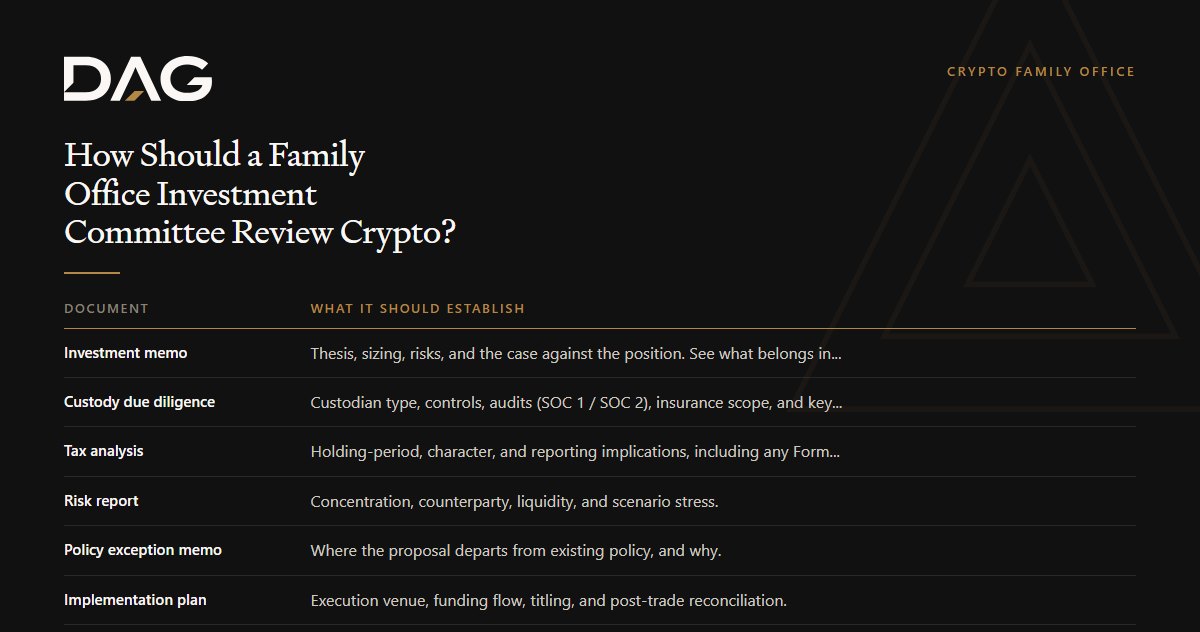
For each proposal, the committee may ask for a defined documentation set so decisions rest on evidence rather than a verbal pitch:
| Document | What it should establish |
|---|---|
| Investment memo | Thesis, sizing, risks, and the case against the position. See what belongs in a crypto investment memo. |
| Custody due diligence | Custodian type, controls, audits (SOC 1 / SOC 2), insurance scope, and key management. |
| Tax analysis | Holding-period, character, and reporting implications, including any Form 1099-DA considerations. |
| Risk report | Concentration, counterparty, liquidity, and scenario stress. |
| Policy exception memo | Where the proposal departs from existing policy, and why. |
| Implementation plan | Execution venue, funding flow, titling, and post-trade reconciliation. |
Ongoing Oversight
A position approved once is not approved forever. Crypto allocations should be reviewed on a set schedule and after material events such as token unlocks, custodian changes, regulatory developments, or large price moves. Standing oversight pairs well with a recurring family-office risk report so the committee tracks the same metrics period over period. None of this removes market, custody, or tax risk; review reduces surprises, not the underlying volatility of the asset class.
Related Questions
Who should sit on a family office crypto investment committee?
Membership depends on the family's structure, but committees generally include the CIO or an investment lead, someone accountable for operations and custody, and access to tax and legal counsel. Independent or outside expertise can help where in-house digital asset knowledge is thin. Roles and authority should be defined in writing.
How often should the committee review crypto allocations?
There is no fixed rule. Many family offices set a periodic cadence (for example, quarterly) and add event-driven reviews triggered by unlocks, custodian or regulatory changes, or large moves. The right frequency depends on position size, liquidity, and the family's risk tolerance; document whatever you choose.
Does using a qualified custodian remove the committee's diligence duty?
No. A qualified custodian and SOC reports address some custody risk, but the committee still has to assess counterparty exposure, valuation, concentration, and tax. Registration or custodian status alone does not guarantee skill or outcomes, and it does not eliminate market, custody, or tax risk. Consult qualified custody and legal professionals.
Sources
- SEC Investor.gov: Crypto Assets
- SEC: Investor Bulletin, Custody of Your Investment Assets
- IRS: Digital assets
Compliance Note
This article is educational and does not provide legal, tax, investment, fiduciary, governance, or custody advice. Family office committees should consult qualified advisors.