
A family office crypto custody policy is a written governance document that defines where digital assets may be held, who can approve transfers, which custodians or wallets are permitted, how keys are controlled, how activity is reported, and what happens during incapacity or death. It turns custody from a personal habit into a documented, supervisable process.
What a Crypto Custody Policy Is
In a family office context, a custody policy is the control layer for digital assets: the rulebook that separates the people who hold keys from the people who authorize movement, and records both. Where a crypto family office holds assets directly rather than only through funds, this policy is what makes custody auditable instead of dependent on one person's memory. It typically sits alongside a broader digital asset governance policy and an investment policy statement.
Why This Matters
Custody is the control layer of crypto wealth. If a family office cannot identify who can move assets, approve transactions, recover access, and document activity, it has an operational risk problem even when the investment thesis is sound. A policy does not remove market, custody, or technology risk; it makes the points of control explicit so they can be supervised, tested, and improved.
What a Custody Policy Should Cover
A custody policy generally addresses the following areas. Use it as a checklist when drafting or reviewing your own:
- Approved custodians and platforms, including whether they are qualified custodians and whether SOC 1 / SOC 2 reports are on file.
- Self-custody rules and prohibited custody methods, where keys may live and what is not allowed.
- Multi-signature or MPC requirements, quorum thresholds for signing.
- Transfer approval thresholds, dollar or asset limits that trigger additional sign-off.
- Emergency access procedures, recovery paths that do not depend on a single individual.
- Staking and delegation authority, who may stake, with which validators, and within what limits.
- Account titling and entity ownership rules, how wallets map to LLCs, trusts, or other entities.
- Trustee, family member, and advisor permissions, read versus approve versus initiate.
- Reporting and reconciliation requirements, frequency and who reviews.
- Incident response and succession procedures, what happens after a breach, incapacity, or death.
For the detailed custody-platform comparison itself, pair this with crypto due diligence for family offices, which evaluates custodians against these criteria.
Custodial vs. Self-Custody: How They Differ
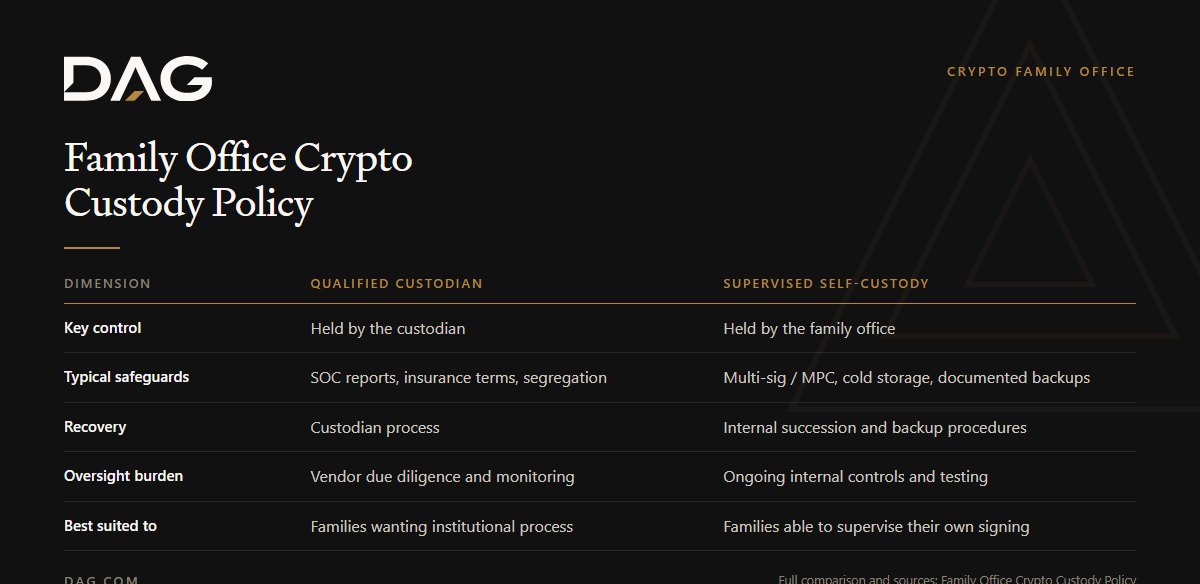
| Dimension | Qualified custodian | Supervised self-custody |
|---|---|---|
| Key control | Held by the custodian | Held by the family office |
| Typical safeguards | SOC reports, insurance terms, segregation | Multi-sig / MPC, cold storage, documented backups |
| Recovery | Custodian process | Internal succession and backup procedures |
| Oversight burden | Vendor due diligence and monitoring | Ongoing internal controls and testing |
| Best suited to | Families wanting institutional process | Families able to supervise their own signing |
Many family offices use both, and the policy should state the rationale for each. Coverage terms (where any exist) are set by the custodian's own agreements; crypto custody is not covered by FDIC or SIPC insurance, and no arrangement removes the risk of loss.
Evidence Standard
This article provides a policy framework, not sample legal language or a case study. Any sample policy should be reviewed by counsel, compliance, tax, and security professionals before use.
When It May Help
- A family office holds direct digital assets.
- Multiple people can approve or request transfers.
- Assets are spread across wallets, custodians, exchanges, and funds.
- Trustees or successors may need future access.
- The family office wants documented, institution-style controls.
When It May Not Be Enough
A policy is only useful if followed. Pair it with custody agreements, written operating procedures, technical controls, training, and periodic testing. A companion crypto custody policy template for family offices can give you a starting structure to adapt with your advisers.
Related Questions
Should the policy allow self-custody?
Generally only if the family office can supervise it. Self-custody needs documented signing rules, backups, access controls, and succession procedures, and the answer depends on the family's operational capacity.
Should a family office use one custodian?
Not necessarily. Some families diversify custody relationships to reduce single-vendor dependence, while others prefer operational simplicity. The policy should state the rationale either way.
Should trustees be included?
Yes, where trusts own or may inherit digital assets. Trustee authority and custody procedures should match so that titling and signing rights stay consistent.
How often should a custody policy be reviewed?
There is no fixed rule, but many family offices review after any custodian change, security incident, or major allocation shift, and on a regular calendar otherwise. Consult qualified counsel and security professionals.
Bottom Line
A family office crypto custody policy protects against informal control. It records who can move assets, where assets may be held, and how access survives real events. Reviewing it sits within the broader work of the Crypto Family Office Hub.
Sources
Compliance Note
This article is for general educational purposes and is not legal, tax, custody, cybersecurity, or investment advice.