
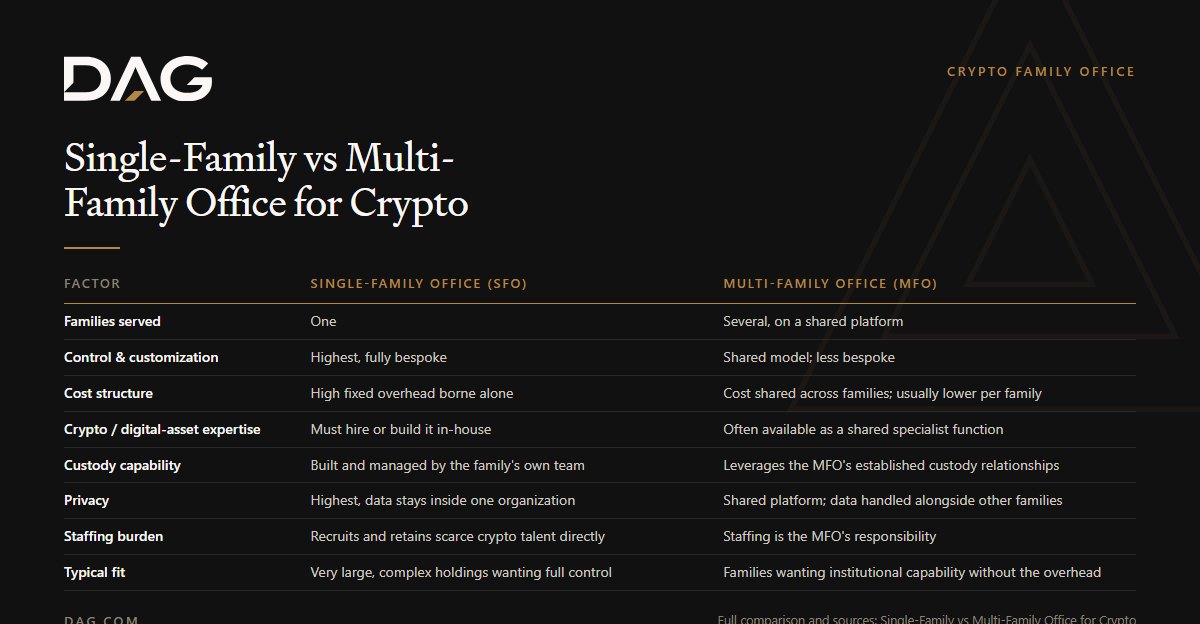
A single-family office (SFO) serves one family with a dedicated, in-house team; a multi-family office (MFO) serves several families on a shared platform. For crypto, the choice turns on the same factors as traditional wealth, control, cost, and privacy, plus a digital-asset-specific one: which model gives the family the custody, key-management, and reporting capability it actually needs without building rare in-house expertise from scratch.
Defining the Two Models
A single-family office is a private organization a family builds and staffs to manage only its own wealth. It offers maximum control and customization and the most privacy, at the cost of carrying all the overhead and hiring scarce crypto-qualified staff directly.
A multi-family office is a firm that serves multiple families, sharing investment, custody, reporting, and tax infrastructure across them. It spreads cost and gives access to specialists, including digital-asset expertise, that a single family might not be able to hire alone, in exchange for less exclusivity and customization.
The decision sits inside the broader question of how much crypto is enough to need a family office and, before that, whether a family office is the right vehicle at all versus a crypto wealth manager.
SFO vs MFO for Crypto: Comparison
| Factor | Single-Family Office (SFO) | Multi-Family Office (MFO) |
|---|---|---|
| Families served | One | Several, on a shared platform |
| Control & customization | Highest, fully bespoke | Shared model; less bespoke |
| Cost structure | High fixed overhead borne alone | Cost shared across families; usually lower per family |
| Crypto / digital-asset expertise | Must hire or build it in-house | Often available as a shared specialist function |
| Custody capability | Built and managed by the family's own team | Leverages the MFO's established custody relationships |
| Privacy | Highest, data stays inside one organization | Shared platform; data handled alongside other families |
| Staffing burden | Recruits and retains scarce crypto talent directly | Staffing is the MFO's responsibility |
| Typical fit | Very large, complex holdings wanting full control | Families wanting institutional capability without the overhead |
Figures are deliberately omitted here because per-family cost varies widely; for fee models and illustrative ranges see crypto family office pricing and fee structures.
How to Choose
The deciding questions are usually:
- Scale. Is the wealth large and complex enough to justify the fixed cost of a dedicated SFO, or is shared infrastructure more efficient?
- Control vs. convenience. Does the family want a fully bespoke, private operation, or institutional capability without running it themselves?
- Crypto expertise. Can the family realistically hire and retain digital-asset specialists, or is shared access to that expertise more reliable?
- Privacy. How important is keeping all data inside a single dedicated organization?
A common path is to start with an MFO or outsourced model and move toward an SFO only as scale and complexity grow. The provider-evaluation criteria for either path are in how to choose a crypto family office, and the underlying systems either model relies on are mapped in the crypto family office technology stack.
Related Questions
Is a single-family office or multi-family office better for crypto?
Neither is universally better; it depends on scale, the desire for control and privacy, and whether the family can staff crypto expertise itself. An SFO offers maximum control, customization, and privacy at high fixed cost; an MFO offers shared institutional capability and lower per-family cost with less exclusivity. Many families start with an MFO and consider an SFO only as holdings and complexity grow.
Can a multi-family office handle crypto custody?
Many MFOs that serve digital-asset families work through established institutional custody relationships and multi-sig arrangements rather than each family building custody alone. Capability varies by firm, so confirm exactly what custody, key-management, and reporting an MFO provides before relying on it. No model removes custody risk.
Do you need a single-family office to keep crypto private?
No. A single-family office offers the most privacy because data stays inside one dedicated organization, but a multi-family office or outsourced arrangement can still maintain strong confidentiality through contracts and controls. Privacy is one factor among control, cost, and expertise, weigh it against the others rather than treating it as decisive on its own.
Sources
- SEC: Family Offices (Investment Advisers Act family-office exclusion, Rule 202(a)(11)(G)-1), verify current at sec.gov
- SEC: Investment Adviser Regulation and Form ADV, verify current at sec.gov
Compliance Note
This article is educational only and is not investment, legal, or tax advice. The comparison is general; the right model depends on each family's facts and should be reviewed with qualified professionals. Advisory services are provided by DAG Wealth, an SEC-registered investment adviser. Registration does not imply a certain level of skill or training. No family office model removes market, custody, or tax risk, and no outcome is guaranteed.