
Crypto governance for family offices is the framework of roles, decision rights, approvals, and controls a family enterprise uses to manage digital assets. It answers who may approve an allocation, move coins, choose a custodian, or release a private key, and how those choices are recorded. Good governance does not remove market, custody, or tax risk; it makes the risk visible and accountable.
What Is Crypto Governance for a Family Office?
Crypto governance is the decision architecture that sits above day-to-day crypto activity. Traditional assets are mediated by brokers, banks, and qualified custodians, so authority is partly enforced by third parties. A self-custodied wallet has no such backstop: whoever holds the key can move the asset. Governance restores structure by defining, in advance, who holds which rights and which approvals a transaction requires. For the related operating model, see what a crypto family office is and the broader Crypto Family Office Hub.
Why a Family Office Needs Crypto Governance
Crypto combines investment exposure with operational control in a way most asset classes do not. A single action on a wallet, custodian, transfer, or key can carry portfolio, tax, security, and estate consequences at the same time. Without defined decision rights, the same family member who picks the allocation may also hold the only key and sign the only approval, a concentration that creates both security and fiduciary exposure.
Governance also serves the people around the family: a trustee who needs a position report, a tax preparer who needs cost-basis records for Form 8949 and the incoming Form 1099-DA regime, and an auditor confirming that controls operate as written. The IRS generally treats digital assets as property, so transfers and disposals can be taxable events that records must support.
Roles and Decision Rights
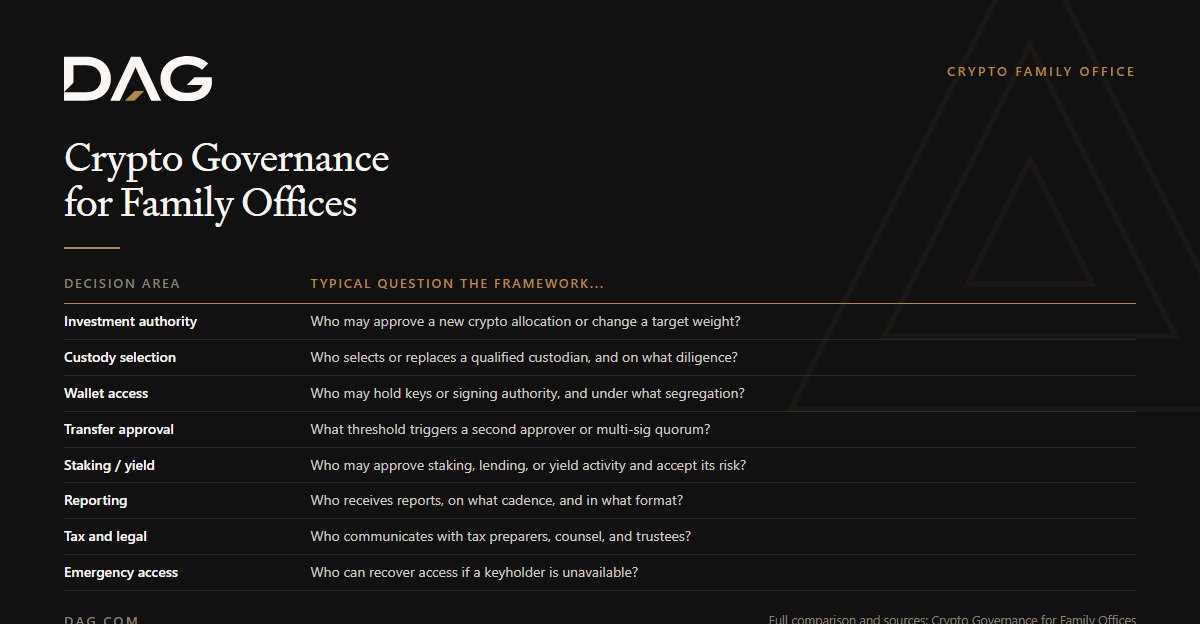
Governance at the framework level is about separating duties, not about line-item rules. A family office should decide, at minimum, who holds each of these rights:
| Decision area | Typical question the framework answers |
|---|---|
| Investment authority | Who may approve a new crypto allocation or change a target weight? |
| Custody selection | Who selects or replaces a qualified custodian, and on what diligence? |
| Wallet access | Who may hold keys or signing authority, and under what segregation? |
| Transfer approval | What threshold triggers a second approver or multi-sig quorum? |
| Staking / yield | Who may approve staking, lending, or yield activity and accept its risk? |
| Reporting | Who receives reports, on what cadence, and in what format? |
| Tax and legal | Who communicates with tax preparers, counsel, and trustees? |
| Emergency access | Who can recover access if a keyholder is unavailable? |
Separating these rights, so that no single person both initiates and approves a material move, is the core governance idea. Multi-signature wallets and approval thresholds are common ways to enforce it. For how a committee operationalizes review, see how a family office investment committee should review crypto and the digital asset governance committee charter.
Governance Framework vs. the Written Policy
This page covers the framework, what governance is and why a family office needs it. The specific clauses a written document should contain (scope, custody standards, approval matrices, reporting templates) belong in the policy itself. For that section-by-section content, see the digital asset governance policy. Written policies reduce ambiguity and help a family office respond consistently when markets move, a family member requests a transfer, or a trustee needs information.
Hypothetical Example
A family office may require two approvals before any crypto transfer above a stated threshold. This is a hypothetical control example, not a statement about any specific family office.
Related Questions
What is crypto governance for a family office?
It is the framework of roles, decision rights, approvals, and controls used to manage digital assets across a family enterprise. It defines who may invest, move assets, select custody, and view reports, generally with duties separated so no one person controls a transaction end to end.
Who should approve crypto transactions in a family office?
That depends on the family's structure, but the common principle is segregation of duties: the person who initiates a transfer should not be the only approver. Many family offices use approval thresholds or multi-signature quorums. The specific design should be set with qualified advisors.
Does crypto governance reduce investment risk?
No framework removes market, custody, or tax risk. Governance is about control and accountability, making sure decisions are authorized, recorded, and reviewable. It can reduce operational and key-management risk but does not guarantee returns or protect against price volatility.
How does governance connect to crypto custody?
Governance sets the rules; custody is one of the things it governs. The framework decides who selects a qualified custodian and what diligence applies, while custody arrangements (cold storage, multi-sig, SOC reports) implement those rules. See the Digital Asset Custody Hub for the custody side.
Sources
Compliance Note
This article is educational and does not provide legal, tax, investment, fiduciary, governance, or custody advice. Family offices should work with qualified advisors to design policies.