
A qualified appraisal for an NFT donation is mandatory once you give an NFT or illiquid token worth over $5,000 to charity as part of any crypto charitable giving strategy: the IRS requires a credentialed appraiser plus Form 8283 Section B with your return. Crypto does not get the exchange-traded-securities exception (CCA 202302012), so a blockchain record or marketplace screenshot will not substitute.
What Is a Qualified Appraisal for Noncash Charitable Donations?
Under IRC § 170(f)(11) and Treasury Reg. § 1.170A-17, a qualified appraisal is a formal written valuation of donated property prepared by a qualified appraiser, an individual with recognized credentials, demonstrated expertise in the type of asset being valued, and no prohibited relationship to the donor or donee. The appraisal must:
- Be conducted no earlier than 60 days before the donation and no later than the due date of the return (including extensions) on which the deduction is claimed
- Use a recognized valuation methodology appropriate for the specific asset type
- Include the appraiser's credentials, qualifications, and signature
- Be attached to the donor's return via Form 8283 Section B for donations exceeding $5,000
The IRS does not accept self-prepared valuations, platform price histories, or exchange-stated values as substitutes for a qualified appraisal on noncash property over the $5,000 threshold.
Does Crypto Get the Exchange-Traded-Securities Exception?
No. Exchange-traded securities donated to charity are generally exempt from the qualified-appraisal requirement because they have a readily determinable fair market value from a public market. The IRS has explicitly stated, in Chief Counsel Advice 202302012 (January 2023), that cryptocurrency does not qualify for this exception, even if it trades on a major exchange with transparent pricing.
NFTs and illiquid tokens are even further removed: they typically lack continuous public-market pricing, have thin or no secondary-market depth, and often involve subjective valuation factors (rarity, utility, provenance, community demand). These characteristics reinforce the requirement rather than diminish it.
Verify current IRS guidance. CCA 202302012 reflects the IRS position as of its publication date. IRS positions on digital assets continue to evolve; confirm current guidance with a qualified tax professional before filing.
How to Satisfy the Qualified-Appraisal Requirement: Step-by-Step
Confirm the donation threshold. If the aggregate fair market value of noncash property donated to a single charity exceeds $5,000 in a tax year, the qualified-appraisal requirement applies. (Publicly traded securities are excluded from the aggregate, but as noted above, crypto is not treated as publicly traded securities for this purpose.)
Identify a qualified appraiser. The appraiser must hold a recognized professional designation or demonstrate education and experience in valuing the specific asset type. For NFTs, this may mean appraisers with expertise in digital art, collectibles, or blockchain-native assets. For illiquid tokens, relevant expertise may include tokenomics, protocol-level analysis, and comparable transaction analysis.
Commission the appraisal within the required window. The appraisal date must fall no earlier than 60 days before the contribution date and no later than the tax return due date (with extensions).
Obtain a written appraisal report. The report must describe the donated property, state the valuation method and its rationale, identify the appraiser's qualifications, and state the appraiser's independence from the donor and donee.
Complete Form 8283 Section B. The appraiser must sign Part III of Section B. The donee organization must also acknowledge the gift in Part IV for donations over $5,000.
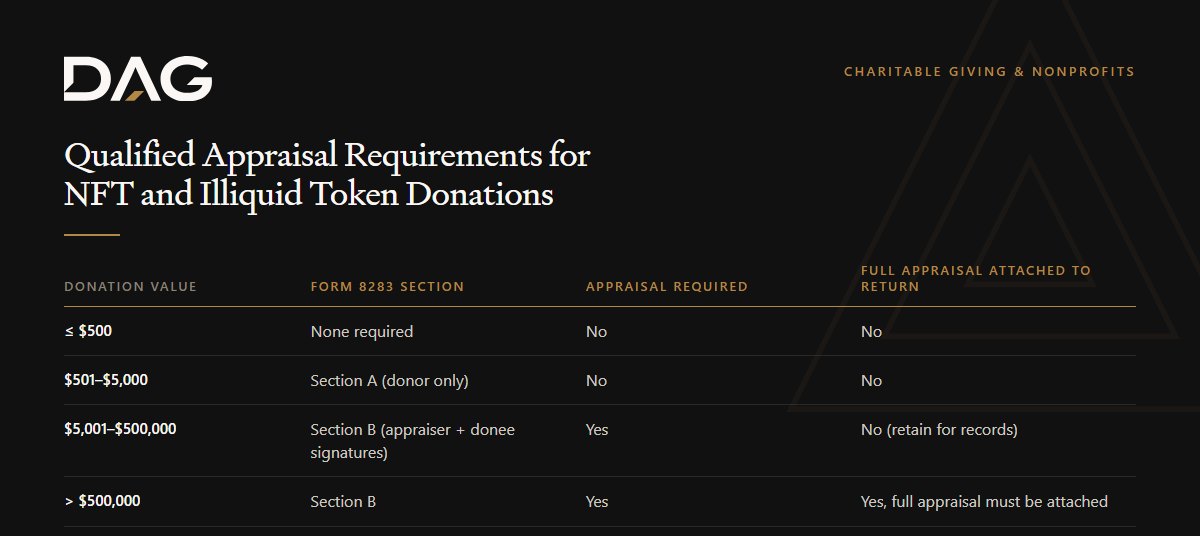
Attach the appraisal summary to your return. For donations exceeding $500,000, the full appraisal (not just the summary) must be attached to the return. For donations between $5,001 and $500,000, the summary on Form 8283 Section B is sufficient, though retaining the full appraisal for your records is strongly advisable.
Retain documentation. Keep the full appraisal, Form 8283 with all required signatures, the charitable acknowledgment letter, and any supporting documentation of the transfer on-chain.
Qualified-Appraisal Threshold Checklist
| Donation Value | Form 8283 Section | Appraisal Required | Full Appraisal Attached to Return |
|---|---|---|---|
| ≤ $500 | None required | No | No |
| $501–$5,000 | Section A (donor only) | No | No |
| $5,001–$500,000 | Section B (appraiser + donee signatures) | Yes | No (retain for records) |
| > $500,000 | Section B | Yes | Yes, full appraisal must be attached |
All thresholds above: verify against current IRS instructions for Form 8283 before filing, as these figures are subject to change.
Why Marketplace Prices and Blockchain Records Are Not Enough
The IRS's position is procedural: even a legitimate donation at a documented fair market value can have its deduction disallowed if the appraisal requirement was not followed. Courts have upheld disallowance on purely procedural grounds where the taxpayer failed to obtain a qualified appraisal, even when the charitable transfer itself was not in dispute.
For NFTs specifically, blockchain-recorded transfer history establishes that a transfer occurred, it does not establish value. OpenSea floor prices, last-sale records, or rarity rankings are data points an appraiser may incorporate, but they do not constitute a qualified appraisal.
For illiquid tokens (tokens with limited secondary-market activity, vesting restrictions, lock-up periods, or no established exchange listing), the valuation challenge is compounded: an appraiser may need to apply a discount for lack of marketability or use an income or cost approach rather than a market approach.
This complexity is part of why coordination between the donor, a qualified tax professional, and a qualified appraiser, ideally before the donation is made, not after, is important for larger digital-asset charitable gifts. See crypto charitable giving for high-net-worth investors for broader strategy context, and crypto tax planning for HNW investors for how this fits into an overall tax picture.
Related Questions
What happens if I forgot to get a qualified appraisal before donating?
The deduction may be disallowed on audit. In some cases, a qualified appraisal obtained before the return is filed (within the allowed window) can cure the deficiency, but once the return is filed and the window has closed, the option to cure retroactively is extremely limited. Courts have generally held that the appraisal requirement is not subject to substantial compliance relief for noncash donations over the threshold. Consult a qualified tax professional immediately if you are in this situation.
Is a DAF (donor-advised fund) donation of an NFT subject to the same appraisal rules?
Yes. Donating an NFT or illiquid token to a donor-advised fund is still a contribution of noncash property. If the value exceeds $5,000, the qualified-appraisal requirement applies to the initial contribution to the DAF, not to subsequent grants from the DAF to operating charities. The DAF sponsor may also have its own internal policies on accepting digital assets, and many sponsors require the donor to arrange for liquidation or have a pre-established acceptance process.
Does donating a token through a Charitable Remainder Trust (CRT) or other structure change the appraisal requirement?
Transferring appreciated digital assets to a charitable remainder trust or similar vehicle is itself a noncash contribution and may trigger the appraisal requirement if the assets exceed the threshold. Structure does not eliminate the requirement, it may shift when and how the requirement applies. A qualified tax attorney and CPA should be involved in any multi-structure charitable giving strategy involving digital assets. See crypto estate planning for high-net-worth families for planning context.
Can a family office handle the appraisal coordination?
A family office or a registered investment adviser operating under fiduciary duty can coordinate the process, identifying qualified appraisers, managing timing, ensuring Form 8283 is properly executed, and integrating the donation into the broader tax and estate plan. This coordination is part of digital asset wealth management for high-net-worth families. The adviser does not perform the appraisal (that role is reserved for a qualified appraiser), but pre-donation coordination substantially reduces the risk of a procedural disallowance.
Sources
- IRC § 170(f)(11). Qualified appraisal requirement for noncash contributions: https://www.law.cornell.edu/uscode/text/26/170
- Treasury Reg. § 1.170A-17. Qualified appraisal and qualified appraiser defined: https://www.ecfr.gov/current/title-26/chapter-I/subchapter-A/part-1/section-1.170A-17
- IRS Chief Counsel Advice 202302012 (January 10, 2023). Cryptocurrency not treated as publicly traded securities for noncash charitable contribution appraisal purposes: https://www.irs.gov/pub/irs-wd/202302012.pdf
- IRS Form 8283 and Instructions. Noncash Charitable Contributions: https://www.irs.gov/forms-pubs/about-form-8283
- IRS Publication 561. Determining the Value of Donated Property: https://www.irs.gov/publications/p561
Compliance Note
This page is educational only and does not constitute tax, legal, or investment advice. IRS rules governing digital-asset charitable contributions, qualified appraisals, and Form 8283 requirements are subject to change and ongoing regulatory development. Tax consequences vary based on individual circumstances, asset type, holding period, donation structure, and applicable state law. Consult a qualified tax attorney and CPA before making any charitable donation of digital assets. Nothing on this page should be relied upon as a guarantee of any tax outcome, deduction, or valuation result.
DAG coordinates charitable giving strategy as part of integrated family office and wealth management services. Qualified appraisals and tax filings are performed by the donor's independent appraiser and CPA; DAG coordinates the process and does not provide legal advice or perform appraisals. Advisory services are provided by DAG Wealth, an SEC-registered investment adviser. Registration does not imply a certain level of skill or training.