
Yes. Many donor-advised fund (DAF) sponsors accept direct crypto charitable giving contributions. Donating appreciated crypto held longer than one year to a qualifying DAF can avoid capital gains and generate a fair-market-value deduction (up to 30% of AGI). The gift is irrevocable, no deduction is guaranteed, and documentation rules apply, so verify the specifics first.
What Is a Donor-Advised Fund?
A donor-advised fund is a charitable giving account sponsored by a 501(c)(3) public charity. You make an irrevocable contribution to the sponsoring organization, take the charitable deduction in the year of the gift, and then recommend grants to qualifying nonprofits over time. The sponsoring organization retains legal control; your grant recommendations are advisory, not binding, though most sponsors follow them.
DAFs are a widely used vehicle for structured charitable giving because they eliminate the administrative burden of running a private foundation while preserving timing flexibility for grants. They are often used by donors in roughly the seven- to eight-figure giving range (illustrative, not a regulatory threshold).
Which DAF Sponsors Accept Direct Crypto?
Not all DAFs accept cryptocurrency. The ones that do generally fall into two groups:
- Large national DAF sponsors affiliated with major asset managers, several accept Bitcoin, Ethereum, and a range of other digital assets directly
- Crypto-native giving platforms, sponsors built specifically to accept crypto and convert it to cash for grantmaking, often supporting a wider list of assets
Sponsors that accept crypto typically liquidate it promptly after receipt. You donate the asset in-kind; you do not retain control over when or how the sponsor sells it.
Always verify current acceptance policies directly with the sponsor before initiating a transfer. Accepted asset lists and minimum transfer amounts change.
How Does Donating Crypto to a DAF Work?
Step-by-step process
- Choose a DAF sponsor that accepts your specific cryptocurrency (confirm the asset, minimum amount, and transfer method, on-chain address vs. exchange transfer).
- Confirm holding period, the crypto must have been held longer than 12 months to qualify for long-term capital gains treatment and a full fair-market-value deduction.
- Get a qualified appraisal if the donation exceeds $5,000. For crypto contributions above this threshold, IRS rules generally require a qualified appraisal and Form 8283 (Section B). (Threshold and form requirement as of the 2024 tax year, verify for the applicable year before filing.)
- Transfer the crypto to the sponsor's wallet address. Do not sell it first; the benefit depends on donating the asset directly.
- Document the transaction, retain blockchain confirmation, sponsor acknowledgment letter, and appraisal (if required).
- Claim the deduction on Schedule A. The deduction is generally limited to 30% of adjusted gross income (AGI) for appreciated non-cash assets (capital-gain property) donated to a public charity. Unused amounts can generally be carried forward up to five years. (AGI limit and carryforward as of the 2024 tax year, verify for the applicable year.)
- Recommend grants from your DAF account to qualifying nonprofits at any time.
Key Rules and Limitations
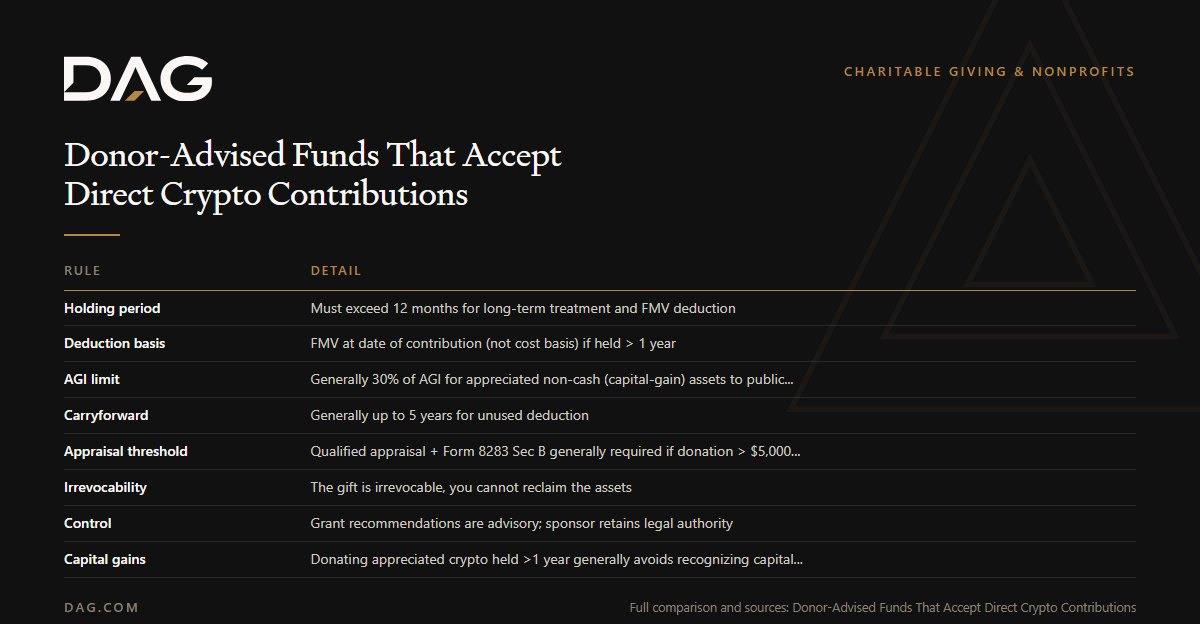
| Rule | Detail |
|---|---|
| Holding period | Must exceed 12 months for long-term treatment and FMV deduction |
| Deduction basis | FMV at date of contribution (not cost basis) if held > 1 year |
| AGI limit | Generally 30% of AGI for appreciated non-cash (capital-gain) assets to public charities (2024 tax year, verify) |
| Carryforward | Generally up to 5 years for unused deduction |
| Appraisal threshold | Qualified appraisal + Form 8283 Sec B generally required if donation > $5,000 (2024, verify) |
| Irrevocability | The gift is irrevocable, you cannot reclaim the assets |
| Control | Grant recommendations are advisory; sponsor retains legal authority |
| Capital gains | Donating appreciated crypto held >1 year generally avoids recognizing capital gains |
| Deduction not guaranteed | IRS can challenge valuation, holding period, or appraisal adequacy |
DAF vs. Private Foundation for Crypto Giving
For most high-net-worth donors, a DAF is simpler. A private foundation gives you more control over grantmaking and investment management but carries significant administrative obligations: annual Form 990-PF filings, excise tax compliance, mandatory distribution requirements (generally 5% of assets annually), and public disclosure of grants and compensation.
At larger asset levels, especially where multi-generational family involvement in grantmaking is the goal, a private foundation may justify the overhead. For most crypto donors making a one-time or periodic major gift, a DAF provides comparable tax benefits with far less complexity.
For how this fits into broader crypto tax planning for high-net-worth investors, coordinating a DAF contribution with your annual tax position is the most common strategy.
Coordinating Crypto DAF Gifts With Wealth Planning
A DAF contribution is most effective when it is timed and sized as part of a larger tax plan. Relevant coordination points:
- Concentration events: Token unlocks, large sales, or liquidity events create elevated AGI in a specific year, a DAF contribution in the same year maximizes deduction value. See token sale tax planning and crypto liquidity planning after a token sale.
- Estate planning: For donors integrating charitable giving into estate structures, DAFs complement trust-based strategies. See crypto estate planning for high-net-worth families.
- Charitable giving strategy: For a broader overview of direct crypto donations and alternatives, see crypto charitable giving for high-net-worth investors and crypto charitable giving.
- Wealth architecture: DAF strategy integrates with the overall structure covered in the five-part crypto wealth architecture.
Related Questions
Can you donate crypto that has lost value to a DAF?
You can, but it rarely makes tax sense. If the crypto has declined below your cost basis, selling it first, realizing the capital loss, and donating the cash proceeds is generally more tax-efficient. You capture the loss deduction and still get the charitable deduction on the cash gift.
Does donating crypto to a DAF trigger a taxable event?
A direct in-kind contribution of appreciated crypto to a qualifying DAF is generally not a taxable disposition for the donor. The capital gain is neither realized by the donor nor recognized by the DAF (which is tax-exempt). This is the core tax benefit, but it depends on proper characterization and documentation. Consult a qualified tax professional before executing.
What happens if the DAF sponsor sells the crypto at a loss after you donate it?
Once donated, the asset belongs to the sponsoring charity. Any gain or loss on the subsequent sale accrues to the charity, not to you. You have no recourse and no ability to direct the timing or price of the sale.
Is there a minimum or maximum size for crypto DAF contributions?
Minimums vary by sponsor, some require $5,000 in total DAF contributions to open an account; others are lower. There is no statutory maximum, but the AGI limitation caps how much of the deduction you can use in a single year. Very large contributions may require multiple years to fully utilize.
Do DAFs accept NFTs or DeFi tokens?
Most major DAF sponsors accept only liquid, market-priced cryptocurrencies (Bitcoin, Ethereum, and select others). NFTs and illiquid or novel DeFi tokens are generally not accepted due to valuation complexity. Some crypto-native giving platforms may accept a wider range, verify directly with the sponsor.
Sources
- IRS Publication 526. Charitable Contributions: https://www.irs.gov/publications/p526
- IRS Form 8283 and Instructions. Noncash Charitable Contributions: https://www.irs.gov/forms-pubs/about-form-8283
- IRS Notice 2014-21. Virtual Currency Guidance: https://www.irs.gov/irb/2014-16_IRB#NOT-2014-21
- IRS Revenue Ruling 2023-14. Crypto staking income (context for asset characterization): https://www.irs.gov/pub/irs-drop/rr-23-14.pdf
- IRC § 170(e)(1). Reduction of deduction for appreciated property
- IRC § 170(b)(1)(B)(ii), 30% AGI limitation for capital gain property to public charities
Compliance Note
This page is educational only and does not constitute legal, tax, investment, or financial advice. Charitable giving strategies, including DAF contributions, appraisal requirements, deduction limits, and crypto tax treatment, depend on individual circumstances and are subject to change. A charitable gift to a DAF is irrevocable, and no charitable deduction is guaranteed; the IRS can challenge valuation, holding period, or appraisal adequacy. IRS rules on cryptocurrency valuation and reporting are evolving; thresholds and AGI limitations cited here should be verified for the applicable tax year. Establishing a DAF involves legal and tax matters; the firm coordinates with your tax and legal advisers and does not provide legal advice. Consult a qualified tax attorney or CPA before executing any charitable giving strategy involving digital assets.
Advisory services are provided by DAG Wealth, an SEC-registered investment adviser. Registration does not imply a certain level of skill or training.