
A crypto giving circle structure is a way for a group, often a DAO, token community, or set of investors, to pool digital assets and grant them to charity together. The structure determines who gets the charitable deduction and how the gift is reported. The key design choice is whether each member donates individually into a shared charitable vehicle or whether one entity receives the pooled assets.
What Is a Crypto Giving Circle?
A giving circle is a group of donors who pool resources and decide together where to grant them. For crypto communities, the appeal is collective impact and shared governance, but the tax mechanics turn on who is treated as the donor. A pooled, un-incorporated wallet that simply collects coins is not a charity, so contributions into it do not by themselves produce a deduction, the deduction generally arises only when assets reach a qualified 501(c)(3).
This is distinct from a single-donor donor-advised fund crypto contributions account and from the entity menu in nonprofit structure options for digital assets. A giving circle adds the coordination layer: multiple contributors, shared decisions, one charitable destination.
How Crypto Giving Circles Are Commonly Structured
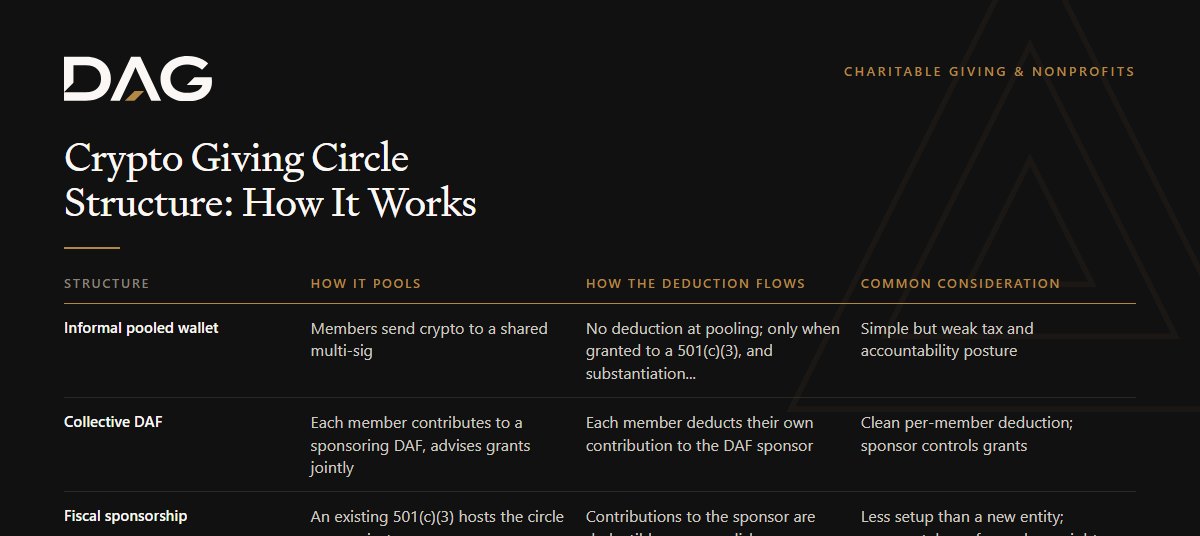
There is no single legal form for a giving circle. The common structures, in rough order of formality:
| Structure | How it pools | How the deduction flows | Common consideration |
|---|---|---|---|
| Informal pooled wallet | Members send crypto to a shared multi-sig | No deduction at pooling; only when granted to a 501(c)(3), and substantiation is messy | Simple but weak tax and accountability posture |
| Collective DAF | Each member contributes to a sponsoring DAF, advises grants jointly | Each member deducts their own contribution to the DAF sponsor | Clean per-member deduction; sponsor controls grants |
| Fiscal sponsorship | An existing 501(c)(3) hosts the circle as a project | Contributions to the sponsor are deductible; sponsor disburses | Less setup than a new entity; sponsor takes a fee and oversight |
| New 501(c)(3) | The circle forms its own charity | Contributions to the charity are deductible | Most control; see forming process |
The cleanest tax outcome usually comes from routing each member's gift to a qualified charity, a DAF sponsor, a fiscal sponsor, or a formed 501(c)(3), rather than into a shared personal wallet. If the circle wants its own entity, see how to start a 501(c)(3) that accepts crypto.
How the Charitable Deduction Flows
The deduction follows the donor to the qualified charity, not the pool.
- Member-level deduction. When each member contributes appreciated crypto directly to a qualifying charity (DAF sponsor, fiscal sponsor, or the circle's own 501(c)(3)), that member may claim their own deduction, subject to AGI limits, holding-period rules, and substantiation. Gifts over $5,000 generally need a qualified appraisal and Form 8283, Section B.
- No deduction for pooling alone. Sending coins to a shared wallet that is not a qualified charity does not create a deduction; it can also create gift-tax and recordkeeping questions among members.
- Avoiding a taxable sale. Each member contributing crypto in-kind to a qualified charity generally avoids recognizing gain, the same non-recognition benefit discussed across crypto charitable giving for high-net-worth investors.
AGI limits, the $5,000 appraisal threshold, and form numbers reflect IRS rules current as of mid-2026 and are illustrative; verify the current rules for the applicable tax year.
Governance for a Crypto Giving Circle
Pooled crypto raises control questions that benefit from written governance before any assets move:
- Custody and signers. Use multi-sig or a qualified custodian with documented signer roles and succession; avoid one member holding sole keys.
- Grant decisions. Define how grant recommendations are proposed and approved (token vote, member vote, committee), recognizing that with a DAF or sponsor the final legal authority rests with the charity.
- Contribution records. Track each member's contribution, value, and date so individual substantiation is clean.
- Conflicts and disqualified persons. If the circle forms or funds a private foundation, self-dealing rules apply, see donate crypto to a private foundation.
Entity formation, governance documents, and tax filings are professional services the firm coordinates with your attorney and CPA.
Related Questions
Do members get a tax deduction for contributing to a crypto giving circle?
Only when their contribution reaches a qualified 501(c)(3), a DAF sponsor, a fiscal sponsor, or the circle's own charity. Sending crypto to a shared, non-charitable wallet does not generate a deduction. Each member's deduction is subject to AGI limits, holding-period rules, and substantiation, including an appraisal for gifts over $5,000.
Is a DAO treated as a charity for giving-circle purposes?
Generally not by default. A DAO or token community is not a 501(c)(3) unless it has actually obtained recognition or routes gifts through one. To produce deductions, most crypto giving circles use a DAF sponsor, fiscal sponsorship, or a formed charity. Confirm the structure with qualified counsel.
Should a crypto giving circle form its own 501(c)(3) or use a DAF?
It depends on the desired control and volume. A collective DAF or fiscal sponsorship is faster and lighter; a new 501(c)(3) gives the circle its own entity and program but adds formation, custody, and Form 990 obligations, see how to start a 501(c)(3) that accepts crypto.
Sources
- IRS Publication 526. Charitable Contributions: https://www.irs.gov/publications/p526
- IRS: About Form 8283, Noncash Charitable Contributions: https://www.irs.gov/forms-pubs/about-form-8283
- IRC §170. Charitable contributions and gifts: https://www.law.cornell.edu/uscode/text/26/170
- IRC §501(c)(3). Exemption requirements: https://www.law.cornell.edu/uscode/text/26/501
- IRS Notice 2014-21. Virtual currency treated as property: https://www.irs.gov/irb/2014-16_IRB#NOT-2014-21
Compliance Note
This page is educational only and does not constitute legal, tax, investment, or financial advice. Giving-circle structures, the flow of charitable deductions, custody of pooled digital assets, governance, and substantiation rules are complex and subject to change. All thresholds, limits, and form numbers cited are illustrative and should be verified against current IRS guidance for the applicable tax year. Entity formation, governance documents, and tax filings are professional services the firm coordinates with your attorney and CPA and does not itself provide. Consult a qualified tax attorney and CPA before structuring a pooled crypto giving arrangement.
Advisory services are provided by DAG Wealth, an SEC-registered investment adviser. Registration does not imply a certain level of skill or training.