
US expat crypto tax follows the person, not the passport stamp. A US citizen or green-card holder living abroad still owes US federal tax on worldwide crypto income and must report foreign accounts. Two reports usually apply: the FBAR (FinCEN Form 114) when foreign financial accounts exceed $10,000, and Form 8938 (FATCA) when specified foreign assets exceed higher thresholds.
What "US Expat Crypto Tax" Means
A US person for tax purposes is a US citizen, a green-card holder, or someone who meets the substantial-presence test. Under IRC §61, US persons are taxed on worldwide income, so moving abroad does not change the duty to report and pay US tax on crypto gains, staking income, or other digital-asset income. Foreign residency, a foreign exchange account, or a self-custody wallet held overseas does not move the income outside the US tax net.
This page is the US-person-abroad angle. If you are a non-US resident, the rules are different, see international crypto tax UK Canada, crypto regulations UK investors, and tax residency planning for Canadian crypto holders. For the broader cross-border map, start at the international crypto wealth hub.
How Are US Citizens Living Abroad Taxed on Crypto?
The same way they would be in the US. Selling crypto for a gain is a taxable event; staking, mining, and most airdrops are ordinary income when received. Living in a zero-tax country does not exempt the gain, it is reported on the same US return. A foreign tax credit or a treaty may reduce double taxation where the host country also taxes the gain, but that is a credit mechanism, not an exemption.
Does the Foreign Earned Income Exclusion (FEIE) shelter crypto gains?
No. The Foreign Earned Income Exclusion under IRC §911 applies only to earned income, wages and self-employment income for services performed abroad. Capital gains from selling crypto are not earned income, so the FEIE does not exclude them. Staking or mining income may be a closer question depending on whether it is treated as earned, but capital appreciation on a held position is outside §911 regardless. Treating the FEIE as a blanket crypto shelter is a common and costly mistake.
What Foreign Crypto Reporting Applies to US Expats?
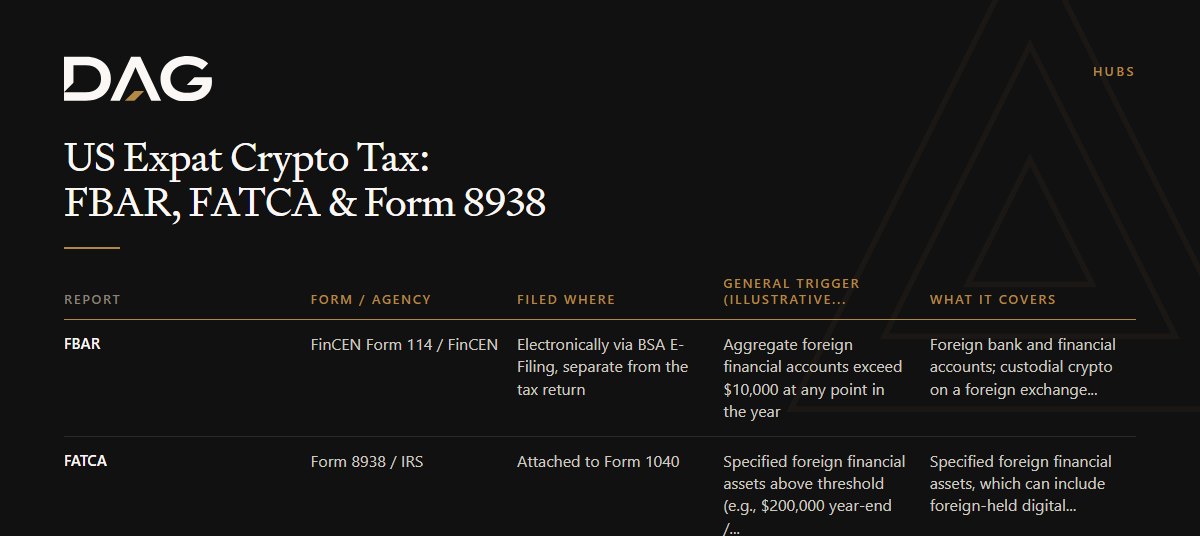
Two separate reporting regimes commonly apply, and they have different thresholds, agencies, and forms. The table below is a starting orientation, not legal advice, thresholds and the treatment of crypto-only accounts are fact-specific and change.
| Report | Form / agency | Filed where | General trigger (illustrative, verify current) | What it covers |
|---|---|---|---|---|
| FBAR | FinCEN Form 114 / FinCEN | Electronically via BSA E-Filing, separate from the tax return | Aggregate foreign financial accounts exceed $10,000 at any point in the year | Foreign bank and financial accounts; custodial crypto on a foreign exchange may count |
| FATCA | Form 8938 / IRS | Attached to Form 1040 | Specified foreign financial assets above threshold (e.g., $200,000 year-end / $300,000 any time for single filers living abroad; lower for US-resident filers) | Specified foreign financial assets, which can include foreign-held digital assets |
| Foreign entity ownership | Form 5471 (corp) / 8865 (partnership) | Attached to Form 1040 | Ownership interest in a foreign corporation or partnership holding crypto | The entity and its income |
| Foreign trust | Form 3520 / 3520-A | Filed with or alongside Form 1040 | Transfers to or interests in a foreign trust | Foreign trust transactions and ownership |
Whether a crypto-only account at a foreign exchange is itself an FBAR-reportable "financial account" has been an evolving question; FinCEN has signaled intent to bring virtual-currency accounts within FBAR rules. Because the answer can turn on how the account is structured, confirm current treatment with a cross-border tax professional before deciding not to file.
FBAR vs Form 8938: They Are Not the Same Filing
The FBAR and Form 8938 overlap but do not replace each other. The FBAR goes to FinCEN under the Bank Secrecy Act; Form 8938 goes to the IRS under FATCA and rides on the tax return. Thresholds differ, the FBAR triggers at a low $10,000 aggregate, while Form 8938 thresholds are higher and rise further for filers living abroad. Many US expats with foreign exchange balances must file both. Filing one does not satisfy the other.
Penalties for Not Reporting
Penalties are set by statute and adjusted over time; confirm current figures with a tax professional. As a general picture: non-willful FBAR violations can carry substantial per-form civil penalties, and willful violations can reach a percentage of the account balance plus potential criminal exposure. Form 8938 failures carry their own civil penalties and can extend the statute of limitations on the entire return. The IRS operates voluntary-disclosure and streamlined-filing programs for taxpayers who failed to report foreign assets non-willfully; a cross-border tax attorney can assess eligibility.
Related Questions
If I pay tax in my country of residence, do I still owe US tax on crypto?
Generally yes, you still file a US return and report the income, but a foreign tax credit or an applicable tax treaty may reduce or offset the US tax on income also taxed abroad. The credit prevents most double taxation; it does not remove the US filing and reporting duty. Coordinate the credit calculation with a cross-border CPA.
Do I have to report crypto held in a self-custody wallet abroad?
The income is always reportable on your US return. Whether the wallet itself is a reportable "foreign financial account" for FBAR purposes is less settled than for a custodial exchange account and depends on the facts. Report the income, and confirm the account-reporting question with a professional rather than assuming self-custody removes a filing duty.
Can renouncing US citizenship end these obligations?
Renouncing is permanent and can itself trigger an exit tax under IRC §877A that treats worldwide assets, including crypto, as sold the day before expatriation. It ends future filing duties only after that mark-to-market reckoning. See the expatriation discussion in crypto tax haven strategies for US residents and treat it as a legal decision, not a tax tactic.
Does living in Puerto Rico count as living abroad for these rules?
No. Puerto Rico is a US territory with its own residency-based regime, not a foreign country for FEIE or these foreign-reporting forms. The analysis there runs through bona-fide residency rules, see Puerto Rico Act 60 crypto.
Sources
- IRS, Frequently Asked Questions on Virtual Currency Transactions, https://www.irs.gov/individuals/international-taxpayers/frequently-asked-questions-on-virtual-currency-transactions (accessed June 2026)
- IRS, Foreign Account Tax Compliance Act (FATCA) and Form 8938 overview, https://www.irs.gov/businesses/corporations/foreign-account-tax-compliance-act-fatca (accessed June 2026)
- IRS, Comparison of Form 8938 and FBAR Requirements, https://www.irs.gov/businesses/comparison-of-form-8938-and-fbar-requirements (accessed June 2026)
- FinCEN, Report of Foreign Bank and Financial Accounts (FBAR), https://www.fincen.gov/report-foreign-bank-and-financial-accounts (accessed June 2026)
- IRS, Foreign Earned Income Exclusion (IRC §911), https://www.irs.gov/individuals/international-taxpayers/foreign-earned-income-exclusion (accessed June 2026)
- IRC §877A, Tax Responsibilities of Expatriation, https://uscode.house.gov/view.xhtml?req=granuleid:USC-prelim-title26-section877A
Compliance Note
This page is published by Digital Ascension Group (DAG Wealth) for educational purposes only. It does not constitute legal, tax, investment, or financial advice and does not create an attorney-client, CPA-client, or adviser-client relationship. Investment advisory services are offered through DAG Wealth, a registered investment adviser. Registration does not imply a certain level of skill or training. Digital Ascension Group is US-registered and is not licensed to provide tax or legal advice in foreign jurisdictions; coordinate local advice with counsel licensed where you reside.
US international tax and foreign-reporting rules are complex, fact-specific, and subject to change. Thresholds and penalty amounts cited here are illustrative and may be adjusted; verify current figures before acting. Nothing here endorses non-reporting, offshore secrecy, or tax evasion. Consult a qualified cross-border tax attorney and CPA before relying on any point in this article.