
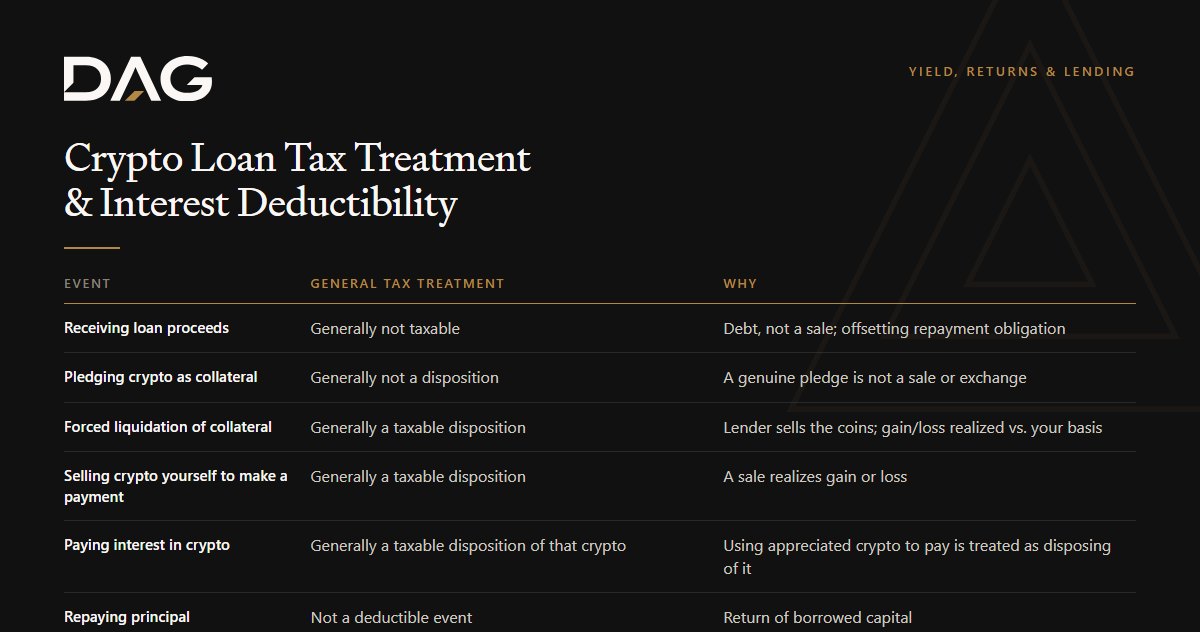
Crypto loan tax treatment starts from one principle: borrowing is not a sale. Loan proceeds from a crypto-backed loan are generally not taxable income, because you take on a debt rather than dispose of an asset. Interest may be deductible depending on how the proceeds are used, but a forced liquidation of collateral is generally a taxable disposition, and paying interest in crypto can itself be a taxable event.
What Is the Tax Treatment of a Crypto-Backed Loan?
A crypto-backed loan is a loan secured by digital-asset collateral. Under general U.S. federal tax principles, receiving loan proceeds is not a taxable event: a genuine loan creates an obligation to repay, so there is no income and no realized gain when the cash hits your account. You also do not get a deduction for repaying principal. This is the same logic that applies to a mortgage or a securities-backed line of credit, and it is why borrowing is often discussed as an alternative to selling.
This page is about the tax angle. For cash-flow and servicing, how to actually fund the payments, see crypto-backed loan interest payments. For the broader sell-vs-borrow decision, see bitcoin-backed loan vs selling bitcoin, and for the institutional context, crypto-backed loans for high-net-worth investors.
Are Crypto Loan Proceeds Taxable Income?
Generally, no. Receiving the proceeds of a bona fide loan does not produce gross income, because the borrower has an offsetting obligation to repay. Pledging crypto as collateral is generally not a sale or exchange, so it does not by itself realize gain or loss on the pledged coins.
Two cautions matter. First, the arrangement has to be a genuine loan with a real repayment obligation; structures that are economically a sale dressed up as a loan can be recharacterized. Second, some lending arrangements transfer the crypto to the lender in a way that could be treated as a disposition rather than a pledge, the documentation and the lender's rights over the collateral matter. Have the specific loan agreement reviewed.
Is Interest on a Crypto-Backed Loan Deductible?
Deductibility depends on what you do with the borrowed money, this is the interest-tracing rule. Under the U.S. tax rules, interest is generally categorized by the use of the loan proceeds, not by what secures the loan:
- Investment interest. If proceeds are used to buy or carry investment property (including, depending on facts, additional crypto held for investment), the interest may be deductible as investment interest expense under Internal Revenue Code §163(d). That deduction is generally limited to net investment income, with the excess carried forward, and it is claimed via Form 4952 by taxpayers who itemize.
- Business / trade-or-business interest. If proceeds fund a genuine trade or business, the interest is generally a business expense (subject to other limitations, such as the §163(j) business-interest limitation for larger taxpayers).
- Personal use. If proceeds are spent on personal consumption, personal interest is generally not deductible. Securing a personal-use loan with crypto does not convert it into deductible interest.
Because deductibility turns on tracing the proceeds, keep clear records of how each draw was used. Borrowing against crypto and then mingling the cash with personal funds can make tracing, and any deduction, hard to support. Confirm treatment with a CPA before relying on a deduction.
When Does a Crypto Loan Create a Taxable Event?
Borrowing is not the taxable moment; several related events can be. The table summarizes the common ones.
| Event | General tax treatment | Why |
|---|---|---|
| Receiving loan proceeds | Generally not taxable | Debt, not a sale; offsetting repayment obligation |
| Pledging crypto as collateral | Generally not a disposition | A genuine pledge is not a sale or exchange |
| Forced liquidation of collateral | Generally a taxable disposition | Lender sells the coins; gain/loss realized vs. your basis |
| Selling crypto yourself to make a payment | Generally a taxable disposition | A sale realizes gain or loss |
| Paying interest in crypto | Generally a taxable disposition of that crypto | Using appreciated crypto to pay is treated as disposing of it |
| Repaying principal | Not a deductible event | Return of borrowed capital |
These are general positions, not a ruling on your facts; specific structures and jurisdictions vary. Verify current treatment with a qualified tax professional.
Forced liquidation is a sale
If the collateral's value falls and the lender liquidates it to satisfy the loan, that liquidation is generally a taxable disposition, the same as if you had sold. You realize capital gain or loss measured against your cost basis in the liquidated coins, often at a bad time in the market. A margin call met by adding collateral is generally not taxable; a margin call met by liquidation generally is.
Paying interest with crypto
If you pay loan interest by transferring crypto rather than cash, you are generally treated as disposing of that crypto at its fair market value on the payment date, realizing gain or loss versus basis, in addition to whatever the interest does for deductibility. Paying from cash or from already-taxed yield avoids this extra disposition. Yield used to fund payments has its own tax consequences; see crypto staking tax reporting and the servicing options in crypto-backed loan interest payments.
How Does This Fit Broader Crypto Tax Planning?
Crypto-backed borrowing interacts with the rest of a tax plan: liquidation events create reportable dispositions, deductible interest depends on documented use, and entity structure can change the analysis. For the wider picture, see crypto tax planning for HNW investors, and where lending and yield sit overall, the crypto lending and yield hub.
Related Questions
Do I owe tax when I take out a crypto-backed loan?
Generally no. Loan proceeds are not income because you incur a repayment obligation, and pledging crypto as collateral is generally not a sale. The taxable risk comes later, if the collateral is liquidated, or if you sell or transfer crypto to make payments. Have the loan documents reviewed to confirm it is a genuine loan and not a disguised sale.
Can I deduct the interest on a loan secured by my crypto?
Maybe, it depends on how the proceeds were used, not on the fact that crypto secures the loan. Investment use may qualify as investment-interest expense under §163(d) (limited to net investment income, reported on Form 4952 by itemizers); business use is generally a business expense; personal-use interest is generally not deductible. Trace and document each draw, and confirm with a CPA.
Is a forced liquidation of my collateral taxable?
Generally yes. When a lender liquidates pledged crypto to cover the loan, that is treated as a disposition, realizing capital gain or loss against your basis. It is the same as selling, except the timing is forced. Adding collateral to cure a margin call, by contrast, is generally not a taxable event.
Does repaying the loan give me a deduction?
No. Repaying principal is a return of borrowed money, not a deductible expense. Only the interest portion is potentially deductible, and only based on how the proceeds were used.
Sources
- IRS. Digital assets (overview and guidance): https://www.irs.gov/filing/digital-assets
- IRS Publication 550, Investment Income and Expenses (investment interest expense): https://www.irs.gov/publications/p550
- Internal Revenue Code §163(d), limitation on investment interest (U.S. Code, irs.gov / law.cornell.edu)- IRS Form 4952, Investment Interest Expense Deduction, and instructions: https://www.irs.gov/forms-pubs/about-form-4952
Compliance Note
This article is for educational purposes only and does not constitute legal, tax, investment, or financial advice. Tax treatment of crypto-backed loans is general and fact-specific: the positions described (loan proceeds not being income, interest deductibility under the tracing rules, liquidation as a disposition, paying interest in crypto as a disposition) depend on the exact loan structure, the use of proceeds, and your jurisdiction, and the law and IRS guidance continue to evolve. Any figures or thresholds referenced elsewhere are illustrative and dated; verify current rules before acting. Tax-return preparation and planning are professional services that Digital Ascension Group coordinates with qualified CPAs and attorneys, not advice the firm provides directly.
DAG Wealth is a brand of Digital Ascension Group. Investment advisory services are offered through DAG Wealth, an SEC-registered investment adviser. Registration does not imply a certain level of skill or training. Consult a qualified CPA and attorney about your specific situation before acting on any information in this article.