
A responsible LTV ratio for crypto-backed loans is often discussed in the 20–30% range for volatile collateral like Bitcoin or Ethereum, because a lower starting ratio leaves more room for prices to fall before a margin call. No LTV is "safe": higher ratios shrink that buffer and raise the risk of forced liquidation. For the full range of borrowing and crypto lending and yield strategies, see the cluster hub.
Illustrative only, not a recommendation. The numbers in this article are for educational purposes. Individual platforms set their own margin-call and liquidation thresholds, which differ across lenders. Consult a qualified financial professional before entering any loan arrangement.
What Is Loan-to-Value (LTV) in Crypto Lending?
Loan-to-value (LTV) is the ratio of the loan amount to the current market value of the pledged collateral:
LTV = Loan Balance ÷ Collateral Market Value × 100
If you borrow $25,000 against $100,000 in Bitcoin, your LTV is 25%.
Margin-call LTV is the threshold at which a lender requires you to add collateral or repay part of the loan, commonly around 70% on many platforms, though terms vary. Liquidation LTV is the level at which the lender automatically sells enough collateral to bring the LTV back down, commonly around 80–85%. Both thresholds differ by platform and are specified in the loan agreement.
Because crypto prices can fall 20–40% in days, the gap between your starting LTV and the margin-call threshold is your practical safety buffer.
Why Does Starting LTV Determine Risk Exposure?
How the buffer shrinks as LTV rises
At 25% LTV, a 50% drop in collateral value is required to reach a 50% LTV, still below a typical 70% margin-call threshold. At 60% LTV, a drop of roughly 15% in collateral value can push the ratio past 70%.
Bitcoin's 30-day realized volatility has historically run between 40–60% annualized in relatively calm periods, and higher during stress. Ethereum and smaller-cap tokens carry even more short-term price swings. That structural reality means the margin between starting LTV and liquidation LTV is the primary lever a borrower controls.
The cost of forced liquidation versus interest
A 12% annual interest rate on a loan costs 12% of principal over a full year, a defined, manageable expense. Forced liquidation during a sharp drawdown can wipe out a disproportionate share of the collateral because the sale occurs at a distressed price, and the borrower has no input on timing or execution.
What Are the Mechanics of Margin Calls and Liquidation?
Margin-call and liquidation processes on crypto lending platforms are typically automated:
- Margin call triggered. LTV reaches the platform's warning threshold (commonly ~70%, varies by platform). The borrower receives notice and typically has 24–48 hours to add collateral or repay principal.
- Liquidation triggered. If the margin call is not resolved and LTV reaches the liquidation threshold (commonly ~80–85%, varies by platform), the platform automatically sells a portion of the collateral at market price. The sale continues until LTV falls back within acceptable bounds.
- Residual position. After liquidation, the borrower retains whatever collateral remains. Depending on how far prices moved, that residual can be a fraction of the original position.
Crypto markets trade around the clock and can move sharply outside business hours. Borrowers who are unavailable, do not have additional collateral on hand, or are unaware of an automated alert face the full consequence of forced liquidation.
Crypto loans are not insured by FDIC or SIPC. Platform failures, smart contract exploits, or insolvency can create additional loss scenarios beyond ordinary price risk. Borrowers bear full price risk on the collateral throughout the loan term.
LTV Risk Bands. Illustrative Framework
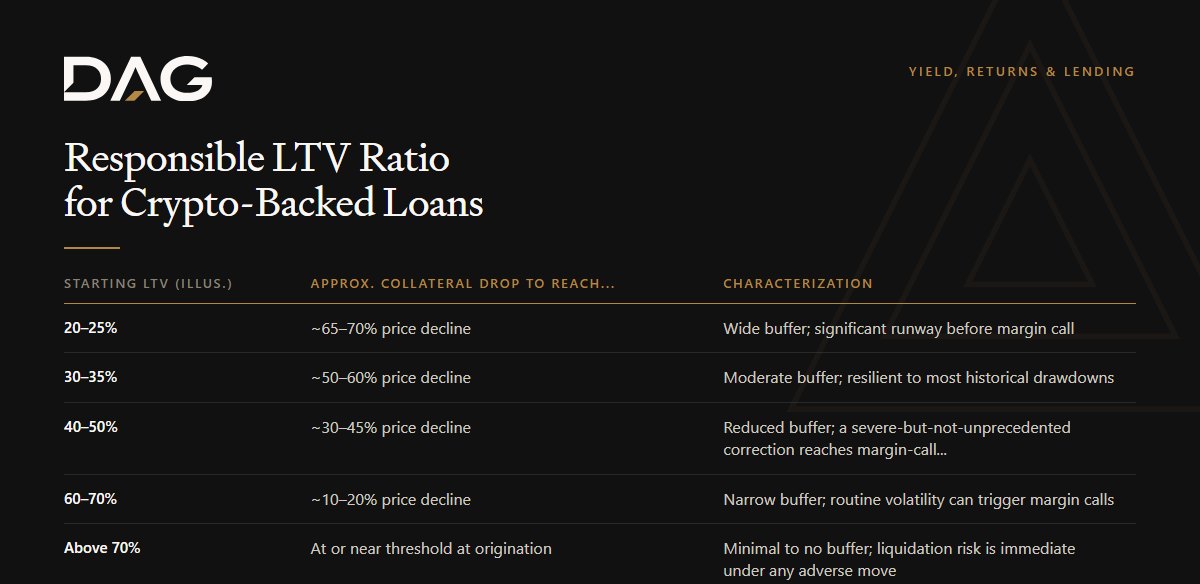
The table below is illustrative only. Actual margin-call and liquidation thresholds are set by individual lenders in their loan agreements and may differ materially from these examples. These are not recommendations.
| Starting LTV (Illus.) | Approx. collateral drop to reach 70% margin-call threshold (Illus.) | Characterization |
|---|---|---|
| 20–25% | ~65–70% price decline | Wide buffer; significant runway before margin call |
| 30–35% | ~50–60% price decline | Moderate buffer; resilient to most historical drawdowns |
| 40–50% | ~30–45% price decline | Reduced buffer; a severe-but-not-unprecedented correction reaches margin-call territory |
| 60–70% | ~10–20% price decline | Narrow buffer; routine volatility can trigger margin calls |
| Above 70% | At or near threshold at origination | Minimal to no buffer; liquidation risk is immediate under any adverse move |
The bands and the price-decline figures above are illustrative models built on a single hypothetical 70% margin-call threshold. They are not lender terms and not recommendations. Margin-call and liquidation thresholds vary by lender, verify your own loan agreement for the figures that actually apply to you.
How Does Collateral Type Affect a Responsible Starting LTV?
Different assets carry different volatility profiles. A starting LTV that provides adequate buffer for Bitcoin may be insufficient for a more volatile token.
- Bitcoin, largest market cap, deepest liquidity; still subject to material drawdowns. Many practitioners treat 25–30% as a conservative starting point, though even BTC can fall 30%+ in a month.
- Ethereum, higher short-term volatility than Bitcoin in most periods; a lower starting LTV than Bitcoin provides a comparable buffer.
- Smaller-cap tokens, can lose 40–60% in days. At elevated LTVs, liquidation may occur faster than an automated alert can be delivered and acted upon.
Some platforms set different maximum LTV caps per asset class to reflect these differences. Those caps represent the lender's maximum, not a default or a recommendation for any individual borrower.
Does Having Collateral Reserves Change the Risk Picture?
Starting at a low LTV only mitigates risk if the borrower has additional resources to deploy when needed. A borrower who pledges their entire crypto holdings at 25% LTV and holds no reserves faces forced liquidation as soon as the margin-call notice cannot be met, because there is nothing left to add.
Maintaining separate, unleveraged reserves, whether additional crypto, cash, or other liquid assets, is the mechanism that makes a conservative LTV operationally protective, not just numerically so.
Effective monitoring tools include real-time LTV dashboards and price alerts configured below the margin-call threshold, so there is time to respond before the platform's automated processes engage.
How Do Variable Interest Rates Interact With LTV Risk?
Some platforms price loans on a variable-rate model that charges higher interest at higher LTV levels. Under this structure, starting at a higher LTV is more expensive in both direct cost (interest) and indirect cost (reduced liquidation buffer). Over time, rising interest accruals can also push the loan balance higher, narrowing the buffer further even without any price move in the collateral.
When evaluating total loan cost, a lower headline APR at a high LTV may carry more economic risk than a higher APR at a conservative LTV, particularly if a drawdown occurs during the loan term.
Related Questions
Does market timing affect what LTV is appropriate?
Yes. In periods of elevated volatility or deteriorating macro conditions, the same starting LTV carries more realized risk than in calm markets, because the probability and speed of a large price move increases. Some borrowers reduce outstanding LTV ratios during volatile periods by repaying principal rather than waiting for a margin call. There is no formula that guarantees a given LTV is "safe" at any point in time.
What happens if a crypto lending platform fails while I have a loan outstanding?
Platform insolvency introduces risks beyond ordinary price risk. Borrowers may face delayed return of collateral, partial recovery through bankruptcy proceedings, or complete loss depending on how the platform segregates and holds pledged assets. Unlike bank deposits, crypto lending balances carry no FDIC or SIPC coverage. Reviewing a platform's custodial structure, insurance arrangements, and regulatory status before opening a loan is part of due diligence.
Can holding a diversified mix of collateral assets reduce LTV volatility?
It can, in some scenarios. If a portfolio includes assets that are not perfectly correlated, for instance, Bitcoin, Ethereum, and stablecoins, a sharp decline in one asset may be partially offset by stability in others, keeping the blended LTV from spiking as quickly. However, during broad market stress events, correlations across crypto assets tend to rise, limiting the diversification benefit precisely when it is most needed. Stablecoins maintain value by design but earn no price appreciation. Diversified collateral is one tool, not a substitute for conservative starting LTV.
How does a crypto-backed loan interact with my overall tax position?
Borrowing against crypto is generally not a taxable event at the time of the loan, no sale has occurred. However, if the lender liquidates collateral to satisfy a margin call, that liquidation is typically treated as a taxable disposition at the liquidation price. Borrowers who entered the loan with a low cost basis in the collateral may face a significant tax liability from a forced liquidation. Coordinating loan structure with a tax professional before borrowing is advisable. For broader planning context, see crypto tax planning for HNW investors.
How Does LTV Strategy Fit Within a Broader Wealth Plan?
A crypto-backed loan is one tool within a larger financial picture. For high-net-worth borrowers, the loan structure should be considered alongside portfolio concentration, estate planning obligations, tax position, and liquidity needs, not evaluated in isolation.
Crypto-backed loans for high-net-worth investors covers the broader use cases and structural considerations. For the alternative to borrowing, accessing liquidity by selling, see Bitcoin-backed loan vs selling Bitcoin.
Concentration risk often underlies the decision to borrow in the first place: a borrower who holds most of their net worth in a single crypto asset faces amplified exposure if a drawdown triggers both a margin call on the loan and a collapse in portfolio value simultaneously. Crypto concentration risk management addresses how to think about that exposure structurally.
For context on the full wealth management framework, see the Crypto Wealth Management Hub.
DAG coordinates lending strategy alongside estate planning, tax positioning, and custody structure for clients managing significant digital asset holdings. How to protect crypto wealth outlines the broader protective framework.
Sources
- CoinDesk Research: "Bitcoin 30-Day Realized Volatility Tracking", coindesk.com (ongoing)
- Chainalysis: "2025 Crypto Market Report", chainalysis.com/reports (2025)
- Federal Reserve: "Supervisory Guidance on Crypto-Asset Risks", federalreserve.gov (reviewed 2024–2025)
Compliance Note
This article is for educational purposes only. It does not constitute legal, tax, investment, or financial advice. Nothing here is a recommendation to enter into any loan or borrowing arrangement. Crypto-collateralized lending carries material risks, including forced liquidation, platform failure, variable interest rates, and the total loss of pledged collateral. Crypto assets are not insured by the FDIC or SIPC. Past price behavior does not predict future prices. All LTV figures, thresholds, and illustrative calculations in this article are examples only; actual platform terms vary and must be reviewed in each lender's loan agreement. Consult a qualified financial, tax, and legal professional before making borrowing decisions involving digital assets.
Investment advisory services referenced under the DAG Wealth brand are provided through DAG Wealth, an SEC-registered investment adviser. Registration does not imply a certain level of skill or training.