
Managing crypto treasury margin call risk on a crypto-backed loan means borrowing well below the maximum loan-to-value ratio, distributing collateral across lenders, and pre-positioning liquid reserves so a sharp drawdown does not force a lender liquidation. Leverage amplifies losses, so conservative structure from the start matters more than reacting after a call. This topic sits within the broader crypto wealth management framework for high-net-worth digital asset holders.
What is a margin call in crypto lending?
A margin call occurs when the value of your pledged collateral falls below the lender's minimum loan-to-value (LTV) threshold. At that point, the lender demands additional collateral or a partial loan repayment. If you cannot respond in time, the lender liquidates your crypto to recover the outstanding balance.
Two compounding risks make crypto margin calls especially damaging:
- Liquidation is a taxable event. Even though borrowing against crypto is not a sale, forced liquidation by the lender is. You may owe capital gains tax at a moment when the asset has already declined in value.
- Crypto can move sharply in a single session. Large, rapid drawdowns mean LTV thresholds that felt safe can become margin call territory quickly.
How do you structure borrowing to avoid forced liquidation?
The goal is a borrowing setup that can survive extreme volatility without triggering lender action. These steps, taken together, reduce that risk materially, though they cannot eliminate it.
Step-by-step: conservative crypto leverage structure
Borrow well below the maximum LTV offered. If a lender offers 50% LTV, borrowing 25–30% leaves a substantial buffer before the liquidation threshold is reached. The gap between your actual LTV and the lender's call threshold is your first line of defense. LTV figures vary by lender, collateral type, and market conditions, verify current terms directly.
Segregate loans by collateral position. Avoid cross-collateralization. Each loan should be isolated to its own specific collateral so that a margin call on one position cannot trigger liquidation across your entire portfolio.
Distribute collateral across multiple lenders. Concentrating all collateral with one lender creates counterparty risk: their platform stability, their risk management decisions, and their terms all become single points of failure. Two or three lenders across different jurisdictions, where feasible, reduces that exposure.
Hold excess collateral unencumbered. Borrow only what you need. Keeping a portion of your holdings free and clear gives you the option to add collateral quickly if markets move against you, without having to liquidate other positions.
Pre-position a liquidity reserve. Maintain cash or stablecoins in a readily accessible account, not in locked staking, not in a DeFi protocol with a multi-day withdrawal delay. This reserve must be deployable within minutes to cover a margin call or pay down principal during volatility.
Read the liquidation terms before signing. Confirm in writing: What exact LTV triggers a margin call? How long do you have to respond? What assets does the lender accept as additional collateral? Does the lender liquidate all at once or in tranches? Are early repayment penalties applicable? Rates on crypto-backed loans are often variable, confirm the rate structure and how quickly it can change.
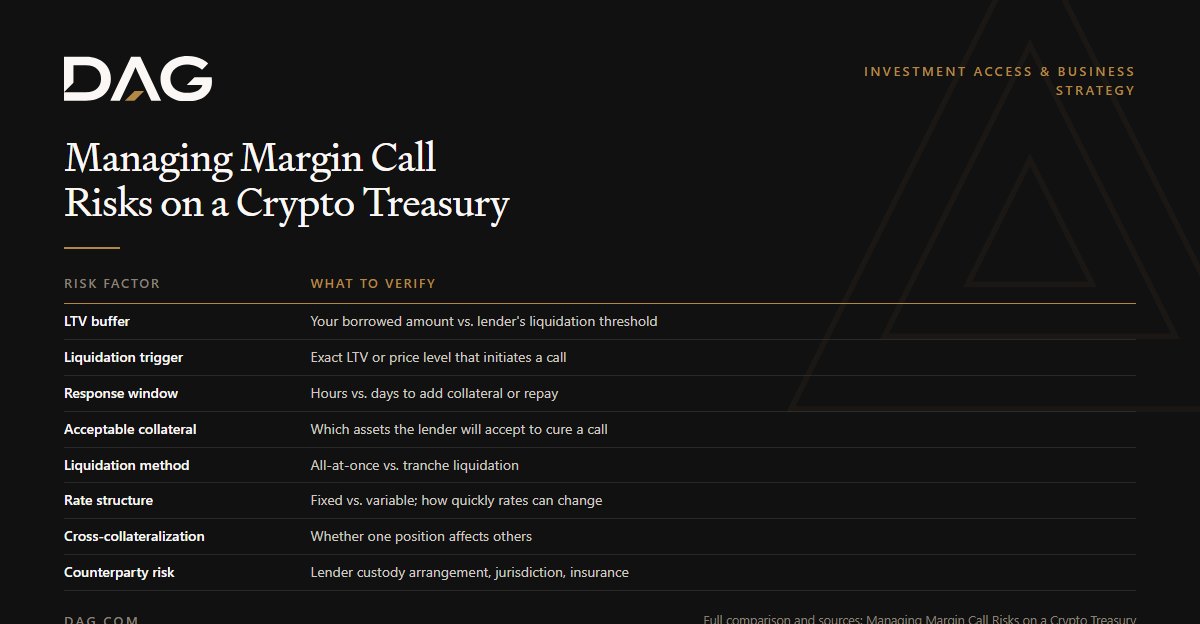
Margin call risk summary: what to check before borrowing
| Risk factor | What to verify |
|---|---|
| LTV buffer | Your borrowed amount vs. lender's liquidation threshold |
| Liquidation trigger | Exact LTV or price level that initiates a call |
| Response window | Hours vs. days to add collateral or repay |
| Acceptable collateral | Which assets the lender will accept to cure a call |
| Liquidation method | All-at-once vs. tranche liquidation |
| Rate structure | Fixed vs. variable; how quickly rates can change |
| Cross-collateralization | Whether one position affects others |
| Counterparty risk | Lender custody arrangement, jurisdiction, insurance |
How does crypto treasury leverage fit into an overall wealth plan?
A crypto borrowing strategy does not exist in isolation. Forced liquidation during a drawdown can create taxable gains, disrupt estate plans, and undermine the long-term allocation strategy for a multi-asset portfolio. Crypto wealth planning for high-net-worth families should account for how a leverage position interacts with trust structures, estate documents, and tax planning before the first loan is taken.
Crypto-backed loans vs. selling bitcoin covers the tradeoff between borrowing and outright sale in more detail, including the tax consequences of each path.
For family offices managing a digital asset family office structure, leveraged positions should be reflected in the investment policy statement and reviewed by the investment committee before implementation. The family office crypto risk report and crypto concentration risk management frameworks address how to document and monitor these exposures over time.
A fiduciary advisor with specific digital asset expertise, not just a traditional RIA, is the appropriate resource for designing and monitoring a crypto borrowing strategy. DAG provides wealth management and investment advisory services for clients with significant digital and traditional assets, coordinating custody, liquidity planning, and cross-asset tax strategy. Entity formation, trust drafting, and operating-agreement work are legal services that DAG coordinates with qualified counsel rather than provides directly.
Related Questions
Does borrowing against crypto trigger a taxable event?
Borrowing against crypto is not itself a taxable event, no sale occurs. However, if the lender liquidates your collateral due to a margin call, that liquidation is treated as a sale for tax purposes and may generate a capital gain or loss. Consult a qualified tax professional for your specific situation.
What is the difference between a margin call and a liquidation?
A margin call is the lender's notice that your LTV has crossed their threshold and you must act. Liquidation is what happens if you do not respond in time, the lender sells your collateral to recover the loan balance. The window between call and liquidation varies by lender and should be confirmed in your loan agreement before borrowing.
Can you borrow against crypto held inside a trust or LLC?
Some institutional lenders will accept crypto held in a properly structured LLC or trust as collateral, but requirements vary significantly. The collateral structure must be documented, and the lending agreement must align with the entity's operating agreement or trust provisions. This is an area where legal and financial coordination is essential before pledging collateral. See crypto custody for trusts for related custody considerations.
How does variable rate risk affect crypto-backed loans?
Many crypto-backed loan products carry variable interest rates that can change materially in a short time. A rising rate environment increases your cost of carry and can push your effective LTV higher as interest accrues. Verify the rate structure and any rate caps before committing to a borrowing arrangement.
Sources
- IRS Notice 2014-21 (digital asset tax treatment): https://www.irs.gov/pub/irs-drop/n-14-21.pdf
- IRS Revenue Ruling 2023-14 (staking income): https://www.irs.gov/pub/irs-drop/rr-23-14.pdf
- SEC crypto assets and securities resources: https://www.sec.gov/securities-topics/crypto-assets
Compliance Note
This page is for educational purposes only. It is not investment, legal, or tax advice. Crypto-backed borrowing involves substantial risks, including but not limited to: liquidation of collateral at unfavorable prices, variable interest rate exposure, counterparty risk, and potential taxable events upon forced sale. Leverage amplifies both gains and losses. LTV figures and thresholds referenced are illustrative only and subject to change, verify current terms with any lender before borrowing. Past performance of any collateral asset is not indicative of future results. Consult a qualified investment advisor, tax professional, and legal counsel before implementing any borrowing strategy involving digital assets. Advisory services are provided by DAG Wealth, an SEC-registered investment adviser. Registration does not imply a certain level of skill or training.