
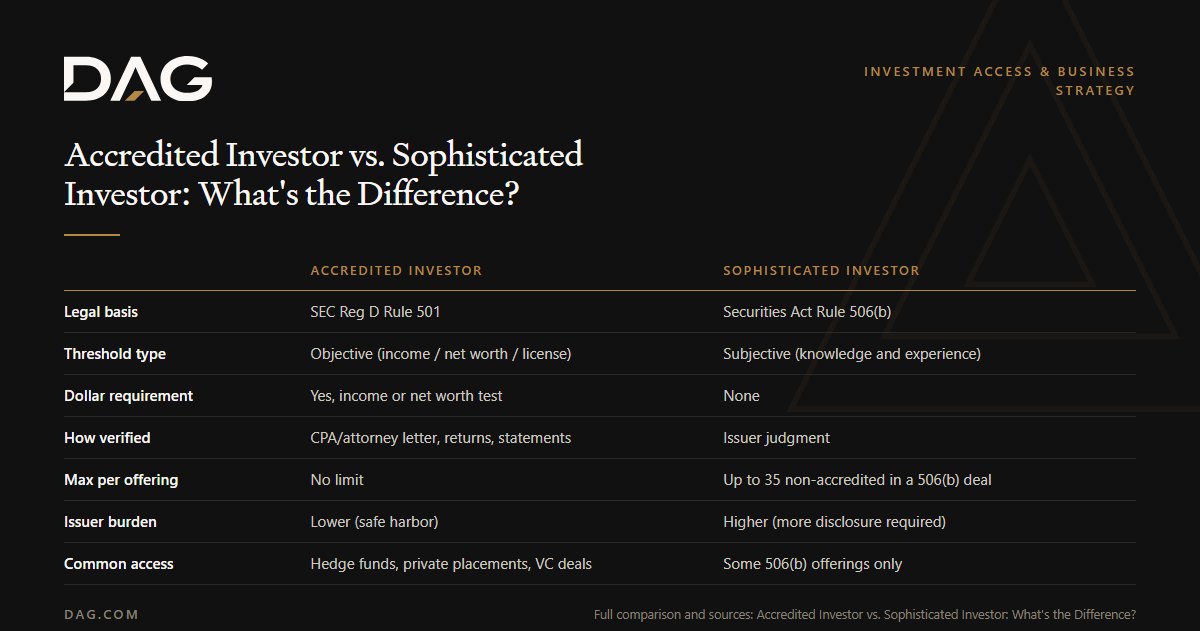
Accredited investor vs sophisticated investor comes down to one distinction: accredited status is a bright-line SEC income/net-worth test under Reg D Rule 501, while sophisticated investor is a knowledge-and-experience standard with no dollar threshold, applied under Rule 506(b) and judged by the issuer. They often overlap but serve different regulatory purposes. Understanding which threshold applies is foundational to navigating crypto wealth management and private investment access.
What Is an Accredited Investor?
The SEC defines accredited investor status in Rule 501 of Regulation D. To qualify, an individual generally must meet one of the following (verify current thresholds):
- Income test: roughly $200,000 in annual income ($300,000 jointly with a spouse or spousal equivalent) for each of the past two years, with a reasonable expectation of reaching the same level in the current year (illustrative; verify current figures against SEC Rule 501)
- Net worth test: approximately $1 million in net worth, excluding the value of the primary residence (illustrative; verify current figures against SEC Rule 501)
- Professional credentials: holding a Series 7, 65, or 82 license in good standing, added by the SEC's 2020 amendment to broaden the definition beyond pure wealth (verify the current credential list)
Accredited status is documented, typically a letter from a CPA, attorney, or broker-dealer, or via review of tax returns and account statements. It functions as a safe harbor for issuers in most Reg D offerings.
What Is a Sophisticated Investor?
Sophisticated investor is not a defined dollar threshold. Under Securities Act Rule 506(b), an issuer may sell to up to 35 non-accredited investors in a given offering if those investors are "sophisticated", meaning each has, or the issuer reasonably believes each has, sufficient knowledge and experience in financial and business matters to evaluate the merits and risks of the prospective investment.
There is no uniform documentation standard. The issuer makes a subjective determination, which creates more regulatory burden than the bright-line accredited test. Issuers must typically provide non-accredited sophisticated investors with more extensive disclosure materials than they would give accredited investors.
Comparison Table
| Accredited Investor | Sophisticated Investor | |
|---|---|---|
| Legal basis | SEC Reg D Rule 501 | Securities Act Rule 506(b) |
| Threshold type | Objective (income / net worth / license) | Subjective (knowledge and experience) |
| Dollar requirement | Yes, income or net worth test | None |
| How verified | CPA/attorney letter, returns, statements | Issuer judgment |
| Max per offering | No limit | Up to 35 non-accredited in a 506(b) deal |
| Issuer burden | Lower (safe harbor) | Higher (more disclosure required) |
| Common access | Hedge funds, private placements, VC deals | Some 506(b) offerings only |
Who Determines Whether You Are "Sophisticated"?
The person selling the investment, or, if you work with a registered investment adviser, potentially your adviser as fiduciary, evaluates whether you have the financial sophistication to assess what you are buying. Because the standard is subjective, outcomes vary by issuer. Sophisticated-only access to private deals is less common than accredited access, and the sponsor bears more liability if the determination is wrong.
How Does Fiduciary Duty Factor In?
Broker-dealers operate under a suitability standard: an investment must be suitable for your situation. A registered investment adviser operating under fiduciary duty must act in your best interest, a higher bar. Meeting the legal threshold to access an investment does not mean the investment is appropriate for your specific goals, tax situation, or risk tolerance.
At higher wealth levels, multi-entity structures, trusts, multiple strategies, coordination of all of these factors can matter as much as legal eligibility. DAG Wealth helps clients evaluate not just what they can access but what they should access based on their complete financial picture. Advisory services are provided by DAG Wealth, an SEC-registered investment adviser. Registration does not imply a certain level of skill or training.
Families with substantial assets that span multiple entities, jurisdictions, or generational structures often require crypto wealth management or family office services that extend beyond determining investor status to coordinating tax strategy, estate planning, and custody, all as part of a single architecture.
For a broader framework on how these pieces connect, see The Five-Part Crypto Wealth Architecture.
Related Questions
Can you be sophisticated but not accredited?
Yes. A person can have deep financial knowledge and professional experience without meeting the income or net worth thresholds for accredited status. In a Rule 506(b) offering, an issuer may allow up to 35 such investors. In most other private offerings and in Rule 506(c) deals, only accredited investors are permitted.
Can accredited status be revoked?
Accredited status is not formally granted by the SEC, there is no registry. It must be re-verified for each offering or on a periodic basis by the issuer or your adviser. If your income or net worth falls below the thresholds in a given year, you would not qualify at that time. Professional credential-based status (Series 7/65/82) requires the license to remain in good standing.
Does accredited investor status matter for crypto investments?
Yes, when the offering involves a security. Depending on the facts, some crypto tokens may be treated as securities under the Howey analysis, and such private offerings are often structured as Reg D deals that can require accredited investor status. Whether a given token is a security is a fact-specific legal question. ETF products and exchange-traded assets generally do not carry this restriction. If you are evaluating a private crypto fund, SAFT, or token sale, your adviser should confirm whether the offering is registered or exempt, and which exemption applies. See also crypto model portfolios for financial advisors and crypto SMA vs crypto ETF for access structures that do not require private placement qualification.
What is the difference between Rule 506(b) and Rule 506(c)?
Rule 506(b) allows sales to up to 35 non-accredited sophisticated investors and permits general solicitation to existing relationships; it does not allow broad public advertising. Rule 506(c) requires that all purchasers be accredited investors but permits general solicitation and advertising. Issuers under 506(c) must take reasonable steps to verify accredited status rather than relying on investor self-certification.
Sources
- SEC Regulation D, Rule 501. Definitions (accredited investor): https://www.ecfr.gov/current/title-17/chapter-II/part-230/section-230.501
- SEC Regulation D, Rule 506(b) and 506(c): https://www.ecfr.gov/current/title-17/chapter-II/part-230/section-230.506
- SEC 2020 Final Rule. Amending the Accredited Investor Definition (August 26, 2020): https://www.sec.gov/rules/final/2020/33-10824.pdf
- SEC Investor Bulletin. Accredited Investors: https://www.sec.gov/resources-small-businesses/capital-raising-building-blocks/accredited-investors
Compliance Note
This page is educational only and does not constitute legal, tax, or investment advice. Regulatory thresholds, exemption rules, and SEC guidance are subject to change; verify current rules with qualified legal counsel or a registered investment adviser before acting. Eligibility for a private offering does not mean the offering is appropriate for your individual situation. Advisory services are provided by DAG Wealth, an SEC-registered investment adviser. Registration does not imply a certain level of skill or training. Consult a qualified professional before making any investment decisions.