
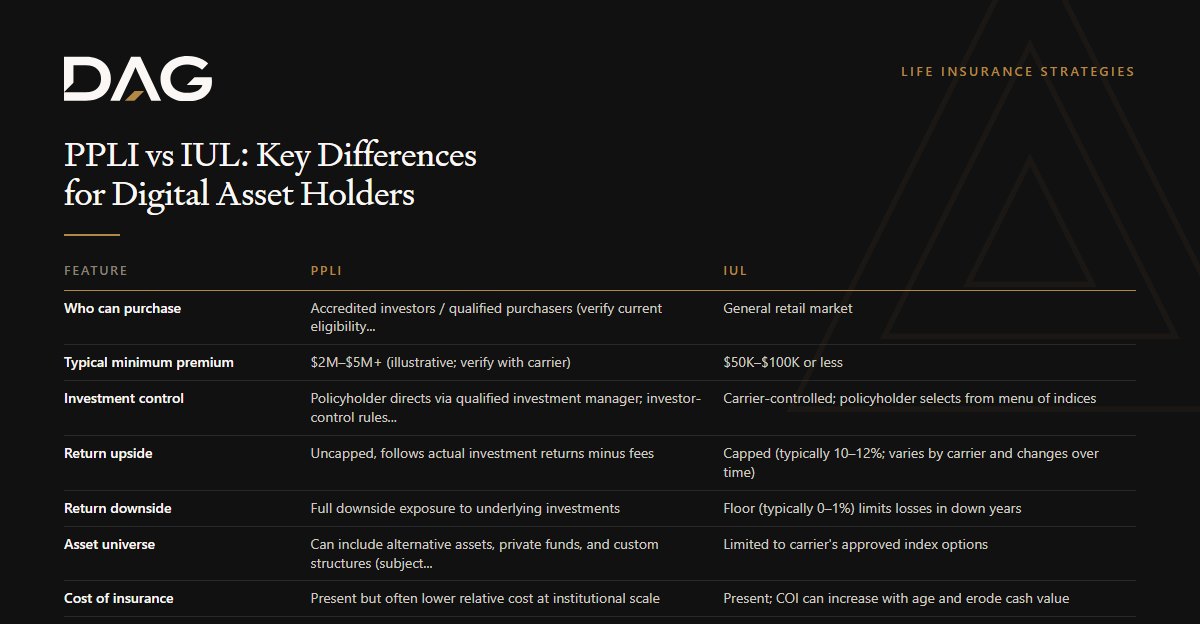
In the PPLI vs IUL comparison, two of the main crypto life insurance structures for digital asset holders, both are permanent life insurance contracts with cash value, but they differ in eligibility, compliance rules, and investment control. PPLI is a privately placed security limited to accredited/qualified purchasers; IUL is a retail product with carrier-set caps and floors. Neither is categorically better, suitability depends on facts, wealth, and objectives.
What Is the Difference Between PPLI and IUL?
IUL is a retail permanent life insurance product. The insurer credits your policy's cash value based on the performance of a market index, commonly the S&P 500, subject to a cap on upside (often 10–12% annually, though caps vary by carrier and may change over time) and a floor on downside (typically 0–1%). The carrier controls the available index options, the crediting methodology, and the cap-and-participation-rate structure. Cost of insurance (COI) charges and surrender charges apply.
PPLI is a privately placed variable life insurance contract, regulated as a security under federal securities law. Investors direct the underlying investments within the policy's separate account. There are no carrier-imposed return caps, gains and losses follow the actual performance of the underlying investments. PPLI is restricted to accredited investors and, depending on the carrier, qualified purchasers under the Investment Company Act of 1940, and typically requires minimum premiums of $2 million–$5 million or more (verify current minimums with the issuing carrier).
How do the compliance rules differ?
PPLI policies must comply with:
- IRC §7702, the policy must qualify as life insurance for tax purposes
- IRC §817(h), the separate account must meet diversification requirements (no fewer than five issuers; no single issuer exceeding 55% of assets; other tests apply)
- Investor-control doctrine, the policyholder cannot exercise day-to-day control over specific investment decisions; a qualified investment manager must make those decisions. If investor control is found, the IRS may disallow the tax-deferred treatment
IUL does not involve these investor-control or §817(h) rules because the insurer, not the policyholder, controls the underlying investments.
PPLI vs IUL: Side-by-Side Comparison
| Feature | PPLI | IUL |
|---|---|---|
| Who can purchase | Accredited investors / qualified purchasers (verify current eligibility thresholds) | General retail market |
| Typical minimum premium | $2M–$5M+ (illustrative; verify with carrier) | $50K–$100K or less |
| Investment control | Policyholder directs via qualified investment manager; investor-control rules apply | Carrier-controlled; policyholder selects from menu of indices |
| Return upside | Uncapped, follows actual investment returns minus fees | Capped (typically 10–12%; varies by carrier and changes over time) |
| Return downside | Full downside exposure to underlying investments | Floor (typically 0–1%) limits losses in down years |
| Asset universe | Can include alternative assets, private funds, and custom structures (subject to §817(h) diversification) | Limited to carrier's approved index options |
| Cost of insurance | Present but often lower relative cost at institutional scale | Present; COI can increase with age and erode cash value |
| Surrender charges | Vary; consult policy illustration | Vary; can be substantial in early years |
| Key tax rules | §7702 qualification, §817(h) diversification, investor-control doctrine | §7702 qualification; MEC rules if overfunded |
| Regulatory classification | Privately placed security (federal securities law) | Insurance product |
| Suitability | High-net-worth / ultra-high-net-worth with complex planning needs | Broader market; moderate wealth accumulation goals |
Figures are illustrative examples. Caps, floors, minimums, and fees vary by carrier, policy design, and market conditions. Verify current terms with a licensed insurance professional.
Can PPLI Hold Digital Assets?
PPLI separate accounts can potentially hold alternative investments, including funds or structures with exposure to digital asset markets, subject to §817(h) diversification requirements. A qualified investment manager must direct those holdings; the policyholder cannot. Whether a specific digital asset or fund qualifies depends on §817(h) compliance and the carrier's accepted asset classes. This requires analysis by a licensed insurance professional and qualified tax counsel.
IUL policies do not hold digital assets directly. The cash value tracks an index; your crypto holdings remain entirely separate.
What Are the Material Risks of Each?
PPLI risks:
- Full investment risk, the separate account can lose value; there is no floor
- §817(h) violations can disqualify the contract from favorable tax treatment
- Investor-control violations can result in loss of tax-deferred status
- High minimums and complexity require institutional-level planning
- Fees: mortality and expense charges, investment management fees, and administrative costs reduce net returns
- Regulatory and legal landscape for PPLI + digital assets is evolving
IUL risks:
- Caps limit upside; you do not participate fully in index gains above the cap
- COI charges increase with age; in poorly designed policies, rising COI can erode or exhaust cash value
- Surrender charges restrict liquidity in early years
- Carrier changes crediting methodology and caps over time, future terms are not guaranteed
- Complexity: policy illustrations assume hypothetical scenarios; actual performance will differ
Related Questions
Is PPLI the same as variable universal life insurance?
PPLI shares structural similarities with variable universal life (VUL), both involve a separate account and investment risk borne by the policyholder, but PPLI is placed privately, restricted to eligible investors, and typically offers access to a broader asset universe than retail VUL. Retail VUL is available to the general public and limited to the carrier's approved sub-account menu. Both must satisfy §7702 and are subject to §817(h).
Can I fund a PPLI policy with cryptocurrency as collateral?
Some structures use crypto holdings as collateral for a loan to fund PPLI premiums, rather than selling the asset and triggering a taxable event. Whether this approach is appropriate depends on collateral terms, loan costs, policy performance assumptions, and individual tax circumstances. This is not a risk-free strategy; a decline in collateral value can trigger a margin call. Consult a licensed insurance professional and qualified tax counsel before proceeding. This is not tax or investment advice.
Does PPLI provide estate planning benefits?
The death benefit of a PPLI policy may pass to beneficiaries income-tax-free under IRC §101(a), subject to policy qualification. Estate inclusion depends on ownership structure, policies owned by the insured may be included in the gross estate under IRC §2042. Irrevocable life insurance trusts (ILITs) are often used to hold the policy outside the taxable estate. Any estate planning benefit requires careful structuring with a qualified estate attorney and tax counsel. This is not legal or tax advice.
Internal Links
Digital asset holders considering life insurance structures typically need coordinated digital asset wealth management for high-net-worth families to ensure insurance fits the broader plan. PPLI sits within the five-part crypto wealth architecture that high-net-worth families use to integrate custody, tax, estate, and insurance layers. Because tax treatment is central to the PPLI value proposition, crypto tax planning for high-net-worth investors is a required input. Custody of digital assets held alongside a PPLI structure should follow institutional crypto custody standards. For families evaluating whether family office services are the right coordination layer, what is a crypto family office? provides context.
Sources
- IRC §7702. Life Insurance Contract Defined, 26 U.S.C. §7702
- IRC §817(h). Diversification Requirements for Variable Contracts, 26 U.S.C. §817(h)
- Investment Company Act of 1940, 15 U.S.C. §80a-2 (definitions of accredited investor / qualified purchaser)
- IRS Revenue Ruling 2003-92. Investor Control Doctrine
- IRS Revenue Ruling 2003-91. Diversification Requirements
- SEC, "Variable Insurance Products," Investor Bulletin (SEC.gov)
- NAIC, Life Insurance Buyer's Guide (available via state insurance departments)
Verify current statute text and IRS guidance; tax law is subject to change.
Compliance Note
This page is for educational purposes only. It is not legal, tax, insurance, or investment advice. PPLI is a complex financial product restricted to eligible investors. Tax treatment of PPLI and IUL depends on individual facts, policy design, and compliance with applicable IRS rules; neither tax-free growth nor any specific return is guaranteed. All insurance products carry fees, risks, and limitations described in the policy illustration and contract. Neither PPLI nor IUL is appropriate for all investors. Consult a licensed insurance professional, qualified tax counsel, and a registered investment adviser before making any decision. DAG Insurance provides insurance-related services; investment advisory services for eligible clients are provided by DAG Wealth, an SEC-registered investment adviser. Registration does not imply a certain level of skill or training.